UNDP
Cover Note
Project Title: "Strengthening the Implementation Capacities for Nutrient
Reduction and Transboundary Cooperation in the Danube River Basin" (Phase 1)
Date: March 2001
Work Programme Inclusion
Reference/Note:
1. Country Ownership
· Country Eligibility
Cover page
· Country Driveness
Clear description of project's fit within:
· National reports/communications to Conventions
· Chapter 1.1
· National or sector development plans
· Chapter 1.6
· Recommendations of appropriate regional intergovernmental meetings or
· Chapter 1.7; 4
agreements.
· Endorsement
· Endorsement by national operational focal point.
· Annex 13
2. Programme & Policy Conformity
· Programme Designation &
· Describe how project objectives are consistent with Operational Programme
· Chapter 1.1
Conformity
objectives or operational criteria.
· Chapter 4; Annex 1
· Annex 9
· Project Design
Describe:
· Sector issues, root causes, threats, barriers, etc, affecting global environment.
· Chapter 1.1 1.5; 1.7
1
UNDP
Work Programme Inclusion
Reference/Note:
· Project logical framework, including a consistent strategy, goals, objectives,
· Annex 2
outputs, inputs/activities, measurable performance indicators, risks and
assumptions.
· Detailed description of goals, objectives, outputs, and related assumptions,
· Chapter 2, Chapter 3, Annex 2
risks and performance indicators.
· Brief description of proposed project activities, including an explanation how
· Chapter 3;
the activities would result in project outputs,
· Global environmental benefits of project.
· Chapter 8; Annex 1
· Incremental Cost Estimation based on the project logical framework.
· Annex 1
§ Describe project outputs (and related activities and costs) that result in
global/regional environmental benefits
§ Describe project outputs (and related activities and costs) that result in joint
global and national environmental benefits.
§ Describe project outputs (and related activities and costs) that result in
national environmental benefits.
§ Describe the process used to jointly estimate incremental cost with in-
country project partner.
§ Present the incremental cost estimate. If presented as a range, then a brief
explanation of challenges and constraints and how these would be addressed
by the time of CEO endorsement.
· Sustainability (including
Describe proposed approach to address factors influencing sustainability, within · Chapter 4
financial sustainability)
and/or outside the project to deal with these factors.
· Replicability
Describe the proposed approach to replication (for e.g., dissemination of lessons,
· Chapter 2
training workshops, information exchange , national and regional forum, etc)
· Chapter 3.2 (vi)
(could be within project description).
· Chapter 3.3
· Stakeholder Involvement
· Describe how stakeholders have been involved in project development.
· Chapter 4
· Describe the approach for stakeholder involvement in further project
· Chapter 10.1
development and implementation.
· Monitoring & Evaluation
· Describe how the project design has incorporated lessons from similar projects · Chapter 5
in the past.
· Describe approach for project M&E system, based on the project logical
· Chapter 10; Annex 2
framework, including the following elements:
UNDP
Work Programme Inclusion
Reference/Note:
§ Specification of indicators for objectives and outputs, including
§
Annex 2
intermediate benchmarks, and means of measurement.
§ Outline organizational arrangement for implementing M&E.
§
Chapter 10
§ Indicative total cost of M&E (maybe reflected in total project cost).
§
included in total project costs
3. Financing
· Financing Plan
· Estimate total GEF project cost :
· Chapter 6.1; Annex 4
· Estimate contribution by financing partners :
· Chapter 6.2
· Baseline Contributions :
· Chapter 6.3-6.7
· Propose type of financing instrument
· The ICPDR shall coordinate donor support and
assist to mobilize funds for implementation of
investment programmes for pollution reduction
under the DRPC.
· Implementing Agency Fees · Propose IA fee
· Cost-effectiveness
· Estimate cost effectiveness, if feasible.
· Chapter 8
· Describe alternate project approaches considered and discarded.
· The present developed approach promises to be
the most effective way to reach the project
objectives, considering the implementation of the
Pollution Reduction Programme, the ICPDR Joint
Action Programme (Investment Programme) and
the development of policies and legislation for
nutrient reduction within the institutional and
operational frame of the ICPDR.
4. Institutional Coordination & Support
· IA Coordination and
Describe how the proposed project is located within the IA's:
Support
· Country/regional/global/sector programmes.
· Chapter 10.1
· Core commitments &
· GEF activities with potential influence on the proposed project (design and
· UNDP/GEF, UNEP and the World Bank
Linkages
implementation).
(Strategic Partnership Programme) will participate
in the ICPDR together with other interested
bilateral donors and internat ional organizations to
assure efficient project implementation and
evaluation of results.
3
UNDP
Work Programme Inclusion
Reference/Note:
· Consultation,
· Describe how the proposed project relates to activities of other IAs in the
· The "Strategic Partnership" developed by UNDP,
Coordination and
country/region.
UNEP, WB and GEF indicates the cooperating
Collaboration between
mechanisms between the World Bank (WB-GEF
IAs, and IAs and EAs, if
Partnership Investment Facility for Nutrient
appropriate.
Reduction), the International Commission for the
Protection of the Black Sea and the International
Commission for the Protection of the Danube
River.
· Describe planned/agreed coordination, collaboration between IAs in project
· In the frame of the ICPDR all activities related to
implementation.
protection of international waters will be
coordinated with particular attention to the EU
approximation process and the development of
policies and legislation in line with international
and EU Directives.
5. Response to Reviews
Council
Respond to Council Comments at pipeline entry.
None; N/A
Convention Secretariat
Respond to comments from Convention Secretariats .
N/A
GEF Secretariat
Respond to comments from GEFSEC on draft project brief.
None; GEFSEC fully supports
Other IAs and 4 RDBs
Respond to comments from other IAs, 4RDBss on draft project brief.
UNEP is co-implementing; World Bank sent
comments supporting the project and emphasizing
coordination with the Partnership Investment Facility
for Nutrient Reduction.
STAP
Respond to comments by STAP at work programme inclusion
None; N/A
Review by expert from STAP Respond to review by expert from STAP roster.1
Review and Response: Annex 3
Roster
1 STAP Roster Review, and IA response, is a required annex of the project brief.
Annex 2
PROJECT BRIEF
1. IDENTIFIERS
PROJECT NUMBER
PROJECT NAME
GEF Strategic Partnership on the Danube/Black Sea
Basin, Element 2 - Regional (Czech Republic, Slovakia,
Hungary, Slovenia, Croatia, Bosnia & Herzegovina,
Yugoslavia, Bulgaria, Romania, Moldova, Ukraine):
Strengthening the Implementation Capacities for
Nutrient Reduction and Transboundary Cooperation
in the Danube River Basin (Phase 1)
DURATION
2 years (July 2001 June 2003)
IMPLEMENTING AGENCY
UNDP
EXECUTING AGENCY
UNOPS / ICPDR
REQUESTING COUNTRIES
Czech Republic, Slovakia, Hungary, Slovenia, Croatia,
Bosnia & Herzegovina, Yugoslavia, Bulgaria, Romania,
Moldova, Ukraine
ELIGIBILITY
Eligible under para. 9(b) of GEF Instrument
PARTICIPATING COUNTRIES
Germany and Austria
GEF FOCAL AREA
International Waters
GEF PROGRAMMING FRAMEWORK
GEF Operational Strategy for International Waters /
Waterbody-Based Operational Programme (#8)
2. SUMMARY
The long-term development objective of the proposed Regional Project is to contribute to sustainable
human development in the DRB through reinforcing the capacities of the participating countries in
developing effective mechanisms for regional cooperation and coordination in order to ensure
protection of international waters, sustainable management of natural resources and biodiversity.
In this context, the proposed GEF Regional Project, being subdivided into two Phases, should support
the ICPDR, its structures and the participating countries in order to ensure an integrated and coherent
implementation of the Strategic Action Plan 1994 (SAP 1994), the ICPDR Joint Action Programme
and the related investment programmes in line with the objectives of the DRPC.
The overall objective of the Danube Regional Project is to complement the activ ities of the ICPDR
required to provide a regional approach and global significance to the development of national policies
and legislation and the definition of priority actions for nutrient reduction and pollution control with
particular attention to achieving sustainable transboundary ecological effects within the DRB and the
Black Sea area.
The Danube Regional Project, in its Phases 1 and 2, shall facilitate implementation of the Danube
River Protection Convention in providing a framework for coordination, dissemination and replication
of successful demonstration that will be developed through investment projects (World Bank-GEF
Partnership Investment Facility for Nutrient Reduction, EBRD, EU programmes for accession
countries etc.).
The specific objective of Phase 1, July 2001 June 2003, is to prepare and initiate basin-wide
capacity-building activities, which will be consolidated in the second phase of the Project. This second
Phase will be implemented from July 2003 June 2006, building up on the results archived in the first
Phase. During the first Phase, altogether 20 project components with 80 activities will be carried out
and thus establishing a solid base for the implementation of Phase 2.
Taking into account the basic orientations of the Danube/Black Sea Basin Strategic Partnership, the
following project components can be designed to respond to the overall development objective:
(1) Creation of sustainable ecological conditions for land use and water management;
(2) Capacity building and reinforcement of transboundary cooperation for the improvement of
water quality and environmental standards in the Danube River Basin;
(3) Strengthening of public involvement in environmental decision making and reinforcement of
community actions for pollution reduction and protection of ecosystems;
(4) Reinforcement of monitoring, evaluation and information systems to control transboundary
pollution, and to reduce nutrients and harmful substances.
3. COSTS AND FINANCING (USD)
GEF
- Project
4,629,630
[administrative cost]
370,370
- PDF
350,000
Subtotal GEF
5,350,000
Co-Financing
Government / ICPDR
6,600,000
Subtotal Co-financing
6,600,000
Total Project Cost
11,950,000
4. ASSOCIATED FINANCING
- Government
186,000,000
- UNDP
1,069,000
- Bilateral, EU and NGO
166,375,000
Total Baseline Costs:
353,431,000
5. GEF OPERATIONAL FOCAL POINT ENDORSEMENTS (ANNEX 13)
Czech Republic:
Martina Motlova, Director of Global Relations Department, Ministry of
Environment, Czech Republic, September 9, 2000
Slovak Republic:
Ivan Mojik, GEF Operational Focal Point, Ministry of Environment, Slovak
Republic, 31 August, 2000
Hungary:
Laszio Becker, Head of Department, Ministry of Environment, Hungary,
August 30, 2000
Slovenia:
Emil Ferjancic, GEF Political and Operational Focal Point, Ministry of the
Environment and Spatial Planning, Slovenia, 29 August, 2000
Croatia
Bozo Kovacevic, Min ister, Ministry of Environmental Protection and
Physical Planning, Croatia, 29 August, 2000
Bosnia & Herzegovina Mladen Rudez, GEF Focal Point, Ministry of Physical Planning and
Environment, Bosnia and Herzegovina, 1 September, 2000
Federal Republic
of Yugoslavia
Nada Sljapic, Federal Minister, Federal Ministry for Development, Science
and Environment, FR Yoguslavia, 13 September, 2000
Bulgaria:
Neno Dimov, Deputy Minister, Ministry of Environment and Water, Republic
of Bulgaria, 1 September, 2000
Romania:
Virgil Diaconu, Deputy Secretary General, Ministry of Waters, Forests and
Environmental Protection, Romania, 30 August, 2000
Moldova:
Arcadie Capcelea, Minister, Ministry of Environment and Territorial
Development, Republic of Moldova,30 August, 2000
Ukraine:
Yaroslav Movchan, GEF Operational Focal Point, Ministry of Environment
and Natural Resources, Ukraine, 7 September, 2000
6. IMPLEMENTING AGENCY CONTACT
Mr. Christopher Briggs
UNDP, GEF Coordinator
Regional Bureau for Europe and CIS
United Nations Plaza 1, New York 10017
Tel: + 1 212 906 5460
Fax: +1 212 906 6595 / 6267
chris.briggs@undp.org
Strengthening the Implementation Capacities for Nutrient Reduction and Transboundary Cooperation
3
Table of Contents
1
Background Information ........................................................................................................5
1.1 Context of the Proposed Danube Regional Project.......................................................................................5
1.2 The Danube River Basin .......................................................................................................................................7
1.3 Political, Demographic and Economic Issues..................................................................................................8
1.4 Accidental Pollution in the Danube and the Tisza and Siret Sub-River Basins ....................................10
1.5 Institutional and Legal Mechanisms and Investment Programmes for Nutrient
Reduction in the Danube Countries...................................................................................................................10
1.6 Mechanisms for Regional Cooperation for the Protection of Water and
Ecological Resources in the Danube River Basin ...........................................................................................15
1.7 Cooperation between the ICPDR and the International Commission for the
Protection of the Black Sea (ICPBS).................................................................................................................16
2
Project Objectives ...................................................................................................................17
3
Project description ..................................................................................................................19
3.1 Creation of sustainable ecological conditions for land use and water
management..............................................................................................................................................................19
3.2 Capacity building and reinforcement of transboundary cooperation for the
improvement of water quality and environmental standards in the Danube
River Basin ................................................................................................................................................................24
3.3 Strengthening of public involvement in environmental decision making and
reinforcement of community actions for pollution reduction and protection of
ecosystems.................................................................................................................................................................28
3.4 Reinforcement of monitoring, evaluation and information systems to control
transboundary pollution, and to reduce nutrients and harmful substances ...........................................30
4
Sustainability and Participation..............................................................................................33
5
Lessons Learned.....................................................................................................................35
6
Project Budget and Financing.................................................................................................36
6.1 GEF Budget Contribution ....................................................................................................................................36
6.2 Contributions from the ICPDR and participating countries: ....................................................................38
6.3 National Capital Investments and Development Costs (2001 2006) ......................................................38
6.4 World Bank Partnership and UNDP (estimated 5 years period) ..............................................................38
6.5 Investments from EU for environmental measures (accession countries)...............................................39
6.6 Assistance from bilateral sources (estimated 2 to 4 years) ..........................................................................39
6.7 Assistance provided through private sector organizations (international and
Danube NGOs for a 2 to 4 years period) ..........................................................................................................39
6.8 Total contributions for environmental protection and nutrient reduction in the
Danube River Basin ................................................................................................................................................39
7
Incremental Costs...................................................................................................................42
8
Cost-effectiveness....................................................................................................................43
9
Project Risks...........................................................................................................................45
10 Institutional Frameworks and Implementation .......................................................................47
10.1 Institutional Arrangements..................................................................................................................................47
10.2 Monitoring and Evaluation..................................................................................................................................48
10.3 Implementation Schedule .....................................................................................................................................49
Annexes
4
Project Brief / Danube Regional Project Phase 1
List of Abbreviations
AEPWS/EG
Accident Emergency Prevention and Warning System Expert Group
APR
Annual Project/Programme Report
AQC
Analytical Quality Control
BAT
Best Available Technology
BEP
Best Environmental Practices
BOD
Biological Oxygen Demand
COD
Chemical Oxygen Demand
DBAM
Danube Basin Alarm Model
DEF
Danube Environmental Forum
DEPA
Danish Environmental Protection Agency
DANUBIS
Danube Information System
DPRP
Danube Pollution Reduction Programme
DRB
Danube River Basin
DRBM/EG
Danube River Basin Management Expert Group
DRP
Danube Regional Project
DRPC
Danube River Protection Convent ion
DWQM
Danube Water Quality Model
Euro
Ad-hoc ECO/EG Ad-hoc Ecology Expert Group
EMIS/EG
Emission Expert Group
EPDRB
Environmental Programme for the Danube River Basin
GEF
Global Environment Facility
GDP
Gross Domestic Product
GPA
Global Programme of Action
IAA
Implementing Agency Agreement
ICPDR
International Commission for the Protection of the Danube River
ICPBS
International Commission for the Protection of the Black Sea
IFI
International Financing Institution
IW
International Waters
JAP
Joint Action Programme
MLIM/EG
Monitoring Lab oratory and Information Management Expert Group
MONERIS
Modeling Nutrient Emission in River System
M&E
Monitoring and Evaluation
MSP
Medium Sized Project
NGOs
Non Government Organizations
PIR
Project Implementation Review
PRP
Pollution Reduction Programme
REC
Regional Environmental Center
S/EG
Strategic Expert Group
SAP
Strategic Action Plan
SIA
Significant Impact Area
STAP
Scientific and Technical Advisory Panel
TAR
Transboundary Analysis Report
UNDP
United Nations Development Programme
UNIDO-TEST
United Nations Industrial Development Office - Transfer of Environmentally
Sound Technology to Reduce Transboundary Pollution in the Danube River Basin
UNOPS
United Nations Office for Project Services
USAID
United State Agency for International Development
USD
United States Dollar
WPPCM
Water Pollution Prevention and Control Model
Strengthening the Implementation Capacities for Nutrient Reduction and Transboundary Cooperation
5
1
Background Information
1.1 Context of the Proposed Danube Regional Project
In the frame of the Environmental Programme for the Danube River Basin (EPDRB) international
support was provided to facilitate the development and the implementation of the Danube River
Protection Convention (DRPC). Since 1992 the European Community has supported, in particular
through its Phare and Tacis programmes and the UNDP/GEF, in particular through its Pollution
Reduction Programme (June 1997 to June 1999), the efforts of the Danube countries and of the
Interim Commission for the Protection of the Danube River to develop the necessary mechanisms for
effective implementation of the Convention. These mechanisms relate in particular to the development
of a regional Strategic Action Plan (SAP) based on national contributions, the elaboration of a
Transboundary Analysis to define causes and effects of transboundary pollution within the Danube
River Basin and on the Black Sea. In the frame of the Danube Pollution Reduction Programme, based
on the results of the Transboundary Analysis, an investment portfolio has been developed with
particular attention to nutrient reduction. All the measures, projects and programmes proposed to
reduce emissions from both point and non-point sources of pollution will improve water quality,
considering a reduction of 50 % in Chemical Oxygen Demand (COD) emissions and 70 % in
Biological Oxygen Demand (BOD) emissions and other toxic elements and thus reduce transboundary
effects within the Danube River Basin. Once implemented, these measures will further substantially
contribute to reducing nutrient transport (Phosphorus by 27 % and Nitrogen by 14 %) to the Black Sea
to improve, over time, environmental status indicators of Black Sea ecosystems of the western shelf.
Since 1992/1993, donor investments in the frame of the Environmental Programme for the Danube
River Basin (EPDRB) have been in the order of 27.2 million USD for the Phare and Tacis
Programmes (ending October 2000) and of 12.4 million USD for the UNDP/GEF assistance.
The International Commission for the Protection of the Danube River Basin (ICPDR) has recently
developed a first Joint Action Programme (JAP) for the years 2001 - 2005, which was adopted at the
ICPDR Plenary Session in November 2000. The JAP will deal i.a. with pollution from point and non-
point sources, wetland and floodplain restoration, priority substances, water quality standards,
prevention of accidental po llution, floods and river basin management.
In order to ensure efficient implementation of the Common Platform for Development of National
Policies and Actions for Pollution Reduction under the DRPC (Common Platform), the Pollution
Reduction Programme and the JAP and to reinforce the appropriate development and application of
policies, strategies and legislation for transboundary pollution reduction at the national level, a new
phase of GEF assistance shall complement the activities of the ICPDR and the Black Sea PIU.
The new GEF assistance is planned within the frame of the Danube/Black Sea Basin Strategic
Partnership (Annex 9) for the Danube and the Black Sea Basin. The DanubeBlack Sea programme is
composed of three complementary parts:
(i)
a series of cou ntry-related investment projects executed through the World Bank-GEF
Partnership Investment Facility for Nutrient Reduction with GEF financial support;
(ii)
two Regional Projects for the Danube River Basin and the Black Sea respectively which
are subdivided into two Phases (July 2001- June 2003 and July 2003- June 2006);
(iii)
other GEF and donor interventions in the basin targeting reduction of nutrients and
toxic pollutants.
The GEF regional Danube/Black Sea basin Strategic Partnership shall provide assistance to the
ICPDR and the Black Sea PIU to reinforce their activities in terms of policy/legislative reforms and
enforcement of environmental regulations (with particular attention to the reduction of nutrients and
toxic substances). The regional projects, in their respective sphere of intervention and jointly, shall
also assure a coherent and coordinated approach and global significance of policy and legislative
measures introduced at the national level of the participating countries. Further, the GEF regional
6
Project Brief / Danube Regional Project Phase 1
components of the Danube/Black Sea Basin Strategic Partnership shall facilitate project
implementation in providing a framework for dissemination and replication of successful
demonstration that will be developed through the implementation of investment projects through the
World Bank-GEF Partnership Investment Facility for Nutrient Reduction.
In this context, the proposed Danube Regional Project (DRP), with is split in two implementation
Phases, has to be seen as an integral part of the Danube/Black Sea Basin Strategic Partnership and a
logical continuation of the GEF support for capacity building provided for a period of five years to the
countries of the DRB.
During the 1st Phase of the Project (July 2001 June 2003) all but one of the project components and
activities will be introduced and will have a logical follow -up in the 2nd Project Phase (July 2003
June 2006) securing efficient achieving of final results. For the reason of continuity and utmost
utilization of available expertise, the Danube Regional Project has to take into account and build on
the existing mechanisms and structures, including:
the Common Platform (revised SAP), focusing on policies and strategies for water quality
control and pollution reduction with particular attention to transbo undary issues and
reduction of nutrient transport to the Black Sea; regional policies and strategies have to be
coordinated with the development of national policies and legislation and implemented
through national investment programmes;
the Transboundar y Analysis Report (TAR) identifies causes and effects of pollution with
particular attention to transboundary issues and nutrient transport to the Black Sea; the
TAR defines priorities for control and management strategies at the regional and national
levels;
The Danube Pollution Reduction Programme (DPRP), is the actual investment programme
of the ICPDR. It is the operational basis for the promotion and monitoring of pollution
reduction measures in the DRB. A total of 421 projects for 5.66 billion USD, primarily
addressing hot spots have been identified for municipal, industrial and agricultural projects
which, once implemented, would decrease phosphorus and nitrogen loads to the Danube
and downstream to the Black Sea by 27 and 14 % respectively;
the ICPDR, its Permanent Secretariat and its Expert Groups are responsible for the
implementation of the DRPC with particular attention to emission control (EMIS/EG),
monitoring of water quality (MLIM/EG), warning and prevention of accidental pollution
(AEPWS/EG), river basin management and implementation of EU Water Framework
Directive (RMB/EG), ecological status (Ad-hoc ECO/EG) and strategic/administrative
issues (S/EG). The Danube Regional Project shall make use of these structures and
instruments to pursue its objectives and organize its activities;
the Joint Action Programme 2001-2005, prepared by the EMIS EG has been approved by
the ICPDR at the Plenary Session in November 2000. The projects and strategic measures
contained in the Joint Action Programme are in most cases coherent with the projects in the
Five Year Nutrient Reduction Action Plan, where the total amount of investment for point
sources reduction is 4.4 billion out of which 3.54 billion are earmarked as national
contributions.
Strengthening the Implementation Capacities for Nutrient Reduction and Transboundary Cooperation
7
1.2 The Danube River Basin
The Danube River is with a length of 2 780 km the second largest river in Europe and drains an area of
817 000 square km. This includes: all of Hungary, nearly all parts of Austria, Romania, Slovenia,
Slovakia and FR Yugoslavia, significant parts of Bosnia-Herzegovina, Bulgaria, Croatia, Czech
Republic, Moldova and small parts of Germany and Ukraine.
The Danube River discharges into the Black Sea through a delta, which is the second largest natural
wetland in Europe. The catchment profile along the Danube is presented in the attached figure.
The Basin, with a total of
about 817 000 km² is
The catchment profile along the Danube (in 1000 km2)
characterized by an aquatic
ecosystem with numerous
subdivided over the 13 principal Danube countries
important wetlands and
900
floodplains. It is of high
environmental as well as
800
Germany
Austria
Czech_Republic
Slovakia
Hungary
Slovenia
economic and social value. It
700
Croatia
Yugoslavia
Bosnia_Herzegovina
Bulgaria
Romania
Moldova
Ukraine
supports drinking water
600
supply, agriculture, industry,
500
fishing, tourism and recreation,
400
power generation, navigation,
etc. A large number of dams,
300
dikes, navigation locks and
200
other hydraulic structures have
100
been built throughout the
0
Source
Outflow
region. (Annex 7 - Maps:
Inn
Major Hydraulic Structures in
D-A border
Morava/ A-SK-H border
H to CR/YU
Drava
Tisa
Sava
YU-RO border
Iron Gates
YU-BG border
BG-RO border
the Danube River Basin).
Utilizing water resources for important economic activities and the release of waste water without
adequate treatment has resulted in changes in the hydrological systems. Problems of water quality and
quantity have been created, including significant environmental damage, with resulting impairment of
public health and quality of life.
Central and eastern European countries in particular, during the period of centralized planning system,
failed to develop adequate environmental protection policies and subsequent measures to fully respond
to water pollution and degradation of river ec osystems. The economic situation of the countries in
transition, most of which are considered as accession countries to the European Union, does not allow
them to fully respond to the needs for environmental protection and the implementation of pollution
control measures.
Appropriate water management concerns must be better integrated into municipal, industrial and
agricultural policies and legislation to assure sustainable human development and promotion of
economic activities. The Danube/Black Sea Basin Strategic Partnership shall in particular assist the
countries in transition to respond to the regional and global environmental concerns with particular
attention to nutrient reduction and elimination of other toxic substances in the water bodies.
8
Project Brief / Danube Regional Project Phase 1
1.3 Political, Demographic and Economic Issues
The present population of the Danube River Basin is about 83 million inhabitants (16 % of the
population in Europe). Nearly 57 % of this population lives in increasingly growing urban areas. The
share of the population
connected to public water
The Danube Countries:
supply varies from 29% in
GDP per Capita in USD (1998)
Moldova to 98 % in Germany,
and GDP adjusted for Purchasing Power Parity
yielding an average of 74%.
The share of population
30,000
branched to public sewer
system varies from 14% in
25,000
GDP per Capita in USD
Moldova to 89% in Germany
20,000
GDP per Capita adjusted with
Purchase Power Parity
an average of 52%. Based on
15,000
the national projection figures,
the population of the Danube
10,000
River Basin can be expected to
GDP per Capita (USD)
5,000
remain at its present level by
the year 2020.
0
A
D
H
CZ
SK
HR
RO
BG
The analysis of economic
SLO
YU*
UA
BiH*
MD*
* estimation
disparities shows a clear trend
of a west east decline of the
GDP from the upstream
countries such as Germany and Austria, with about 25,000 USD per capita and year (in 1997), to the
downstream countries among which Ukraine accounts for less than 1,000 USD per capita and year.
The middle and downstream Danube countries in transition are facing serious economic and financial
problems in responding to the objectives of the Danube River Protection Convention and
implementing measures for pollution reduction and for environmental protection as required for the
accession to the European Union. This analysis also shows the need to assist the countries in transition
and makes evident the responsibilities of the international community to respond to the regional and
global concerns of environmental protection.
In general terms, the 13 DRB countries can be categorized and characterized as follows:
(i)
Germany and Austria
These two countries are members of the European Union and are located at the upper part of the DRB.
Compared to all other DRB countries, Germany and Austria have significantly higher economic
development levels, represented by a per capita income of about 25 000 USD per annum. In terms of
pollution reduction (COD, BOD, N and P) they have achieved high standards of emission reduction
and water pollution control. From 1990 to 1999 both countries have in vested important amounts for
the installation of third stages and for the upgrading of municipal waste water treatment plants.
In 1997 and 1998 (2 years) Germany invested more then 2.4 billion USD for pollution reduction
measures to respond to EU Water Directives and in particular to Nitrate Directive. Current investment
in the water sector in the German part of the Danube River Basin is at the level of about 1.5 billion
USD per year of which 1.2 billion USD is spent for communal waste water treatment facilities
(including 3rd stage for nutrient removal). From 1993 to 1999 Austria invested about 9 billion ATS
(780 million USD) per year for municipal waste water treatment including nutrient removal facilities.
Concerning the ongoing projects indicated in the Nutrient Reduction Plan, further investments of 234
million USD for Germany and 264 million USD for Austria are foreseen for the period from 2000 to
2005.
Strengthening the Implementation Capacities for Nutrient Reduction and Transboundary Cooperation
9
Austria and Germany together hold around 17% of territory and 21 % of the population of the Danube
watershed. In terms of water flow of the Danube to the Black Sea Austria alone contributes to more
than 20%. Based on the DWQM, Germany and Austria contribute to nutrient load reaching the Black
Sea by 26.2% of Nitrogen and 15.3% of Phosphorus. Apart from the waste water purification
programme, Austria is implementing a large programme for environmentally friendly agriculture
named ÖPUL. Essentially it is aiming at extensive agricultural practices and reduction of nutrients
load. Since 1995 this programme is running comprising around 90% of Austria´s agricultural area and
backed yearly by financial means in the order of 9 Billion ATS (650 million ). In spite of these
efforts in the agricultural sector neither country has yet met the European emission standards (EU
Nitrate Directive). However, one must bear in mind that changes in agricultural practices and land
management will due to delay in runoff - take five or more years before producing obvious effects in
terms of nutrient reduction.
(ii)
Czech Republic, Slovakia, Hungary, Slovenia and Croatia
These countries are located in the central part of the DRB. They have to a great extent overcom e the
former central state planning systems and have reached medium economic development levels
reflected in their annual GDP of between USD 4,000 and USD 9,000 per capita. The economic
transition process has caused significant reduction of industrial and agricultural production, thus
temporarily reducing production-related pollution loads. This has created an opportunity to establish
and integrate environmental objectives into industrial and agricultural policies and legislation in line
with EU guidelines. All these countries are interested in joining the EU as soon as possible; Hungary,
the Czech Republic and Slovenia are obviously the priority candidates. In the process of fulfilling the
basic accession criteria, these countries as well as Slovakia will receive special financial and technical
support from the European Commission (ISPA funds) to help them develop an infrastructure and meet
environmental standards. The present Regional Project shall in its two Phases assist these countries to
develop adequate policies and legislation for emission control with particular attention to nutrient
reduction.
(iii)
FR Yugoslavia and Bosnia and Herzegovina
These two countries, also located in the central Danube River Basin, are still in the critical phase,
struggling to overcome the aftermath of the war. In the forthcoming period, their main task will be to
re-organize their political, legal, administrative and socio-economic structures in order to comply with
the requirements of the commencing process of economic liberalization and privatization as well as of
international normalization. With annual per -capita GDP of USD 1,100 (BiH) and USD 1,500
(Yugoslavia), both countries are presently well below their pre-war levels.
(iv)
Romania, Bulgaria, Moldova and Ukraine
These countries are located in the lower Danube River Basin. Romania, Bulgaria and Ukraine are also
Black Sea countries and contribute substantially to the degradation of the Black Sea ecosystems.
These countries are both polluters and victims of pollution to the Black Sea. All four countries face
serious economic problems and are in a difficult phase of political and social transition. Whereas
environmental concerns are of high importance, the financial means for investments are very limited.
Particularly critical is also the fact, that their legal and administrative framework is still to a certain
extent determined by the former central planning structures and therefore not yet in compliance with
the requirements of the commencing process of economic liberalization and privatization. This is
particularly true for the two former Soviet Union countries Moldova and Ukraine and to a lesser extent
for the two potential EU-Accession countries Bulgaria and Romania. The lower economic status of the
four downstream Danube River countries is clearly documented by per capita GDP between USD 900
and 1,500 per annum.
It is obvious from this broad description of the DRB countries that there is a clear distinction in terms
of political, administrative and economic capability from the wealthy countries in the upper DRB, the
mid-income countries in the central DRB, down to the poorer countries in the lower part of the DRB.
10
Project Brief / Danube Regional Project Phase 1
1.4 Accidental Pollution in the Danube and the Tisza and Siret
Sub-River Basins
Since the DRPC entered into force, first concerns about contamination of ground and surface waters
were raised during the NATO intervention against Yugoslavia from March to June 1999. The bombing
and destruction of petrochemical plants and refineries led to contamination of channels and tributaries
emptying into the Danube River. Sampling and analysis have shown high levels of contamination with
heavy metals, in particular mercury, oil and petroleum products, volatile organic substances, PCBs,
PAHs, etc. However, one must bear in mind that the accumulation of toxic substances is not the effect
of the recent bombing of industrial installations only but also the result of years of inefficient
treatment and careless handling of wastes from industrial and mining activities.
In the beginning of the year 2000 two accidents occurred with disastrous environmental effects in the
upper Tisza Sub-River Basin where mining activities are carried out. Waste water containing cyanide
and heavy metals was accidentally discharged into receiving waters. Ecosystems where affected and
large fish kills of several hundred tons were reported. Drinking water supply for urban centers at the
riverbanks and fishing activities had to be suspended. Important economic losses were reported in
tourism and fisheries. The effects of the cyanide wave were reported over a stretch of 900 to 1000 km
from the Tisza River to the Danube and dangerous cyanide concentrations were still measured even
downstream of the Iron Gate dam.
In January 2001 a new pollution accident was reported from the upper Siret Sub-River Basin where
waste water containing cyanide was leaking from a chemical factory. This accident caused tons of
killed fish and transboundary pollution and dozens of people, in particular children, got hospitalized
from eating contaminated fish.
There are actually serious concerns over the possible accumulation of toxic substances in the
sediments and biota of the Iron Gate reservoirs. Preventive management programmes have to be
developed and implemented in order to gradually clean up the sediments and assure the rehabilitation
of ecosystems in the central and lower part of the Danube River basin.
1.5 Institutional and Legal Mechanisms and Investment Programmes for
Nutrient Reduction in the Danube Countries
In the frame of the present project preparation (PDF-Block B activities), specific subjects concerning
the institutional, legal and policy frame as well as national investment programmes for nutrient
reduction have been studied and analyzed.
(i)
Inter ministerial coordination mechanisms
In the frame of the PDF-Block B activities, inter-ministerial mechanism at the national level and
concepts of cooperation for pollution reduction, in particular nutrient reduction, have been analyzed.
The diversity of views and proposals for the implementation of EU Directives in the frame of the
accession process create an encouraging environment for the countries to create new inter -ministerial
mechanism or improve the existing structures with nutrient reduction and control responsibilities.
Based on the finding of the national contributions, the Danube countries can be classified in three
groups.
The first group is made up of EU member countries, Germany and Austria, in which the existing
national inter-ministerial structures allow an effective performance of nutrient reduction and control
tasks. In Germany, the inter-ministerial cooperation takes place on both federal and state levels,
covering legislative procedures, implementation of EU-directives, and development of minimum
requirements for point sources for municipalities as well as for industrial branches. In Austria, the
recently restructured Ministry of Agriculture, Forestry, Environment and Water Management provides
the necessary structure to adequately implement nutrient control and reduction measures.
Strengthening the Implementation Capacities for Nutrient Reduction and Transboundary Cooperation
11
The second group, made up of the Czech Republic, Hungary, Romania and Bulgaria includes
countries where specific mechanisms or inter-ministerial structures for nutrient reduction do not yet
exist. However, there are several relevant national inter-ministerial bodies with responsibilities for
water pollution abatement and environmental protection. Most of these structures also deal with
diffuse sources of pollution, the implementation of pollution reduction measures or approval of new
investments in the water sector.
Finally, in the remaining Danube countries, the nutrient reduction and control issues do not yet
represent a high priority for the policy makers.
All countries have developed proposals for the improvement/creation of inter -ministerial mechanisms
capable of responding to nutrient reduction concerns. These proposals refer to both legal and
institutional frameworks and include:
(i)
the implementation of nutrient-related legislation based on EU Directives and ratified
International Conventions,
(ii)
the development of instruments for diffuse pollution characterization and control,
(iii)
the elaboration of rules for good farming practices and good practices in drinking water
protection zones,
(iv)
the application of an integrated approach to the management of water resources on the
river basin level.
The Danube countries believe that cooperation between governments, local communities and Non-
Governmental Organizations (NGOs) in relation to the nutrient reduction is very important. Nutrient
reduction issues are included directly or indirectly in the mandate and the responsibilities of the local
authorities, farm enterprises, industrial plants and environmental NGOs. In the frame of river basin
organizations the majority of the countries sets good examples of cooperation between the
government, inter-ministerial bodies, local communities and NGOs.
The activities of the PDF-Block B investigation have raised awareness and provided important
legitimacy to the concept of inter-ministerial mechanism for nutrient reduction and helped move it into
the mainstream of policy debate for its implementation. The forthcoming Danube Regional Project
with its two Phases will reinforce national initiatives and contribute towards the setting up of adequate
nutrient reduction mechanisms at the national and regional levels.
(ii)
Policies and legislation relating to nutrient control and reduction
After a critical period of transition, all DRB countries have in the meantime developed a
comprehensive hierarchic system of short, medium and long-term environmental policy objectives,
strategies and principles which usually reflect the key country-specific environmental problems and
the sector priorities on national and regional levels.
Despite the diversity of problems, interests and priorities across the DRB, the Danube countries share
certain values and principles relating to the environment, conservation of natural resources and
nutrient control and reduction. The most essential and commonly accepted principles are:
· the precautionary principle;
· best available technology (BAT) - best environmental practice (BEP);
· control of pollution at the source;
· the "polluter pays" principle and the related "user pays" principle;
· the principle of integrated approach (e.g. River Basin Management approach);
· the principle of shared responsibilities, respectively the principle of subsidiarity;
· the implementation of EU Directive 76/464/EEC on pollution caused by certain
dangerous substances.
None of the DRB countries currently has an explicitly formulated nutrient reduction programme.
Measures and activities with relevance to nutrient reduction are usually sub-components of or are
substantially incorporated in other programmes.
12
Project Brief / Danube Regional Project Phase 1
While Germany and Austria have legislation in compliance with "highest environmental standards" on
nutrients (e.g. EU Nitrate Directive), they have not yet fully implemented / enforced these legislation.
The adequacy of the legal framework for sound environmental management of water resources of the
other countries has to be view ed against the political, economic, administrative and social changes that
have taken place in the particular DRB countries during the previous years of transition.
Thus, the relevant legislation is in most DRB countries currently undergoing substantial reform and
modernization. Given the complexity of the task, the reform can be expected to take several years
before the relevant legislation has reached an acceptable level of compliance with the international
requirements.
Except for the two EC member states, Germany and Austria, all other DRB countries consider the
harmonization of national environment and water -related legislation with EU legislation as the most
essential prerequisite for long-term sustainable nutrient control and reduction in their countries. In the
Czech Republic, Hungary and Bulgaria, this harmonization is incorporated in an ongoing programme
and considered as a short-term task.
In Romania, Slovakia and Slovenia, the harmonization of relevant national laws with EU legislation or
standar ds is expected to be achieved in the short, respectively medium term. For the final
implementation of the Urban Waste Water Treatment Directive, an adjustment period of
approximately 10 to 20 years is considered to be necessary.
In other countries - Moldova, Ukraine and the war-impacted countries Croatia, Bosnia-Herzegovina
and Yugoslavia - the status of the water sector legislation is still unsatisfactory.
From the point of view of nutrients, the most essential issue is the substantial transposition of:
· the new Council Directive 2000/60 of 22 December 2000 concerning water policy which aims
at a good status for all surface and groundwater within (often transboundary) river basin
districts (RBD). By December 2015, river basin management plans must be prepared for each
RBD; already by December 2012, all polluting discharges must be controlled under a combined
approach of best available techniques and emission limit values, as well as by best
environmental practice for diffuse pollution;
· the Council Directive 91/271/EEC of May 1991 concerning urban waste-water treatment;
· the Council Directive 91/676/EEC of 12 December 1991 concerning the protection of waters
against pollution caused by nitrates from agricultural sources.
Regarding the particular issue of control, respectively the out-phasing of phosphate-containing
detergents, the current situation in the particular DRB countries indicates that there is a substantial
potential for phosphorus reduction in most DRB countries, which should be followed up on.
(iii)
Nutrient reduction programmes 2000 2005 and related investments
Within the frame of further development of Five Nutrient Reduction Action Plan, both
structural/investment and legal/policy reforms projects that address nutrient reduction will be
introduced.
(a)
Point Source Projects and anticipated nutrient reduction
Within the elaboration of the PDF -B project all 13 DRB countries have provided a draft national lists
of priority projects that are supposed to be ready for implementation in the coming 5-year period and
can be considered as a reasonable basis for the elaboration of comprehensive Nutrient Reduction
Action Plans as part of the ICPDR Joint Action Programme.
According to the available data, the total investment required for the 245 priority point source projects
for all 13 DRB countries amounts to about 4,404 million .
Strengthening the Implementation Capacities for Nutrient Reduction and Transboundary Cooperation
13
The structure of the identified investment requirements by sector is as follows (2001 2005):
Municipal
Industrial
Agricultural
Wetlands
Total
No of Projects
157
44
21
23
245
Million
3,702
267
113
323
4,404
(%)-Structure
84%
6%
3%
7%
100
The structure of the identified investment requirements by countries is as follows:
GER A
CZ SK HUN SLO CRO B&H YUG BUL RO MOL UA TOT
No of Proj. 11
4
12
20
24
24
11
12
40
21
25
31
10 245
Mill.
231 264 147 118 687 384 433 176 785 125 493 493
67 4,404
(%)
5
6
3
3
16
9
10
4
18
3
11
11
1
100
The anticipated composition of the funding of the identified priority projects across the DRB countries
is as follows:
Funding component
Million
(%) Structure
National funding contribution
1,716
39 (%)
International loans:
1,163
26 (%)
International grants:
663
15 (%)
Not secured funding comp onents:
862
20 (%)
Total:
4,404
100 (%)
According to the available data provided by the national reports, total pollution reduction as a result of
the implementation of the proposed priority point source projects including waste water from urban
areas, which are not connected to WWTP, is anticipated to be in the fo llowing ranges:
Municipal
Industrial
Agricultural
Wetlands
Total
No of Projects
157
44
21
23
245
N (t/y)
33 300
3 400
6 700
15 100
58 500
P (t/y)
5 500
3 700
1 100
1 800
12 100
BOD (t/y)
221 000
39 700
9 500
5 900
276 100
COD (t/y)
398 900
78 700
15 000
32 400
525 000
(b)
Nutrient reduction from agricultural non point sources of pollution
Based on the available data, the assessment of the anticipated nutrients reduction from agricultural non
point sources of pollution shows values ranging between 10 and 25 % for nitrogen and between 3 and
25 % for phosphorus.
To ensure significant nutrient loads reduction from diffuse sources of pollution, the Danube countries
have identified measures that primarily address:
(i)
policy and legislation-related actions: the improvement of national policies and legislat ion
regarding the utilization of fertilizers and livestock waste and approximation of national
legislation to relevant EU legislation and standards;
(ii)
institutional strengthening and capacity building: the elaboration and enforcement of
guidance on the application of the agro-environmental schemes and best environmental
practice;
(iii)
raising public awareness and strengthening public participation in nutrient reduction
initiatives: the development of pilot projects for the implementation of alternative
methods.
14
Project Brief / Danube Regional Project Phase 1
The estimates of the nitrogen and phosphorus reduction for point sources and non point sources
as presented in the national contributions are summarized below:
Country
Nutrient loads
Anticipated national emission
Expected
(DWQM 1994/98)
reductions
national load
reduction
Point Sources Non Point Sources*
N (t/y)
P (t/y)
N (%) P (%)
N (%)
P (%)
N (t/y) P (t/y)
Germany
68,000
3,700
6.0
2.0
10.0
3.0
10,891
185
Austria
77,000
3,800
5.1
10.6
10.0
3.0
11,650
518
Czech Republic
15,000
1,100
7.3
5.6
10.0
3.0
2,591
95
Slovakia
30,000
1,700
8.6
8.6
15.0
10.0
7,074
318
Hungary
31,000
3,800
21.6
40.1
15.0
10.0
11,358
1,902
Slovenia
20,000
1,300
26.2
62.6
15.0
10.0
8,233
944
Croatia
23,000
2,200
6.6
10.9
15.0
10.0
4,959
459
Bosnia-Herzegovina
36,000
2,200
13.1
38.8
10.0
10.0
8,300
1,073
Yugoslavia
72,000
7,000
9.4
69.5
10.0
10.0
13,993
5,563
Bulgaria
23,000
4,000
11.7
15.0
10.0
10.0
4,983
999
Romania
121,000
12,700
9.8
12.5
10.0
10.0
23,960
2,861
Moldova
8,000
1,400
86.3
64.6
5.0
5.0
7,298
975
Ukraine
28,000
4,000
1.7
1.6
10.0
5.0
3,286
265
Total
552,000
48,900
10.3
23.8
10.9
8.2
118,576
16,156
* Percentage for expected reduction of nutrient emissions from non-point sources for groups of countries has
been estimated, based on available information and data for expected emission reduction following the
implementation of new policies and legislation in line with EU Directives.
The results in the table indicate that with the implementation of structural (projects) and non-structural
measures (policies and legislation), the total annual nutrient reduction will be about 119,000 tons for
nitrogen (22%) and 16,000 tons for phosphorus (33%). It can be further assumed that about half of the
nitrogen reduction will come from the rehabilitation of point sources (waste water treatment) and the
other part from nutrient reduction from diffuse sources, in particular from change of agricultural
practices.
The GEF Regional Project with its two Phases will provide the necessary support to the ICPDR and
the participating countries to realize these goals and to contribute essentially to achieving the goal of
holding the Nitrogen and Phosphorus loads to the Black Sea at the 1997 level respectively further
reducing them to meet the objectives of the Memorandum of Understanding between the ICPDR and
ICPBS.
Strengthening the Implementation Capacities for Nutrient Reduction and Transboundary Cooperation
15
1.6 Mechanisms for Regional Cooperation for the Protection of Water
and Ecological Resources in the Danube River Basin
(i)
The Danube River Protection Convention
The Danube River Protection Convention is a legally binding instrument, which provides a substantial
framework and a legal basis for cooperation between the contracting parties, including enforcement.
The main objective is the protection and sustainable use of ground and surface waters and ecological
resources, directed at basin-wide and sub-basin-wide cooperation with transboundary relevance. Joint
activities and actions are focused on coordination and enhancement of policies and strategies, while
the implementation of measures lies mainly with the executive tools at the national level. The
Strategic Action Plan provides guidance concerning policies and strategies in developing and
supporting the implementation measures for pollution reduction and sustainable management of water
resources enhancing the enforcement of the Danube River Protection Convention.
Eleven of the 13 DRB countries eligible to join the Convention have signed with the European
Commission the Danube River Protection Convention (DRPC), which came into force in
October 1998, and most have ratif ied it.
(ii)
The International Commission for the Protection of the Danube River (ICPDR)
Recognizing individually and responding in common to the obligations of the DRPC, the Danube
countries have established the International Commission for the Protection of the Danube River to
strengthen regional
cooperation. It is the Organizational Structure under the Danube River Protection Convention
institutional frame not
only for pollution
CONFERENCE OF THE PARTIES
control and the
protection of water
Permanent Secretariat (PS)
· Supporting ICPDR sessions
bodies but it also sets a
International Commission for the
· Supporting Expert Groups, PMTF
Protection of the Danube River -
common platform for
· Coordinating Work Programme
Programme Management Task Force
ICPDR
· Supporting project development and
sustainable use of
(PMTF)
· Implementation of the Danube River
implementation
· Coordination and Implementation of
Protection Convention
· Maintenance of Information System
ecological resources
donor supported activities
· Decision making, management and
· Development of financing mechanisms
coordination of regional cooperation
and coherent and
for project execution
GEF/ Danube Regional Project
· Approval of annual work program
· Creation of sustainable ecological conditions
and budget
integrated river basin
for land use and water management
· Follow up of activities and evaluation
· Capacity building and reinforcement of
of results from Expert Groups
management. The
transboundary cooperation
· Strengthening of public involvement in
Commission has _______ existing structure
environmental decision making
........... planned structure
· Reinforcement of monitoring, evaluation and
created several Expert
information systems
Groups to strengthen
Emission Issues
Monitoring, Laboratory &
Accidental Emergency
Strategic Expert
Expert Group
Ad hoc Ecological
the proactive
(EMIS/EG)
Information Management
Prevention and Warning
Group (S / EG)
on WFD and RBM
Expert Group
(MLIM/EG)
System (AEPWS / EG)
(WFD/RBM)
(ECO/EG)
participation of all
·Point sources
· Trans National Monitoring
· Accidental pollution
·Strategic issues
· Implementation of
· Implementation of ecol.
·Diffuse sources
Network
incidents
·Legal issues
Water Framework
issues of EC WFD
Contracting Parties and
·Joint action programmes
· Laboratory quality
· AEWS operations
·Administrative and
Directive
· evaluation of riverine
·Basic information and
assurance
· Accident prevention
financial issues
· River Basin
ecology and habitats
guidelines
· Respective information
Management
· Determine need to
associated countries in
management
prepare `eco` annex to
the DRPC
the design and
implementation of joint measures for pollution reduction, including nutrients, and water management.
16
Project Brief / Danube Regional Project Phase 1
1.7 Cooperation between the ICPDR and the International Commission
for the Protection of the Black Sea (ICPBS)
(i)
Findings of the Joint Ad-hoc Technical Working Group of the ICPDR and the ICPBS
In 1998, the ICPDR and the ICPBS established a joint Working Group, which analyzed the causes and
the effects of eutrophication in the Black Sea. In its findings, the Working Group indicated that the
loads entering the Black Sea from the Danube had fallen in recent years due to the collapse of the
economy of many transition countries formerly attached to the Soviet Block, the measures undertaken
to reduce nutrient discharges in the upper Danube countries, in particular Germany and Austria, and a
decline in the use of phosphate in detergent.
The Working Group concluded that in spite of the evidence of recovery in the Black Sea ecosystems,
there were still concerns that the nutrient discharges to the Black Sea in line with the expected
economic growth were likely to rise again unless action was taken to implement nutrient discharge
control measures as part of economic development strategies. The Working Group went on to define
the possible objectives and strategies, which are presently included in the Memorandum of
Understanding between the ICPDR and the ICPBS, as follows:
the long-term goal is defined as a recovery of the Black Sea ecosystems to conditions
similar to those in 1960;
as a mid -term goal, measures should be taken to prevent discharges of nutrients and
hazardous substances from exceeding the levels of 1997;
inputs of nutrients and hazardous substances should be assessed, monitoring and sampling
procedures should be determined, and the results should be reported.
(ii)
Analysis of Point Sources and Non-Point Sources of Pollution with Particular Attention
to Nutrient Transport to the Black Sea
In the frame of the Pollution Reduction Programme, over 500 hot spots were identified for the
municipal, industrial and agricultural sectors. The geographical distribution of hot spots in the Danube
River Basin indicates a clear concentration of municipal and agricultural hot spots in the upper Drava
and Sava Sub-river Basins, in the Lower Tisza and around Belgrade and in the central part of Bosnia-
Herzegovina. In the Carpathian Mountains of the upper Tisza and Prut Sub-river Basins, important
mining and industrial hot spots have been identified, from which recent accidents - the cyanide spill of
Baia Mare and the sludge containing heavy metals from Baia Borsa - have been reported. (Annex 7
Maps: Distribution of Hot Spots in the Danube Sub-River Basins).
Applying the Danube Water Quality Model (DWQM), the total nutrient transport from point and non-
point sources, to the Black Sea
was analyzed, indicating a total
Annual Nitrogen Load in the Danube (in kt/y), by countries
of 552 kilotons of nitrogen and
of origin, with a high estimate for the in stream
48.9 kilotons of phosphorus
denitrification (= removal rate)
reaching annually the Black
nitrogen ( kt/a)
600
Sea. Studies undertaken in the
28 (5.1%)
8 (1.5%)
frame of the Danube
500
GERMANY
AU STRIA
C ZEC H_RE
SLOVAKIA
H UNGARY
SLOVENIA
C ROA TI A
YU GOSLAV
121 (22%)
Environmental Programme
BOSNI A_H
BU LGARIA
R OMANIA
MOLDOVA
400
U KRAINE
suggest that about half of the
23 (4.1%)
36 (6.5%)
nutrient discharged internally
300
72 (13.1%)
in the basin come from
23 (4.1%)
20 (3.5%)
31 (5.6%)
200
agriculture (diffuse sources of
30 (5.4%)
15 (2.8%)
pollution), slightly more than
77 (13.9%)
100
one quarter from domestic
68 (12.3%)
sources, an additional larger
0
r
U
r
r
r
r
c
e
I
n
n
v
a
v
a
r
d
e
r
o
r
d
e
/
Y
r
a
T
i
s
a
S
a
r
d
e
a
t
e
s
r
d
e
r
d
e
t
f
l
o
w
s
o
u
R
D
b
o
C
b
o
G
b
o
b
o
o
u
-
A
-
H
b
D
t
o
-
R
O
I
r
o
n
-
B
G
-
R
O
share comes from industry and
-
S
K
H
U
U
G
total
552 (100%)
Y
Y
B
a
/
A
o
r
a
v
M
the remainder from
"background" sources.
Strengthening the Implementation Capacities for Nutrient Reduction and Transboundary Cooperation
17
2
Project Objectives
The long-term development objective of the proposed Regional Project is to contribute to sustainable
human development in the DRB through reinforcing the capacities of the participating countries in
developing effective mechanisms for regional cooperation and coordination in order to ensure
protection of international waters, sustainable management of natural resources and biodiversity.
In this context, the proposed GEF Regional Project should support the ICPDR, its structures and the
participating countries in order to ensure an integrated and coherent implementation of the Strategic
Action Plan 1994 (SAP 1994), the Common Platform and the forthcoming JAP and the related
investment programmes in line with the objectives of the DRPC.
The overall objective of the Danube Regional Project is to complement the activities of the
ICPDR required to provide a regional approach and global significance to the development of
national policies and legislation and the definition of priority actions for nutrient reduction and
pollution control with particular attention to achieving sustainable transboundary ecological
effects within the DRB and the Black Sea area.
The specific objective of Phase 1, July 2001 June 2003, is to prepare and initiate basin -wide
capacity-building activities, which will be consolidated in the second phase of the Project. This
second Phase will be implemented from July 2003 June 2006, building up on the results archived
in the first Phase. During the first Phase, altogether 20 project components with 80 activities will be
carried out and thus establishing a solid base for the implementation of Phase 2 of the GEF support
to the ICPDR.
Further, the Danube Regional Project, in its Phases 1 and 2, shall facilitate implementation of the
Danube River Protection Convention in providing a framework for coordination, dissemination and
replication of successful demonstration that will be developed through investment projects (World
Bank-GEF Partnership Investment Facility for Nutrient Reduction, EBRD, EU programmes for
accession countries etc.).
Taking into account the basic orientations of the Danube/Black Sea Basin Strategic Partnership, the
following immediate objectives can be designed to respond to the overall development objective:
(1) OBJECTIVE : Creation of sustainable ecological conditions for land use and water
management
Output : Concepts for nutrient reduction policies and legal instruments and measures for
compliance are developed for all Danube River Basin countries with particular attention to the
EU Water Framework Directive, integrated river basin management, best agricultural practices,
appropriate land use and wetlands management and economic instruments.
Approach : Supporting the ICPDR and the DRB countries in developing of appropriate policies
and legal instruments for river basin management, appropriate land use, improved water
management and water quality control with particular attention to toxic substances and nutrient
reduction (e.g. agricultural, industrial, and municipal policy and legislative reforms, wetlands
management) and in developing mechanisms for exacting compliance with policies and
legislation.
Assuring policy coherence to the guidelines of the Global Programme of Action on Control of
Land Based Sources of Pollution, with particular emphasis on the strategic goals regarding
mitigation of transboundary ef fects and rehabilitation of the Black Sea.
18
Project Brief / Danube Regional Project Phase 1
(2) OBJECTIVE : Capacity building and reinforcement of transboundary cooperation for the
improvement of water quality and environmental standards in the DRB
Output : Institutional and organizational mechanisms for transboundary cooperation in pollution
control and nutrient reduction are put in place and concepts for improved water quality
monitoring, emission control, emergency warning and accidental prevention are developed.
Approach : Conceptualizing and putting in place "Inter-ministerial Committees" at the national
level, involving all technical, administrative and financial departments to assure adequate
coordination and implementation of policies, legislation and projects for nutrient reduction and
pollution control. Supporting the ICPDR and its Expert Groups to improve their institutional,
administrative and technical capacities to assure basin wide harmonization of water quality
regulatory standards including specific provisions for nutrient reduction; to further develop
specific regional information system and mechanisms for transboundary pollution monitoring
and evaluation considering EU regulations (WFD) and GEF IW M&E indicators (process, stress
reduction, environmental status).
Organizing workshops and training courses on institutional, administrative, technological and
economic issues for individuals and participants from ministries, public authorities and private
institutions with responsibilities related to the use, control and impacts of nutrients in the DRB,
respectively their effects on the Black Sea.
(3) OBJECTIVE : Strengthening of public involvement in environmental decision making
and reinforcement of community actions for pollution reduction and protection of
ecosystems
Output : The DEF Secretariat is fully operational and supports national NGOs. Community
based projects for nutrient reduction (Small Grants Programme) and awareness campaigns are
prepared and information material is regularly published. Consequently public concern and
response to ecological issues has increased.
Approach : Supporting NGOs in professional, institutional, administrative and funding issues to
boost their capacities for active participation in transboundary pollution control with particular
attention to nutrients and certain toxic substances. In this context, NGO activities and public
awareness shall be reinforced through the setting up of a Small Grants Programme providing
financial support for community based nutrient reduction projects. Concepts for special
campaigns for awareness raising and information of the public shall be developed and
cooperation with mass media shall be reinforced.
(4) OBJECTIVE : Reinforcement of monitoring, evaluation and information systems to
control transboundary pollution, and to reduce nutrients and harmful substances
Output : A Danube Basin wide system for monitoring and evaluation of environmental impacts
is prepared and indicators are identified for process, stress reduction and environmental status in
line with EU and international reporting requirements. Economic instruments for nutrient
reduction (nutrient trading possibilities) are analyzed and findings are published.
Approach : Supporting the development and upgrading of monitoring and information systems,
which are of significant importance for transboundary cooperation in water quality and water
management and of common interest for the Danube and the Black Sea countries. Particular
attention will be given to the development of indicators (process, stress reduction and
environmental status indicators) to monitor progress of project implementation. For this purpose
special methodologies will be developed for assessment nutrient removal capacities of wetlands.
Also economic mechanisms will be analyzed to encourage investments in nutrient reduction
measures.
Strengthening the Implementation Capacities for Nutrient Reduction and Transboundary Cooperation
19
3
Project description
The compilation of immediate objectives indicates the broad spectrum of 20 project components and
80 activities to be dealt with in the framework of the proposed Phase 1 of the Danube Regional Project
in order to fulfill its role as an integral part of the proposed Danube/Black Sea Basin Strategic
Partnership.
In line with the immediate objectives, the particular 20 project components of the proposed Phase 1 of
the Danube Regional Project can be grouped as follows:
1. Creation of sustainable ecological conditions for land use and water management;
2. Capacity building and reinforcement of transboundary cooperation for the improvement
of water quality and environmental standards in the Danube River Basin;
3. Strengthening of public involvement in environmental decision making and
reinforcement of community actions for pollution reduction and protection of ecosystems;
4. Reinforcement of monitoring, evaluation and information systems to control
transboundary pollution, and to reduce nutrients and harmful substances.
3.1 Creation of sustainable ecological conditions for land use and water
management
In most central and downstream DRB countries, the development of water-related policies and legal
instruments are still in the phase of preparation and it is obvious that there are significant deficiencies
in the existing policy framework. Most of these countries are in the EU accession process and have to
adjust their legal frame to meet the EU directives and regulations and assure compliance. For issues
that are of common interest for the DRB countries and of special importance for water quality and
water resource management, particularly related to nutrients, eight project components have been
identified to be carried out in the frame of the present Regional Project.
(i)
Development of policy guidelines for river basin and water resources management
Considering the DRPC´s mandate to assure sustainable water management in the DRB and taking into
account the central role of the river basin management in implementing the new EU Water Framework
Directive, there is a substantial need to facilitate the development of river basin management plans in
the Danube River Basin and in its sub-basin areas. These river basin management plans will have to
deal with nutrient reduction from point- and non-point sources.
To assure efficient implementation of the EU Water Framework Directive and a coherent approach to
River Basin Management, the ICPDR has set up a specialized Expert Group to develop guidelines for
the elaboration of the River Basin Management Plans, their implementation and the development of
institutional and legal mechanisms. Two workshops have been organized in the frame of the EC Phare
assistance programme and case study materia l had been prepared. These elements will be integrated in
the proposed activities of the GEF-DRP. During the Phase 1 of the Danube Project concepts and
analytical material will be prepared, which later during Phase 2 of the Project will be implemented in
form of national contributions, pilot projects and workshops on river basin management and
implementation of the EU WFD.
The activities of the EG shall be supported by international expertise in order to develop standardized
methodologies and guidelines for sub-river basin management plans and a methodology for the
aggregation of the sub-river basin management plans to a basin wide management concept. This
should take into consideration EU-WFD and GEF IW strategies to develop guidelines for particular
sub-river basins to reinforce transboundary cooperation.
20
Project Brief / Danube Regional Project Phase 1
The main activities to be supported and carried out in Phase 1 in cooperation with the RBM Expert
Group can be summarized as follows:
· Identifying River Basin District (RBD), in particular the assignment of coastal waters and
groundwater bodies;
· Developing common approaches and methodologies for pressure and impact analysis;
· Implementing the common approaches and methodologies for pressure and impact analysis at
the national level (to be followed up in Phas e 2);
· Applying the EU Guidelines for economic analysis and arrive at the overall economic analysis
for the Danube River Basin (to be followed up in Phase 2);
· Developing RBM tools (mapping, GIS, remote sensing, etc.) and related data management,
including the arriving at the typology of surface waters and the relevant reference conditions
(to be followed up in Phase 2);
· Identifying pilot river basins and apply common approaches, methodologies, standards and
guidelines, in observing also the link to the Working Groups of the European Commission
(to be followed up in Phase 2);
· Develop concepts and programmes for workshops and training courses in order to produce the
River Basin Management Plan and to strengthen basin-wide cooperation (to be followed up in
Phase 2).
(ii)
Reduction of nutrients and other harmful substances from agricultural point and non-
point sources through agricultural policy changes
As indicated in chapter 1.7 it is assumed that about half of nutrients discharged internally in the
Danube Basin to the fine web of the river network come from agriculture. The project will support a
series of measures to operationalize actions for pollution reduction from point and non-point source. In
the Phase 1 of the Project, a first analysis should be based on a revised and prioritized "hot spot"
inventory of point and non-point sources of pollution and take into account the findings and
recommendations of the field-based demonstration programmes conducted in Eastern European
countries with the support of the European Union and GEF. The project will update the information on
the use of agrochemicals and identify specific policy and legal measures to assist the participating
countries in meeting their obligations to reduce agricultural point and non-point source pollution. For
EU accession countries, specific programmes will be developed that will assist them in meeting their
obligations under the EU Environment and Water Framework Directives, as well as the requirements
of the important Nitrate Directive (91/676/EEC). In Phase 2 of the Project policy and legal
recommendations will be worked out for DRB governments to reinforce the introduction of "best
agricultural practice" and to optimize the use of agrochemicals
The main focus of this assistance is to identify for each DRB country the main administrative,
institutional and funding deficiencies and to develop priority reform measures for policies which are
expected to best support the integration of environmental concerns into farm management ("best
agricultural practices"), including improvements in the handling of manure and sludge from livestock
operations, minimization of chemical fertilizers and pesticides, promotion of improved tillage
methods, management of restored wetlands and buffer zones as well as farmer education and outreach
activities.
For this purpose, the following actions should be considered in Phase 1:
· Up-dating the basin-wide inventory on priority agricultural point and non-point sources of
pollution "hot spots" in line with EMIS emission inventory;
· Reviewing the relevant legislation, existing policy programmes and actual state of enforcement
in the DRB with respect to promotion and application of best agricultural practices (to be
followed up in Phase 2);
· Reviewing the inventory on important agrochemicals (nutrients etc.) in terms of quantities of
utilization, their misuse in application, their environmental impacts and potential for reduction
(to be followed up in Phase 2);
Strengthening the Implementation Capacities for Nutrient Reduction and Transboundary Cooperation
21
· Identifying the main institutional, administrative and funding deficiencies (including
complementary measures) to reduce pollutants;
· Introducing or, where existing, further developing concepts for the application of best
agricultural practices in all DRB countries, by taking into account country-specific traditional,
social and economic issues, and the ECE recommendations (to be followed up in Phase 2).
(iii)
Development of pilot projects on reduction of nutrients and other harmful substances
from agricultural point and non-point sources
This pilot project component has to be considered as complementary to the above-described policy
component, which also includes the updating of the list of point and non-point sources of pollution
with particular attention to priority agricultural "hot spots". It is particularly focusing on adequate
handling of manure and on the practical introduction of organic farming methods. Agricultural point
sources (e.g. large pig farms), including inappropriate handling of manure, are estimated to supply
2.5% and 6.8 %, respectively, of the nitrogen and phosphorus reaching the Danube River Basin.
The initial project review of existing national programmes promoting best agricultural practice should
be based on and take into account the findings and recommendations of the field-based demonstration
programmes conducted in Eastern European countries with the support of the European Union and
GEF.
Specific needs to improve agricultural practices and relevant sites for demonstration activities on
manure handling and should be identified in practical concepts for each DRB country. Focus countries
for pilot projects (training and institutional development of best agricultural practice) should be
Ukraine, Moldova, Romania, Bulgaria, Yugoslavia and Bosnia & Herzegovina. The implementation of
the prioritized pilot projects will be carried out in Phase 2.
The following steps should lead to an efficient implementation of this project component in Phase 1:
· Analyzing existing programmes and pilot projects promoting best agricultural practice
(especially regarding animal farm ing and manure handling, as well as organic farming) in DRB
countries, and assess nutrient reduction capacities;
· Developing practical concepts for the introduction respectively promotion of appropriate
agricultural practices and manure handling in the central and downstream DRB countries by
taking into account national demand and international markets and ECE recommendations;
· Preparing and implementing for the central and lower DRB countries typical pilot projects
(especially in UA, MD, RO, BG, YU and B-H) to train and support farmers in the application of
best agricultural practice (to be followed up in Phase 2).
(iv)
Policy development for wetlands rehabilitation under the aspect of appropriate land use
In the case of conflicting land use, priorities were in the past usually set on extension and
intensification of human settlement and economic activities, with the consequence that ecologically
sensitive areas/wetlands were steadily impacted in their function or completely disappeared.
The present project component shall address questions in relation to typical situations of inappropriate
land use resulting from municipal settlement, agricultural activities, hydraulic structures and their
impact on ecologically sensitive areas and wetlands and effects of transboundary pollution with
particular attention to nutrients and toxic substances. Standardized concepts shall be developed for the
rehabilitation of selected sensitive areas/wetlands and for an integrated land use especially around
these wetlands. In Phase 2 of the Project, these concepts shall be implemented and required policy,
legal and institutional reforms shall be applied for integrated land use as models for the DRB.
22
Project Brief / Danube Regional Project Phase 1
The main tasks of the proposed activity in Phase 1 can be summarized as follows:
· Define methodology for integrated land use assessment around wetlands (called "wetland
areas");
· Carry out case studies for selected wetland areas and assess inappropriate land use (e.g. forestry,
settlements and development zones, agriculture and hydraulic structures);
· Develop alternative concepts and strategies for achieving integrated land use and management
in chosen wetland areas, including required actions and measures (regulatory and legal issues,
economic fines and incentives, compensation payments, etc.)
(v)
Industrial reform and development of policies and legislation for application of BAT
(best available techniques including cleaner technologies) towards reduction of nutrients
(N and P) and dangerous substances
Industrial reform is one of the most urgent and most critical issues in most central and lower DRB
countries and can certainly not be efficiently initiated by an environmental programme of this scale.
Considering that in transition countries the industrial production is actually very low, it is not
surprising, that industry generates only respectively 5 and 8 % of nitrogen and phosphorus that enter
the Danube River.
Taking into account the expected revitalization of industries, it is necessary to focus on industrial
policies and on a review of legislation in order to ensure that environmental considerations are
adequately taken into account and that mechanisms for compliance are put in place.
The project should also address the problem of industrial "hot spots" in relation to Significant Impact
Areas (SIA) as identified in the Transboundary Analysis, to determine transboundary nutrients and
toxics pollution from particular industries and identify possible solutions (BAT - best available
techniques including cleaner technologies, treatment process, etc.) to reduce the emissions of toxic
substances and nutrients in particular. While Phase 1 of the Project focuses on the identification of
gaps and opportunities for reforms, Phase 2 will later develop pilot applications of BAT concepts in
selected countries.
The subject of this component is closely related to the work of the EMIS/EG, therefore the project
component should closely cooperate with the envisaged UNIDO-TEST MSP to ensure that
interventions at the policy/legislative and at the technical (demonstration) levels are complementary.
In this context, the execution of the project component through an IAA or sub-contract with UNIDO
should be considered.
The following steps should lead in Phase 1 to an efficient implementation of this project component:
· Up-dating the basin-wide inventory on industrial and mining "hot spots" (EMIS inventory)
taking into account emissions of nutrient and toxic substances;
· Reviewing data and information on the actual status of industrial production techniques
involving nutrients (N and P) and dangerous substances in the DRB countries;
· Reviewing policies and relevant existing and future legislation for industrial pollution control
and identification enforcement mechanisms on a country level (to be followed up in Phase 2);
· Comparing and identifying gaps between relevant EU and national legislation (to be followed up
in Phase 2);
· Developing necessary complementing policy and legal measures for the introduction of BAT
taking into account regulatory and legal issues, awareness raising, financial fines and incentives,
etc (to be followed up in Phase 2);
· Identifying, in relation to Significant Impact Areas, industrial "hot spots" having a significant
impact on water resources and water quality (to be followed up in Phase 2);
· Organizing workshops with participants from relevant ministries, industrial managers, banking
institutions, introducing information on best available technologies, financial support, etc. (to be
followed up in Phase 2).
Strengthening the Implementation Capacities for Nutrient Reduction and Transboundary Cooperation
23
(vi)
Policy reform and legislation measures for the development of cost-covering concepts for
water and waste water tariffs, focusing on nutrient reduction and control of dangerous
substances
The funding of water sector-related investments and the cost coverage for the operation of WWTP in
the DRB countries largely depends on economically and socially acceptable water and waste water
tariffs. An assessment of water and waste water tariffs is currently being conducted with financial
support from the Austrian Environmental GEF Trust Fund. Based on the results of this study, which
will be available in June 2001, policy and legislative measures shall be developed for interested DRB
countries to assure the introduction of economically and socially acceptable tariffs. This project
component shall help to improve the investment possibilities for reduction of nutrients and toxic
substances. Phase 1 of the Project will focus on developing country-specific concepts for tariff reforms
while the Phase 2 will analyze and finalize these results in cooperation with all national stakeholders.
The implementation of new policy and legislative measures can make a substantial contribution
towards increasing internal funds and releasing public budgets and can thus facilitate the provision of
baseline contributions for new investment projects in transboundary nutrient reduction and pollution
control.
Based on the results of the assessment of Water and Waste Water Tariffs, the following actions shall
be considered in Phase 1:
· Analyzing significant differences /deficiencies regarding water sector relevant legislation, level
of tariffs, status of metering, level of illegal and unaccounted for consumptions, collection rate,
etc.; assessing the potential for the increase of revenues of the companies operating in the water
and waste water sector;
· Developing appropriate concepts for tariff reforms aimed at cost covering models in line with
the EU WFD (on a country level).
(vii)
Implementation of effective systems of water pollution charges, fines and incentives,
focusing on nutrients and dangerous substances
Most DRB countries are not putting into operation any effective system of fines for water pollution or
respective incentives as applied in industrialized Western European countries. The basic idea is,
therefore, to assist the interested DRB countries to develop an effective system of fines and incentives
to promote rational utilization of water resources and to prevent or reduce effects of environmental
pollution, specifically nutrients and certain toxics. Within the broad framework of fines and incentives
particular attention should be given on discharges of nutrients and toxic pollutants with significant
transboundary effects. Phase 1 of the Project will produce a DRB-wide assessment of presently
existing tools and institutional mechanisms, while Phase 2 will prepare and suggest guidelines for the
most appropriate charges, fines and incentives.
The main tasks of the proposed component in Phase 1 can be summarized as follows:
· Analyzing the present systems of water pollution charges, fines and incentives in the DRB
countries and identifying significant deficiencies (types and basis of charges, fines and
incentives, effectiveness, collection procedures, exemptions, etc);
· Identifying the most essential and effective water pollution charges, fines and incentives,
assessing the main obstacles/barriers to their introduction and develop enforcement
mechanisms;
· Assessing the institutional and economic capabilities of the particular DRB countries for a
reform of water pollution charges, fines and incentives.
(viii) Recommendations for the reduction of phosphorus in detergents
The EU policies and legislation do not provide for phosphate detergents phase-out plans. The present
situation in the EU countries is based on voluntary arrangements set by the industry. Phase 1 of the
Project will assess the country-specific situation and discuss measures to overcome reduction barriers,
while Phase 2 will later periodically check the implementation of recommendations.
24
Project Brief / Danube Regional Project Phase 1
The basic idea of this project component in Phase 1 is to:
· Reviewing the existing legislation, policies and voluntary commitments;
· Developing recommendations for phosphorus reduction in detergents in line with EU
regulations and commonly agreed international standards;
· Developing proposals for enforcement and compliance (economic, financial incentives);
· Organizing a basin-wide workshop dealing with the implementation of recommendations at
national level (to be followed up in Phase 2).
The country-specific recommendations and implementation schedules should be mostly based on the
experiences from Western European countries and should take into account the institutional and
especially the economic capability of the particular DRB countries.
3.2 Capacity building and reinforcement of transboundary cooperation
for the improvement of water quality and environmental standards in
the Danube River Basin
One of the essential and positive results of the previous GEF Pollution Reduction Programme was the
successful support provided for institutional strengthening and capacity building of government, local
administration and the private sector (NGOs) in the participating DRB countries.
In order to ensure efficient implementation of the ICPDR policies and related Investment Programme
defined under the DRPC, it is recommended that national capacities of the central and the sub-ordinate
national level should be reinforced. In this context, exchange of information, reinforcement of
environment research and standardization of methods and parameters are essential to strengthen
regional cooperation and joint decision making in implementing the SAP. At the national level "Inter -
ministerial Committees" will be set up to assure adequate coordination and implementation of policies,
legislation and projects for nutrient reduction and pollution control.
The respective project components defined in the frame of the present Regional Project (Phases 1
and 2) are primarily designed to support the ICPDR in establishing an appropriate Management and
Information System, and in establishing appropriate indicators for evaluation and monitoring of
programme and project implementation (process, status and stress reduction). Secondly, the Expert
Groups established under the ICPDR should be supported in carrying out the particular tasks and
activities clearly dealing with nutrient reduction and transboundary issues, which might not be
adequately covered without GEF assistance.
(i)
Setting up of "Inter-ministerial Committees" for development, implementation and
follow-up of national policies legislation and projects for nutrient reduction and
pollution control
To assure adequate coordination and implementation of policies, legislation and projects for nutrient
reduction and pollution control, "Inter -ministerial Committees" will be set up at the national level
involving all technical, administrative and financial departments. The following steps are foreseen :
· Evaluate existing national structures for coordination of water management and water pollution
control (follow up action on report on "Existing and planne d inter-ministerial coordination
mechanisms relating to pollution control and nutrient reduction", August 2000, Annex 8.1);
· In cooperation with national governments, propose adequate structures, including technical,
administrative and financial departments to coordinate the review and implementation of
policies, legislation and projects for nutrient reduction and pollution control;
· Assist Governments in setting up national "Inter-ministerial Committees" and provide initial
guidance for the implementation of GEF project components.
Strengthening the Implementation Capacities for Nutrient Reduction and Transboundary Cooperation
25
(ii)
Development of operational tools for monitoring, laboratory and information
management and for emission analysis from point and non -point sources of pollution
with particular attention to nutrients and toxic substances
The subject of this component is professional and financial support aimed at reinforcing the activities
related to emission control (EMIS/EG) and monitoring of water quality, laboratory and information
management (MLIM/EG), particularly aiming at improvement, further development and application
of:
· the Danube Water Quality Model;
· the Modelling Nutrient Emissions in River Systems (MONERIS);
· the Analytical Quality Control (AQC).
If adequately designed and provided with reliable data, these two models and the quality assurance
programme are essential tools for a profound assessment of transboundary nutrient and toxic pollutant
flows as well as an assessment of the expected effects of nutrient and other pollution reduction
measures. The present nutrient reduction plans can be adjusted and the implementation of policy
measures can be focused on specific areas or sectors. Phase 1 of the Project will prepare the upgrading
of existing operational tools, while Phase 2 will secure their effective application and the DRB-wide
data availability.
Further assistance is proposed in Phase 1 to strengthen other activities in the MLIM/EG and the
EMIS/EG, with particular attention to the following nutrient/pollution reduction and transboundary
issues:
· Harmonizing water quality standards and quality assurance for nutrients and toxic substances
(to be followed up in Phase 2);
· Assisting in the creation of a database and emission inventory for point and non point sources of
phosphorus and nitrogen, including maps (to be followed up in Phase 2);
· Optimizing TNMN and identifying sources and amounts of transboundary pollution for
substances on the list of EU priority substances (to be followed up in Phase 2).
In this context, consultation and working meetings of the Expert Groups for particular research work
(modelling, development of nutrient data base, etc) should be arranged in cooperation with
international consultants specialized in the respective field of work. For this purpose, special TOR
have to be defined by the Expert Groups.
To assure the coherence and viability of data collection in all Danube countries, it would be necessary
to provide training and additional laboratory and monitoring tools, in particular for those countries
that:
· still need to be brought to the same operational level (Ukraine, Moldova) or
· are not yet integrated in the MLIM and EMIS systems (Bosnia-Herzegovina, FR Yugoslavia).
(iii)
Improvement of procedures and tools for accidental emergency response with particular
attention to transboundary emergency situations
The recent accidental pollution of the Tisza river from mining activities and the effects of NATO
intervention in Yugoslavia, the bombing of petrochemical and other industrial complexes in the
Danube River Basin, led to a contamination of ground water and rivers with toxic substances (PCBs,
PAHs, cyanide, etc.), the accumulation of heavy metals in sediments and to a degradation of
ecosystems (fish kill). Hence, urgent support is needed to improve preventive and emergency
response measures.
The subject of this project component is to support development activities for accident emergency
warning and prevention of accidental pollution. The experience from the recent accidental pollution
events indicates that the basically established AEPWS/EG needs substantial improvement before it can
become a satisfactory tool for adequate management of transboundary contamination from
catastrophic events. During Phase 1 of the Project, the operational bases of the alarm system will be
26
Project Brief / Danube Regional Project Phase 1
upgraded and preventive policy measures recommended. During Phase 2, the practical application of
the alarm system will be further extended in the DRB.
In this context, technical assistance and reinforcement of operational conditions are required in Phase
1 for:
· The reinforcement of operational conditions in national alert stations (PIACs) and geographical
extension of the AEPWS in Bosnia & Herzegovina and the FR of Yugoslavia2) (to be followed
up in Phase 2);
· The completion of the inventory presently available only for the upper Tisza River Basin, and
evaluation of all high accidental risk spots in all countries in the Danube River Basin, in line
with EU legislation, considering that similar accidental "hot spots" exist in many transition
countries (to be followed up in Phase 2);
· The designing of preventive measures, the adjusting of national legislation and improved
compliance with safety standards (to be followed up in Phase 2);
· Maintenance and calibration of the Danube Basin Alarm Model (DBAM), to predict the
propagation of the accidental pollution and evaluate temporal, spatial and magnitude
characteristics in the Danube river system and to the Black Sea (to be followed up in Phase 2).
(iv)
Support for reinforcement of ICPDR Information and Monitoring System (DANUBIS)
The Danube Information System (DANUBIS) has been developed with the financial support from the
Austrian Government (computer equipment and software) and from the Austrian Environmental Trust
Fund, administered by UNOPS (concept and development of the Information System). The system is
presently installed at the Permanent Secretariat of the ICPDR (Vienna International Center) and fully
operational.
Further professional/technical and financial support is needed for the build-up and extension of
DANUBIS to assure adequate administration of the information and reporting obligations under the
DRPC. A new interactive web-site is to be adapted ensuring a smooth flow of textual and geographic
information between the national level and the central unit at the ICPDR Secretariat to achieve
permanent monitoring and exchange of information on pollution control and nutrient reduction
measures and to disseminate information to the public on policy and legal matters related to nutrient
reduction: GEF nutrient reduction policies, relevant EU guidelines and directives, other information
from international initiatives/conventions concerning land based sources of pollution, agricultural
practices, fertilizer application, phosphate free detergents, etc. During Phase 1 of the Project, the
DANUBIS website extension will be made fully operational, during Phase 2 the new interactive
website will be built up.
This would require in Phase 1 that:
· The ICPDR Information System is fully developed and used by its expert groups and other
operational bodies;
· All Contracting Parties of the ICPDR and other participating countries would be linked to
DANUBIS, which applies the development and implementation of national linkages and
establishment of operational units to communicate also in case of accidental emergency
situations (to be followed up in Phase 2);
2) The FR of Yugoslavia is situated in an extremely important geographical position in the center of the Danube River Basin
where the most important tributaries, Tisza, Sava and Drava are joining the Danube. During the recent accidental pollution
the AEWS has also informed Yugoslavia and cooperated with its technical staff to monitor the effects of accidental
pollution. The UNEP Balkan Task Force and the EU-Baia Mare Task Force have closely cooperated with Yugoslavian
authorities in the assessment of accidental pollution and the design of emergency measures.
Strengthening the Implementation Capacities for Nutrient Reduction and Transboundary Cooperation
27
· DANUBIS would be reinforced through the implementation of an interactive web-site to
integrate further textual, numerical and digital mapping information and to fulfill all the
requirements of the work of the nutrient reduction programme (communication, monitoring,
public information, etc.) (to be followed up in Phase 2);
· An extensive training programme would be launched and series of workshops be organized at
different users levels and in different regions of the DRB to train and assist futures users in the
best use of the tools made available by the system (to be followed up in Phase 2).
It should be noted that the ICPDR assure regular maintenance and updating of the information with
particular attention the Data Base developed within the frame of the previous GEF project (Danube
Pollution Reduction Programme.
(v)
Implementation of the Memorandum of Understanding between the ICPDR and the
ICPBS relating to discharges of nutrients and hazardous substances to the Black Sea
This component implies assisting the ICPBS and the ICPDR in further implementing the
Memorandum of Understanding (MoU), identifying appropriate modalities for the implementation and
developing of a monitoring system for commonly agreed process, stress reduction and environmental
status indicators for the Black Sea. During the Phase 1 of the Project, a joint working programme will
be worked out and approved, which will be practically applied in Phase 2.
The main tasks for the implementation of the MoU in Phase 1 can be summarized as follows:
· Developing a joint work programme for MoU implementation (to be followed up in Phase 2);
· Defining and agreeing on status indicators to monitor nutrient transport from the Danube and
change of ecosystems in the Black Sea (to be followed up in Phase 2);
· Defining and establish reporting procedures (to be followed up in Phase 2);
· Re-establishing and organizing regular meetings of the Joint Danube-Black Sea working groups
to evaluate progress of nutrient reduction and recovery of Black Sea ecosystems (to be followed
up in Phase 2);
· Organizing joint Danube-Black Sea meeting to approve and sign MoU by both Commissions.
(vi)
Training and consultation workshops for resource management and pollution control
with particular attention to nutrient reduction and transboundary issues
In order to assure sustainability of appropriate resources management and pollution control and to
assure the same level of understanding throughout the Danube River Basin, it is necessary to provide
training in the fields of environmental analysis and planning, management and impact assessment for
nutrient reduction and control of toxic substances through workshops, consultation meetings and study
tours for participants from government, local administration, NGOs and other stakeholder from the
private sector (professional associations, opinion leaders, etc.). Besides this, additional materials and
equipment should be supplied and technical assistance should be provided where necessary. During
the Phase 1 of the Project, the various training programmes will be worked out and trainers trained,
during the Phase 2 Project these trainings will be organized and evaluated.
Besides the workshops on policy development and legislation to be organized in the frame of each of
the above-described project components, training courses should be provided in Phase 1 in the
following fields:
· Policy development and legal frame for transboundary cooperation in nutrient reduction and
control of toxic substances (to be followed up in Phase 2);
· Technical and legal issues of river basin planning and transboundary water resources
management in line with the new EU Water Framework Directive with a view to ensuring
effective nutrient reduction (to be followed up in Phase 2);
· Technical and legal issues (land reclamation) of wetland restoration and management to assure
nutrient removal (to be followed up in Phase 2);
28
Project Brief / Danube Regional Project Phase 1
· Innovative technologies for municipal and industrial waste water treatment; use of sewage and
animal waste as fertilizer to reduce nutrient emissions (to be followed up in Phase 2);
· Technical and legal issues of management and control of use of fertilizers and manure (to be
followed up in Phase 2);
· Preparation of documents for nutrient reduction projects with international co-funding and
application of GEF criteria concerning incremental cost calculation (to be followed up in
Phase 2);
· Training courses for NGO activities (to be followed up in Phase 2).
The last training course should also focus on methodology and standards for economic and financial
analysis of bankable projects with international co-funding; and in particular on identification and
documentation of nutrient reduction projects according to GEF requirements and guidelines regarding
baseline / incremental cost, transboundary effects, etc.
The proposed training courses should be organized with the assistance of experienced international
consultants in a series of three-to-five-days workshops and should also be run in the national
languages at least once in each Project Phase (i.e. twice during the total project period of 5 years).
Regional Workshops designed to reinforce transboundary cooperation should be attended by at least
two or three participants from each DRB country. One essential task will be to prepare, prior to the
workshops, adequate documents and case study materials for dissemination among the participants.
3.3 Strengthening of public involvement in environmental decision
making and reinforcement of community actions for pollution
reduction and protection of ecosyste ms
All activities outlined in the previous chapter on institutional strengthening and capacity building
contribute to awareness raising in a broader sense. The publication through the mass media and
through publications of the ICPDR (Danube Watch etc.) of the results of ICPDR´s and its Expert
Groups´ activities, in particular the results of workshops and consultation meetings, constitute an
excellent opportunity to raise public awareness. These actions of awareness raising should primarily
address representatives from central and local governments and from administration and - to a lesser
extent - from the private sector.
The Regional Environmental Center (REC) in Hungary has elaborated a project proposal for GEF
financial support for the Building of Environmental Citizenship to Support Transboundary Pollution
Reduction in the Danube. Public awareness and public participation, as well as cooperation with the
government and administration, shall be demonstrated in the frame of two pilot projects in Hungary
and Slovenia.
The present GEF Regional Project component has a much wider spectrum and geographical outreach
but should nevertheless benefit from the REC initiative and establish close cooperation during its
implementation period.
The objective of the Project is to enhance awareness raising in the civil society and the reinforcement
of the role of NGOs in water management and pollution reduction (nutrients and toxic substances)
with particular attention to transboundary cooperation and river basin management. This can best be
achieved through practical measures and the support of community-based activities for rational
resources management, transboundary cooperation and pollution control with particular attention to
nutrient reduction. Financial support shou ld be provided to assist the implementation of community-
based demonstration projects in various Danube River Basin countries (Small Grants Programme).
Cooperation of the civil society and in particular the local NGOs is essential to achieving the
objectives and goals of the ICPDR and the new Danube Regional Project. Particular attention will be
given to the reinforcement and the role of the Danube Environmental Forum (DEF), which is the
umbrella organization of the NGOs in the Danube River Basin. The previous GEF Project has
Strengthening the Implementation Capacities for Nutrient Reduction and Transboundary Cooperation
29
provided some support to facilitate the organization of NGO cooperation at the national level and the
establishment of the Danube Environmental Forum.
Within the frame of the present GEF project component, the support for awareness raising should be
extended (i.e. make each project more relevant), linked with the reinforcement of NGO activities and
should focus on concrete demonstration measures of pollution control, nutrient reduction and
transboundary cooperation. In this context, the following project components have been identified as
particularly promising:
(i)
Support for institutional development of NGOs and community involvement
This should come in the form of technical/professional assistance and financial support for the Danube
Environmental Forum and for national NGOs working on transboundary pollution issues and nutrient
reduction. During Phase 1 of the Project, this will be focusing on making the DEF fully operational
and preparing the training programmes which will be followed up in Phase 2 with the actual training
and publications:
· Support for the DEF Secretariat for operation, communication and information
management (to be followed up in Phase 2);
· Organization of consultation meetings and training workshops on nutrients and toxics
issues (to be followed up in Phase 2);
· Publishing special NGO publications in national languages on nutrients and toxic
substances(to be followed up in Phase 2);
· Organization of training courses for the development of NGO activities and cooperation in
national projects (nutrient reduction) (to be followed up in Phase 2).
(ii)
Applied awareness raising through community-based "Small Grants Programme"
It is important and necessary to provide administrative, professional and financial support for the
extension of the GEF -Small Grants Programme. This is mainly focusing in Phase 1 of the Project on
the identification of suitable projects and the preparation of applications for financial support. In Phase
2 of the Project grants will be awarding and the programme will be implemented:
· Identifying NGO grants programme and projects for reduction of nutrients and toxic
substances and mitigation of transboundary pollution;
· Designing and implementing a region-wide granting programme focusing on demonstration
activities and awareness campaigns for sustainable land management and pollution
reduction (nutrients) in the agricultural, industrial and municipal sectors (to be followed up
in Phase 2);
· Designing and implementing two granting programmes at the local and national level in
terms of small scale community based investment projects for pollution control,
rehabilitation of wetlands, best agricultural practices, reduction of use of fertilizers, manure
management, improvement of village sewer systems, etc. (to be follow ed up in Phase 2).
Based on previous experience and good performance, this project component shall be implemented
with technical and policy guidance from the ICPDR, by the Regional Environmental Center (REC) in
Hungary. Through its national offices, the REC will inform local communities and NGOs to develop
and submit relevant project proposals and will organize and follow-up in the 2nd Phase of the Project
the implementation of selected projects for nutrient reduction and awareness raising.
30
Project Brief / Danube Regional Project Phase 1
(iii) Organization of public awareness raising campaigns on nutrient reduction and control of
toxic substances
The practical awareness and daily sensitivity of the general public on pollution problems and their
transboundary impacts is still very low in most DRB countries. The many new local NGO small grants
projects organized within this GEF Project frame (component 3.3.(i)) will become more relevant for
the public's opinion-making at national and regional scale if they will be complemented by nation-
wide awareness campaigns. Therefore, the GEF Project aims at raising awareness on accidental
pollution and prevention and nutrient reduction in daily life through media activities and campaigning.
Phase 1 of the Project will prepare and start first public activities in the DRB countries, which will be
intensified in Phase 2 of the Project. Further support will be given in both Phases by the publication of
periodicals in English and in national languages.
Phase 1 of the Project will therefore focus on:
· Conceptualization and implementation of public awareness raising campaigns on nutrients
issues (to be followed up in Phase 2);
· Development and production of materials for public press and mass media on nutrients and
toxics (to be followed up in Phase 2);
· Support to the publication of scientific documents and regular papers or special issues on
water management and pollution reduction with particular attention to nutrient issues and
Black Sea recovery (to be followed up in Phase 2).
3.4 Reinforcement of monitoring, evaluation and information systems to
control transboundary pollution, and to reduce nutrients and
harmful substances
The development and the upgrading the monitoring and information systems is of significant
importance for transboundary cooperation in water quality and water management, and of common
interest for the Danube and the Black Sea countries. Particular attention will be given to the
development of indicators (process, stress reduction and environmental status indicators) to monitor
progress of project implementation. For this purpose, special methodologies will be developed to
assess sediments (heavy metals, toxic substances) and nutrient removal capacities of wetlands. Also
economic mechanisms will be analyzed to encourage investments in nutrient reduction measures.
Regarding specific issues on monitoring and preparation of information, the following project
activities have been proposed to be carried out within the frame of Phase 1 and 2 of the Danube
Regional Project:
(i)
Development of indicators for project monitoring and impact evaluation
To assure efficient monitoring and evaluation of project implementation, and to document project and
programme achievements, it is necessary - in line with EU and the existing international requirements
- to establish an operational system of indicators (process, stress reduction and environmental status)
under the ICPDR. It should be considered, that under the new EU Water Framework Directive criteria
for the assessment of the ecological status of the rivers and for monitoring the achievement of good
ecological status will have to be applied. Within Phase 1 of the Project, new indicators and
methodologies will be developed, which will be established and applied in Phase 2.
Strengthening the Implementation Capacities for Nutrient Reduction and Transboundary Cooperation
31
The following tasks should therefore be carried out in Phase 1 under this component:
· Establishing a system for M&E in using specific indicators for process (legal and
institutional frame), stress reduction (emissions, removal of hot spots) and environmental
status (water quality, recovery of ecosystems) to demonstrate results of programme and
project implementation and to evaluate environmental effects of implementation of policies
and regulations (nutrient reduction) (to be followed up in Phase 2);
· Reviewing in the frame of the ICPDR Trans National Monitoring Programme (TNMN)
specific indicators (e.g. bio-indicators) for emission control and water quality monitoring
with particular attention to nutrients and toxic substances (to be followed up in Phase 2);
· Establishing monitoring system in using specific progr ess indicators (benchmarks) for
project implementation (GEF- projects activities) (to be followed up in Phase 2);
· Implementing ecological status assessment in line with requirements of EU WFD using
specific bio-indicators to demonstrate effects of pollution /nutrient reduction in water-bodies
and ecosystems(to be followed up in Phase 2).
(ii)
Analysis of sediments in the Iron Gate reservoirs and impact assessment of heavy metals
and other dangerous substances on the Danube and Black Sea ecosystems
(This component will be carried out in the Phase 2 of the Project.)
(iii)
Monitoring and assessment of nutrient removal capacities of riverine wetlands
In the frame of the GEF Pollution Reduction Programme, the rehabilitation and management of about
600.000 hectares of wetlands and floodplains in the DRB have been proposed. In the World Bank-
GEF Partnership Investment Facility for Nutrient Reduction, the restoration or creation of wetlands is
one of the three types of projects eligible for funding. It is generally recognized that the removal
capacity varies considerably according to water flow, concentration, loads and natural conditions of
the wetlands.
In the frame of Phase 1 and 2 of the Projects, a quantified approach could be made for the DRB
wetlands to better assess their removal capacities and the possibilities in wetland management to
optimise such processes, while still giving priority to the ecological needs of these ecosystems. These
results would considerably improve and disseminate world-wide the knowledge about nutrient
removal through wetlands rehabilitation and would define the technical and economic parameters for
efficient wetlands management.
This proposed project component, which would support a larger GEF need in the frame of Targeted
Research, shou ld cover in Phase 1 preparatory tasks and would later in Phase 2 provide the actual
removal observation programme and management guidance:
· Classifying the wetlands and floodplains in the DRB by category and define potential
observation sites;
· Defining the methodological approach for assessment of nutrient removal capacities of
wetlands and flood plains.
(iv)
Danube Basin study on pollution trading and corresponding economic instruments for
nutrient reduction
In the frame of the study on Financing Pollution Reduction Measures in the DRB Present Situation
and Suggestions for New Instruments, the implementation of a system of nutrient discharge quotas and
auctions has been proposed. Considering the diversified economic conditions of the riparian countries
and the particular relation of the Danube countries to the Black Sea, new approaches, in particular
economic instruments, could be necessary to achieve efficiency in nutrient reduction reforms.
Whenever the principle of "pollutant auctions" is presently not compatible with the EU water quality
guidelines, which are based on the emission principle, interesting and innovative approaches could be
32
Project Brief / Danube Regional Project Phase 1
developed and possibly introduced in the forthcoming EU policies to solve the nutrient problem.
Further, the results would also contribute to support a larger GEF need for Targeted Research in
developing economic instruments for nutrient reduction.
This component should therefore assess the viability and feasibility of "pollution trading" concept in
the DRB countries (Phase 1 of the Project) and initiate a broad discussion with all stakeholders on
alternative economic concepts for pollution control (Phase 2 of the Project). It should further be noted
that the present study proposed for the Danube River Basin (considering in particular the EU policies
and directives) is complementary to a similar study conducted by the World Bank in the frame of the
Black Sea Regional Project, which shall develop the concept of nutrient emission trading taking into
account the specific conditions of the Black Sea countries.
For this purpose, it is proposed to prepare an EU-Danube specific assessment covering in Phase 1 the
following main issues:
· Reviewing existing concepts of successful "pollutant trading / auctions" or corresponding
economic instruments in the water and air pollution sector in the US, Australia and Europe;
· Studying the general possibilities to establish the idea of "pollution trading" or
corresponding economic instruments for nutrient reduction under the EU policies and
directives in the Danube River Basin;
· Assessing the main problems / obstacles for "pollution trading" and corresponding economic
instruments in the DRB and the interest of the particular DRB countries for implementation.
Strengthening the Implementation Capacities for Nutrient Reduction and Transboundary Cooperation
33
4
Sustainability and Participation
The proposed Danube Regional Projects (Phases 1 and 2) have to be seen as a logical continuation of
the GEF assistance to the Danube Environmental Programme. The Danube Pollution Reduction
Programme has established the necessary conditions for the ICPDR and for the DRB countries to
assure efficient implementation of policies and measures for pollution reduction and resource
management. The proposed Danube Regional Projects can build on a very favorable framework for
sustainability and participation, and on the findings and recommendations of:
· the SAP 1994 as the agreed-upon policy document of the EPDRB focusing on policies and
strategies for pollution control and resource management,
· the Common Platform for the Development of National Policies and Actions for Pollution
Reduction under the DRPC, representing a summary of policies and actions developed in the
frame of the Pollution Reduction Programme,
· the Danube Pollution Reduction Programme (DPRP) and the Inventory of Investment
Projects (Database) providing the operational basis for promoting investments for pollution
reduction measures.
Institutional capacities and arrangements: With its entry into force on 22 October 1998, the
Danube River Protection Convention (DRPC), to which the ECE-Convention for the Protec tion and
Use of Transboundary Waters (Helsinki Convention 1992) is the framework, became the overall legal
instrument for cooperation and transboundary water management in the Danube River Basin. Since
mid-1999 all bodies of the ICPDR, the Expert Groups and the ICPDR Permanent Secretariat have
been fully operational. The primary objective of the proposed Danube Regional Project is to support
the ICPDR in order to achieve a well-balanced integrated implementation of the Common Platform,
the PRP and the forthcoming JAP. It is assured that there is a full developed and functioning
institutional framework for project performance.
As the ICPDR is permanently sustained via financial contributions of the member states, the GEF
intervention would support and strengthen the ICPDR and its Expert Groups to improve technical and
management capacities for the implementation of nutrient reduction measures identified in the
Pollution Reduction Programme.
The participation of the contracting parties including the European Community, the signatory
countries (Ukraine) and other cooperating countries (Bosnia-Herzegovina and Yugoslavia) of the DRB
is assured through the work of ICPDR-Steering Group and the through the Conference of Parties,
which is the highest body for the implementation of the Danube River Protection Convention.
Government commitment: All countries in the DRB have actively participated in the frame of the
elaboration of the Pollution Reduction Programme and have provided all necessary information for the
preparation of the present Project Brief (PDF-Block B actives) and thus demonstrated their interest in
and commitment to pollution control, nutrient reduction and sustainable water management. Further, it
should be noticed that central and downstream Danube countries are actually preparing for accession
to the European Union and are therefore committed to applying the European water directives and
guidelines for pollution reduction with particular attention to the EU Nitrate Directive, the Urban
Waste Water Directive and the implementation of the new EU Water Framework Directive.
Legal Frame: The Danube River Protection Convention is a legally binding instrument, which
provides a solid framework and a legal basis for cooperation, including enforcement. The
International Commission for the Protection of the Danube River (ICPDR) has been established
according to the Danube River Protection Convention provision (Art.18) and has its seat in Vienna,
Austria. The ICPDR and its bodies are responsible for the implementation of the Danube River
Protection Convention.
34
Project Brief / Danube Regional Project Phase 1
Stakeholder participation: The development of NGOs and the re-establishment of the Danube
Environ-mental Forum as an umbrella organization for all Danube NGOs was an essential contribution
of the previous GEF assistance to assure public participation in the planning and plan implementation
processes. Further, the GEF Small Grants Programme has facilitated the implementation of
community-based projects in the middle and lower Danube countries. It is thus assured that the
existing structures of local NGOs and the DEF will play an important role in the implementation of the
GEF Danube Regional Project and in the development and application of new policies and regulation
to improve water quality and to assure rational use of resources.
Strengthening the Implementation Capacities for Nutrient Reduction and Transboundary Cooperation
35
5
Lessons Learned
Some important lessons have been learned from a range of GEF and other environmental planning
projects in the Danube region, and especially from the GEF -supported Danube Pollution Reduction
Programme (DPRP), whic h was completed in June 1999. In the frame of this project, the Danube
countries cooperating under the DRPC have achieved important results in terms of capacity building
and institutional strengthening. The planning process in elaborating the Transboundary Analysis and
in revising the SAP, which involved stakeholders from the local governments, scientific institutions
and NGOs had created a high momentum in adopting GEF operational principles for the protection of
international waters and ecosystems. Further, the interaction with other organization, in particular the
EU Phare and Tacis, the World Bank, the EBRD, etc., and joint actions with the Black Sea Programme
have set new standards for regional cooperation. These positive achievements will be consolidated in
implementing the Danube / Black Sea Basin Strategic Partnership.
The first phase of the DPRP indicated how time consuming and difficult it is to set up institutional
structures, information networks and to introduce new approaches of planning in countries that are in a
continuous process of political and economic transition. Based on this experience, it is recommended
that wherever possible - the newly created institutional settings, networks and methodological tools
should be reinforced through the Danube Regional Project. Special emphasis should be put on the
maximum utilization of the participatory approach that is now fully understood and accepted by the
participating countries.
In many transition countries, the policy and legal frame is presently being reviewed and adjusted,
focusing in particular on unclear land ownership and uncontrolled resource management (forestry,
mining, etc.), which lead to environmental degradation and damage. In many countries, compliance
with environmental laws and regulations is not controlled and is consequently very low. This is
partially due to structural and organizational weaknesses and more to budgetary limitations.
Inter-ministerial coordination is another common and serious problem for project implementation
when coordinating structures are missing at national levels. The involvement and cooperation of all
relevant governmental bodies, in particular the Ministry of Finance, Ministry of Agriculture, of Land
Reform, of Foreign Affairs, etc. is essential in the early project preparation phase.
Another lesson learned is that project activities conducted by international expert teams without close
integration and cooperation with experts from the relevant Danube countries are often not recognized.
In the frame of the Environmental Programme for the Danube River Basin (EU Phare) many project
components have failed to be sufficiently coordinated with the ICPDR and its Expert Groups and thus
did not respond to the expressed needs of the beneficiaries. It is therefore recommended that all project
components should be carried out under the guidance of the ICPDR and in close cooperation with its
expert bodies and that highly qualified national experts/consultants available in all DRB countries
should be contracted.
A particular feature impacting basin-wide project activities is that of the disparities between the DRB
countries, which have clearly different institutional, administrative and economic capabilities and are
confronted with qualitatively different requirements. Particular attention should be paid on the one
hand to the EU accession countries that have reached a high level of competence and organization and,
on the other hand, to the central Danube Basin countries as Bosnia-Herzegovina and Yugoslavia,
which have been affected by the war and political instability.
In this context, IW: LEARN, a distance education programme whose purpose is to improve the global
management of transboundary water systems, will contribute to improve regional cooperation and
capacity building. Following the experience gained in the DPRP, IW: LEARN should be connected to
the Danube Information System (DANUBIS) and used as an interactive conference capacity across
and within GEF international waters projects for sharing information and learning related to nutrient
reduction and river basin and coastal zones management. Training courses started during the DPRP
will be revitalized and continued to enhance technical knowledge for water managers in nutrient
reduction and sustainable management of water resources and ecosystems in the Danube River Basin.
36
Project Brief / Danube Regional Project Phase 1
6
Project Budget and Financing
6.1 GEF Budget Contribution
The total financial requirements for the performance of the proposed Phase 1 Danube Regional Project
are USD 5,000,000. According to the provisional estimates the allocation of the budget by cost
categories is anticipated as follows:
BUDGET OF THE DRP BY COST CATEGORIES
USD
Percentage
Permanent professional project staff
386,000
7.7 %
Project Support Staff
256,250
5.1 %
Subcontractors / International consultants
1,404,000
28.1 %
National consultants from the DRB countries
1,080,000
21.6 %
Workshops, training courses, meetings
536,890
10.8 %
Identification and preparation of "GEF- Small Grants Projects"
153,350
3.1 %
Awareness raising and public information material
100,000
2.0 %
Equipment for nutrient monitoring/information
267,000
5.3 %
Project operational costs
246,140
4.9 %
Organizational support for DEF and NGOs
200,000
4.0 %
UNOPS/ICPDR Support cost
370,370
7.4 %
Total
5,000,000
100 %
The allocation of the budget by the main project components according to the budget proposal (Annex
4) is as follows:
BUDGET BY MAIN PROJECT COMPONENTS
USD
Percentage
(1) Creation of sustainable ecological conditions
2,425,400
48.5 %
(2) Capacity building and reinforcement of transboundary cooperation
821,940
16.4 %
(3) Strengthening of public involvement and reinforc. community actions
827,650
16.6 %
(4) Reinforcement of monitoring, evaluation and information systems
554,640
11.1 %
UNOPS/ICPDR Support cost
370,370
7.4 %
Total
5,000,000
100,0 %
From the GEF budget contributions 48.5 % is earmarked for the development of policies and legal
instruments for nutrient reduction and will be invested directly in supporting the work at the national
level. 16.4 % of the budget is aimed at strengthening regional cooperation for implementing the
ICPDR policies and related investment programmes (JAP) and at reinforcing monitoring and
information capacities. In both first project components a total of 10.8 % is allocated for training
courses and preparation of workshops.
The budgetary allotment for awareness raising and NGO activities is 16.6 % to assure participation of
the civil society in nutrient reduction activities. 11.1 % of the GEF budget is earmarked for
strengthening monitoring, evaluation and information systems. 7.4 % is earmarked as support cost for
the executing agencies.
Strengthening the Implementation Capacities for Nutrient Reduction and Transboundary Cooperation
37
Project Budget
Detailed Budget by Project Components
Particip.
B aseline
and Assigned Baseline Costs (USD)
GEF
Danube
Costs
Countries
1
Creation of sustainable ecological conditions for land use and water management
General project costs
629,032
400,000
1.1 Development and implementation of policy guidelines for river basin
447,600 1,188,000 22,470,000
management
1.2 Reduction of nutrients and harmful substances from agricultural point and non-
380,600
16,740,000
point sources through agricultural policy changes
1.3 Development of pilot projects on reduction of nutrients and other harmful
269,200
16,810,000
substances from agricultural point and non-point sources
1.4 Policy development for wetland rehabilitation under the aspect of appropriate
246,400
9,460,000
land use
1.5 Industrial reform and development of policies and legislation for application of
269,600
16,215,000
BAT
1.6 Policy reform and legislation measures for the development of cost-covering
163,000
7,780,000
concepts for water and waste water tariffs
1.7 Implementation of effective systems of water pollution charges, fines and
92,000
4,700,000
incentives, focusing on nutrients and dangerous substances
1.8 Recommendations for the reduction of phosphorus in detergents
122,000
3,780,000
Subtotal
2,619,432 1,188,000 98,355,000
2
Capacity building and reinforcement of transboundary cooperation for the improvement of
water quality and environmental standards in the DRB
General project costs
243,255
2,400,000
Setting up of "Inter-ministerial Committees" for development, implementation
2.1 and follow- up of national policies, legislation and projects for nutrient
38,000
181,500
3,720,000
reduction and pollution control
Development of operat. tools for monitoring, laboratory and information
2.2 management and for emission analysis from point and non-point sources of
178,720 1,089,000 22,320,000
pollution
2.3 Improvement of procedures and tools for accidental emergency response with
81,160
762,300 15,624,000
particular attention to transboundary emergency situations
2.4 Support for reinforcement of ICPDR Information System (DANUBIS)
202,160 1,089,000 20,832,000
Implementation of the "Memorandum of Understanding" between the ICPDR
2.5 and the ICPBS relating to discharges of nutrients and hazard. Substances to the
27,600
217,800
4,464,000
Black Sea
2.6 Training and consultation workshops for resource management and pollution
116,800
137,800,000
control with particular attention to nutrient reduction and transboundary issues
Subtotal
887,695 3,267,000 207,160,000
Strengthening of public involvement in environmental decision making and reinforcement of community
3
actions for pollution reduction and protection of ecosystems
General project costs
167,212
10,100,000
3.1 Support for institutional development of NGOs and community involvement
275,300
143,220
2,570,000
3.2 Applied awareness raising through community based "Small Grants
188,350
55,440
9,030,000
Programme"
3.3 Awareness raising campaigns on nutrient reduction & control of toxic
substances
263,000
263,340
108,800
Subtotal
893,862
462,000 21,808,800
4
Reinforcement of monitoring, evaluation and information systems to control transboundary pollution,
and to reduce nutrients and harmful substances
General project costs
167,121
0
4.1 Development of indicators for project monitoring and impact evaluation
126,150
363,000
7,440,000
Analysis of sediments in the Iron Gate reservoir and impact assessment of
4.2 heavy metals and other substances on the Danube and the Black Sea
0
396,000
5,580,000
ecosystems
4.3 Monitoring and assessment of nutrient removal capacities of riverine wetlands
109,340
528,000
7,520,000
4.4 Danube Basin study on pollution trading and corresponding economic
196,400
396,000
5,580,000
instruments for nutrient reduction
Subtotal
599,011 1,683,000 18,680,000
PDF-B
350,000
PROJECT TOTAL
5,350,000 6,600,000 353,443,800
38
Project Brief / Danube Regional Project Phase 1
6.2 Contributions from the ICPDR and participating countries:
Total ICPDR and Danube country contributions :
6,600,000 USD
o The ICPDR, Permanent Secretariat will facilitate overall project
implementation with an annual operational budget of 800,000 USD
for a period of 2 years :
1,600,000 USD
o The ICPDR Expert Groups will assure the implementation of
project components. The cost for experts, operation, participation and
communication can be estimated at 1,200,000 USD per year, for a
period of 2 years :
2,400,000 USD
o The participating countries will contribute in the frame of joint
activities under the DRPC to project implementation through
financial and in kind contributions (experts, equipment, operational
cost), estimated at 100,000 USD per country and year, for 13
2,600,000 USD
countries and 2 years :
6.3 National Capital Investments and Development Costs (2001 2006)
The Joint Action Programme (JAP) has been developed under the ICPDR, and is in most cases
coherent with the Five-Year Nutrient Reduction Action Plan prepared in the frame of the PDF-Block
B activities (see Annex 8-3). The following costs for policy and legislation development and for
capital investments for municipal and industrial waste water treatment and wetland restoration have
been identified :
Total capital investments3)
4.40 billion
o Assured national funding
1.72 billion
o Assured international loans
1.16 billion
o Expected grants (national and EU)
0.66 billion
o Additional funding to be raised
0.86 billion
Total cost for non -structural measures
0.51 billion
It should be noted that from the planned investments of 4.40 billion , about 3.54 billion have been
made available from national funding sources, whereas 0.86 billion remain to be raised. 510,989,000
are estimated for developing adequate monitoring and enforcement systems in the frame of the EU
accession process 4) and are considered as non-structural investments to be mobilized by all Danube
countries.
6.4 World Bank Partnership and UNDP (estimated 5 years period)
W.B. Nutrient reduction projects
o Loans
210,000,000 USD
280,000,000 USD
o GEF Grants
70,000,000 USD
UNDP country programmes (2 to 4 years)
1,069,000 USD
3 ) 4.0 billion USD, respectively 3.22 billion USD available and 0.78 billion USD to be raised
4 ) Sector Case Study, WRc, Report CO 3291/2, 1993
Strengthening the Implementation Capacities for Nutrient Reduction and Transboundary Cooperation
39
6.5 Investments from EU for environmental measures (accession
countries)
The following investment from the EU is for a period of seven years to assist accession countries to
improve environmental management and to build or modernize waste water treatment plants and other
technical structures; it can be assumed that about half of the Phare money is earmarked for non-
structural measures:
Total investment for a period of 7 years 5)
13.5 billion
o EU Stability Pact for Southeastern Europe (Danube countries)
3.0 billion
o Phare for environmental protection (Danube countries)
5.3 billion
o ISPA funds for environment and infrastructure (Danube countries)
3.5 billion
o SAPARD funds for agricultural sector (Danube countries)
1.7 billion
6.6 Assistance from bilateral sources (estimated 2 to 4 years)
o USAID (amount allocated for environmental/sustainable development
projects in 2000 out of which 120.000.000 for structural projects)
162,000,000 USD
o Danish Environmental Protection Agency (DEPA)
not available
o Netherlands (Wetlands Ukraine)
6.7 Assistance provided through private sector organizations
(international and Danube NGOs for a 2 to 4 years period)
Total Investments (estimated 2 to 4 years period)
29,437,800 USD
o Regional Environmental Center (REC): support for national NGO
22,500,000 USD
activities (environmental, sustainable development, awareness raising)
o World Wide Fund for Nature (WWF): Implementation of
5,800,000 USD
environmental projects in cooperation with governments and national
NGOs
o Danube national NGOs (ECCG -Romania, Distelverein-Austria)
1,137,000 USD
6.8 Total contributions for environmental protection and nutrient
reduction in the Danube River Basin
The total allocations earmarked for pollution control and nutrient reduction in the Danube River Basin
fall into two categories:
1.
Non-structural projects (estimation for 2 years period): Reinforcement of legislation and
institutional mechanisms for transboundary cooperation (Danube Regional Project for nutrient
reduction):
· GEF UNDP: Danube Regional Project Phase 1 (2 years) + PDF-B
5,350,000 USD
· ICPDR and participating countries for Danube Regional Project (2 years)
6,600,000 USD
· National investments for monitoring and enforcement systems (2 years)
186,000,000 USD
· International private organizations and NGOs 2 to 4 years)
11,774,800 USD
· Bilateral Assistance (USAID) and UNDP (2 to 4 years)
17,869,000 USD
· EU programme for Danube accession countries, 2 years period
137,800,000 USD
(10 % of Phare programme is estimated for non structural measures)
5 ) 12.28 billion USD, applied exchange rate : 1 = 0.91 USD
40
Project Brief / Danube Regional Project Phase 1
The GEF budget and the contributions from the ICPDR and the participating countries are
considered as "incremental" costs for the overall development and implementation of new
policies and legislation in line with GEF operational principles for international waters and with
EU environmental directives. The non-structural "baseline" cost is estimated at 353.4 million
USD, out of which the Danube countries will contribute 52.6 % and the EU in the frame of the
Phare programme 40.0 %. NGOs will provide 3.3 % of the total costs. However, it has to be
taken into account that the actual figures are incomplete and that real bilateral and NGO
contributions in the coming 2 to 5 years will be a great deal higher than indicated.
Summary of capital investments by country and expected nutrient reduction (5 years programme)
Country
Funding Scheme ()
Expected Reduction
(t/y)
Assured Funding Funds to be raised Total Investments
N
P
Germany
231,000,000
231,000,000
4,091
74
Austria
264,000,000
264,000,000
3,950
404
Czech Republic
104,000,000
43,000,000
147,000,000
1,091
62
Slovakia
54,000,000
65,000,000
118,000,000
2,574
147
Hungary
682,000,000
5,000,000
687,000,000
6,708
1,522
Croatia
12,000,000
421,000,000
433,000,000
5,233
814
Slovenia
382,000,000
2,000,000
384,000,000
1,509
239
Bosnia & Herzegovina
176,000,000
176,000,000
4,700
853
Yugoslavia
785,000,000
785,000,000
6,793
4,850
Bulgaria
37,000,000
88,000,000
125,000,000
2,683
599
Romania
493,000,000
493,000,000
11,860
1,591
Moldova
493,000,000
493,000,000
6,901
905
Ukraine
5,000,000
62,000,000
67,000,000
486
65
TOTAL
3,542,000,000
862,000,000
4,404,000,000
58,579
12,138
2.
Structural projects (estimation for 2 years period) : Investment figures as presented in the
previous chapters 6.3, 6.4 and 6.5 have been theoretically adjusted to a 2 years period to
demonstrate the capital investments during the project period. In the project period, the
following investments for waste water treatment facilities, wetland restoration, the reduction of
pollution from agricultural non-point sources, etc. could be expected:
· GEF World Bank Partnership Programme (loans and GRF grants)
112,000,000 USD
· Bilateral Assistance (USAID, other not available)
120,000,000 USD
· Joint Action Programme (assured funds from Danube countries)
1,289,000,000 USD
· EU programme for Danube accession countries, 2-year period
3,600,000,000 USD
(ISPA, SAPARD, Stability Pact, 90% Phare for structural
measures)
In the frame of the ICPDR Joint Action Programme (5-Year Nutrient Reduction Plan), the Danube
countries contribute from own resources and internal loans for an estimated 2 years period 25.1 % to
finance structural projects (municipal and industrial waste water treatment plants, wetlands restoration,
agricultural projects etc.). The EU provides the biggest share of 70.3 % of investments to support
national efforts of EU accession countries.
Strengthening the Implementation Capacities for Nutrient Reduction and Transboundary Cooperation
41
The contribution of the World Bank Partnership represents 2.2 % of investments for structural projects
and is complementary to the UNDP/GEF Danube Regional Project. Other contributions, e.g. from the
EBRD or the EIB, are not taken into account.
Summary of investments for reinforcement of legislation and institutional mechanisms (non-structural
projects / programmes) by country and expected nutrient reduction (5 years programme)
Country
Funding Scheme (USD)
Expected
Reduction (t/y)
Governments
UNDP
USAID
EU
NGO
Total
N
P
Germany
51,290,900
51,290,900
6,800
111
Austria
43,400,000
1,583,300
44,983,300
7,700
114
Czech Republic
15,781,800
95,000
2,455,000
14,681,900
2,983,300
35,997,000
1,500
33
Slovakia
29,309,100
125,000
5,454,000
27,266,400
2,983,300
65,137,800
4,500
170
Hungary
57,490,900
5,454,000
53,484,000
2,741,700 119,170,600
4,650
380
Croatia
9,581,800
3,954,000
8,914,000
2,741,700
25,191,500
3,000
130
Slovenia
18,036,400
80,000
2,455,000
16,779,300
2,741,700
40,092,400
3,450
220
Bosnia & Herzegovina
16,345,500
3,954,000
15,206,200
2,500,000
38,005,700
3,600
220
Yugoslavia
50,727,300
2,455,000
47,191,800
2,741,700 103,115,800
7,200
700
Bulgaria
21,981,800
3,954,000
20,449,800
3,466,700
49,852,300
2,300
400
Romania
127,381,800
6,955,000 118,503,800
3,503,700 256,344,300
12,100 1,270
Moldova
6,200,000
2,455,000
5,767,900
483,300
14,906,200
397
70
Ukraine
17,472,700
769,000
2,455,000
16,254,900
966,600
37,918,200
2,800
200
TOTAL
465,000,000 1,069,000 42,000,000 344,500,000 29,437,000 882,006,000
59,997 4,018
Total Expected Nutrient Reduction from Capital Investments and
118,576 tons N/y = 22 %
Investments for Non -structural Projects
16,156 tons P/y = 33 %
42
Project Brief / Danube Regional Project Phase 1
7
Incremental Costs
The description and calculation of baseline and incremental costs can adequately be done for technical
investment projects designed for the protection and management of international waters, respectively
the conservation of biodiversity. In these cases it is possible to determine for each expected output and
for each activity the respective baseline and incremental costs and analyze the resulting domestic and
global benefits.
In the case of the Danube Regional Project, "incremental" costs are considered to be the GEF project
cost (including PDF-B) of 5,350,000 USD. The special contributions of the ICPDR and the
participating countries for implementing the DRPC, which amount to 6,600,000 USD, are considered
as "incremental" co-financing costs. The Project, with a total financial support of 11,950,000 USD
will reinforce - in addition to the investments described under "baseline" cost - the capacities of the
ICPDR and the participating countries to address adequately the problem of nutrient reduction.
"Incremental" costs are specially defined to strengthen transboundary cooperation under the DRPC for
the development of national policies and legislation and the identification of jointly implemented
priority actions for nutrient reduction leading to the restoration of the Black Sea ecosystems.
For the definition of "baseline" costs directly related to the development of adequate monitoring and
enforcement systems at the national level, the results of the WRc Sector Case Study from 19936) have
been taken into account. According to this report, the present systems of monitoring are budget
inadequate, staff resources are overstretched and laboratory facilities overloaded. The report estimates
the annual cost of compliance for Bulgaria 10 million , Hungary 12 million , Romania 28 million
and Slovakia 6 million based on per capita cost of 1.16 at 1990 prices. Based on this information,
the total cost for compliance, also for those Danube countries, which are not yet in the approximation
process but which are undertaking special efforts to upgrade their legislation and mechanisms for
compliance with international and EU standards has been estimated at 186,000,000 USD for the
coming 2 years.
Other "baseline" costs, with a total of 416.9 million USD, but only indirectly related with project
activities, can be identified in relation to non-structural projects for the development of policies,
legislation, institutional mechanisms and enforcement systems, which are financed in the frame of
technical assistance projects from bilateral and international sources :
· Bilateral Assistance (USAID) and UNDP
17,869,000 USD
· International private organizations and NGOs
11,774,800 USD
· EU programme for Danube accession countries, 5 years period
137,800,000 USD
(10 % of the Phare Programme is estimated for non structural
measures)
Considering that the approximation process of the Danube countries will take between 10 and 20
years, including the introductio n of new environmental standards in line with international and EU
directives, the "incremental" support of the Project will enhance the process with particular attention
to nutrient reduction and will considerably accelerate the development and implementation of policies,
regulations and adequate monitoring and enforcement systems for nutrient emissions and reduction of
nutrient loads discharged into the Black Sea.
Structural projects concerning actually planned investments in waste water treatment facilit ies,
wetland restoration, agricultural pilot projects and other environmental measures, contributing mostly
to pollution reduction from point sources or in-stream pollution reduction, amount to 12.6 billion
USD. To demonstrate the capital investments during the project period, investment figures as
presented in chapters 6.3, 6.4 and 6.5 of the Project Brief have been theoretically adjusted, indicating
an amount of 5.1 billion USD for a period of 2 years. These capital investments are not contributing to
project implementation and therefore are not considered as baseline cost.
6 ) Sector Case Study, WRc, Report CO 3291/2, 1993
Strengthening the Implementation Capacities for Nutrient Reduction and Transboundary Cooperation
43
8
Cost-effectiveness
Taking into account the social and economic development which will take place in the coming 10 to
20 years in the Danube transition countries and considering the EU approximation process and the
need to adapt environmental standards to international and EU directives, it is evident that investments
in environmental protection and management of resources are necessary to assure a sustainable
development in the countr ies of the Danube River Basin.
It is to be expected that most Danube countries - mainly those in transition will in the next five to
seven years see their GDP grow at an annual rate of 2 to 4 % ending up in five years from now at 10 to
20 % above its current level. This economic growth will be the result of economic recovery in
transition countries and new investments in industry, agriculture and services. The development and
implementation of adequate environmental standards and mechanisms for compliance is, therefore,
essential to assure sustainable development in the region.
The implementation of projects for waste water treatment in the urban and industrial sectors (including
agro-industries) is part of national investment programmes for pollution reduction from point sources,
summarized in the Five-Year Nutrient Reduction Action Plan and the Joint Action Plan of the ICPDR
respectively. According to these documents, capital investments will be about 4.4 billion (4.0 billion
USD). Considering EU engag ements for accession countries and other multilateral and bilateral
assistance in the form of soft loans and grants (World Bank/GEF), the additional financial assistance
for implementation of structural projects will be 9.4 billion USD. These investments will lead to an
annual reduction of 58,600 tons of nitrogen and 12,100 tons of phosphorus representing 10.6 % and
24.8 % respectively of the total nutrient loads discharged into the Black Sea.
Non-point sources of pollution in relation to land use and agricultural activities represent about half of
all nutrients, in particular nitrogen, discharged into the Black Sea. It is assumed that through the
development and implementation of policies, legislation and mechanism for compliance, nutrient
emissions from non-point sources (land use and agriculture) can be considerably reduced. The actual
estimations in the Five-Year Nutrient Reduction Action Plan show that development and
implementation of appropriate policies and legislation will lead to a reduction of about 60,000 tons of
nitrogen and 4,000 tons of phosphorus, representing 10.9 % and 8.2 % respectively of total nutrient
loads discharged into the Black Sea.
The corresponding investments for the development of new policies, legislation and monitoring and
enforcements systems in line with international and EU directives are 913.9 million USD, out of
which the major part 465.0 million USD or 50.9 % is considered as national contributions and part
of direct baseline costs. 344.5 million USD or 37.7 % is provided from the EU Phare programme to
the accession countries and 72.5 million USD or 7.9 % is provided in the frame of international,
bilateral and non-governmental assistance. These investments for technical assistance are also baseline
cost but only indirectly related to project implementation measures.
Considering the GEF/ICPDR investment of 11.95 million USD for a period of 2 years and taking into
account additional investments of 19.9 million USD in the 2nd Phase of the project (July 2003 to June
2006), in the particular sector of nutrient reduction and restoration of the Black Sea ecosystems, the
benefits for nutrient reduction from non-point sources of pollution - 10.9 % for nitrogen and 8.2 % for
phosphorus - can be calculated as representing 20 % of the value for capital investments for nutrient
reduction in point sources projects of the Five Year Nutrient Reduction Action Plan, which is equal to
800.0 million USD, respectively 320.0 million USD for a period of 2 years7).
7 ) The Pollution Reduction Programme Report, GEF/Environmental Programme for the DRB, June 1999 indicates in its methodological
approach that 20 % of investments in WWTP are specified for nutrient reduction. Considerin g a total investments in the 5-YNRAP of 4.4
billion = 4.0 billion USD, 20 % of the investment = 800.0 million USD would be needed for pollution reduction from point sources. This
amount is considered as the comparative benefit for removal of nutrient also from non-point sources of pollution.
44
Project Brief / Danube Regional Project Phase 1
The cost-effectiveness of this Project lies in the opportunity to improve water quality in general and to
reduce transboundary nutrient loads in particular, thus contributing to the rehabilitation of the Black
Sea ecosystems. Considering incremental cost of 11.95 million USD for the 1st Phase of the Project,
the benefits of the Project, at a cost-effectiveness ratio of 1:27 for the first two years period and of
1:25 for the full fives years period, are considerable in terms of its contribution to reducing and
mitigating serious damage to regional and globally important waters and ecosystems.
Strengthening the Implementation Capacities for Nutrient Reduction and Transboundary Cooperation
45
9
Project Risks
The success of two Regional Projects for the Danube and the Black Sea depends ultimately upon the
political willingness and the financial and technical means of the contracting parties and participating
countries to cooperate. This willingness depends not only on issues related to national or international
security but also on changing political and economic conditions of the countries involved. Risks for
the performance of the proposed Danube Regional Project might be occur in the following fields:
(i)
Commitment of the UNDP/GEF
Taking into account that the submission of the Strategic Partnership Programme for Nutrient
Reduction in the Black Sea and the Danube Basin to the GEF Council in November 2000 was deferred
due to resources constraints, the actual Project as prepared in 2000 with a total budget of 15 million
USD had to be split in two phases. The present Project Brief with a budget of 5 million USD, to be
approved by the GEF Counc il in May 2001, covers the 1st Phase of the Project from July 2001 to June
2003. The 2nd Phase, with a budget of 10 million USD, will cover the period from July 2003 to June
2006. The 2nd tranche to be approved by the GEF Council in May 2002 includes 16 million USD for
capacity building out of which 10 million are earmarked for the Danube and 6 million for the Black
Sea Programme. The approval of these funds is essential to assure the continuation of the activities
initiated in the 1st Phase of the projec t and to achieve the ultimate goals.
(ii)
Commitment of participating countries
At the institutional level the conditions for the implementation of the Danube Regional Project are
already set-up through the structures of the ICPDR, which have already been successfully utilized in
the frame of the Pollution Reduction Programme. Taking into account that financial inputs from the
participating countries are relatively small, there are probably no significant risks for project
performance. All Danube countries are prepared to deliver in-kind contributions in the frame of the
ICPDR Expert Groups and experience has shown that special in-kind contributions to the project
implementation are also voluntarily made available.
Considering political and administrative constraints and slow decision-making process, a certain risk
can be expected for the actual implementation of the findings and recommendations of the project,
especially regarding the issues of policy reforms and changes of legislation. Also administrative
obstacles might hamper the implementation of measures for exacting compliance.
(iii)
Methodological approach
The methodological approach as applied for the implementation of the proposed project components is
in line with the work programme of the ICPDR and corresponds national standards. It is therefore
unlikely to expect major problems. However, as mentioned in point (i), the ultimate goals of the
project will only be achieved if the funding for the 2nd Phase of the GEF assistance will be made
available in time.
For project implementation the choice of qualified experts is an essential prerequisite. Experts and
consultants should be familiar with the social and economic conditions in the Danube River Basin and
in the participating countries, knowledgeable about modern planning methodology and the efficient
organization of consultation meetings and workshops.
The scope for the organization of workshops and awareness building activities should be clearly
defined from the beginning and accepted by the participating countries; this should include the precise
definition and agreement for the selection of participants, which is a joint responsibility of the
stakeholders involved.
46
Project Brief / Danube Regional Project Phase 1
The same agreements have to be reached for the identification of sub-contractors and national
consultants, which should respond to defined levels of professional standards and be acceptable to the
ICPDR and the Executing Agency.
(iv)
Delivery of counterpart contribution and availability of information
Considering administrative and financial constraints, participating countries might not be able to
provide in time necessary data for the proposed project components and administrative support for
meetings and workshops.
Hence, requests for counterpart contribution are to be precisely defined and timely delivery has to be
agreed upon. The type of analysis and information needed has to be clearly identified in order to
assure the timely availability of precise and viable information.
Strengthening the Implementation Capacities for Nutrient Reduction and Transboundary Cooperation
47
10 Institutional Frameworks and Implementation
10.1 Institutional Arrangements
Taking into account that there was a successful GEF project in operation for 6 years, which resulted in
a revised SAP (Common Platform for Development of National Policies and Actions for Pollution
Reduction under the DRPC), and a Pollution Reduction Programme for the DRB, it is proposed to
make utmost use of institutional mechanisms and structures which are already operational.
In this context it is proposed that the International Commission for the Protection of the Danube River
(ICPDR) will become the responsible organization for project implementation in cooperation with
UNOPS as executing agency. A Project Manager, under the supervision of the ICPDR Executive
Secretary, shall establish close cooperation with all participating countries, organize effic iently the
planning process and assure timely execution of all project components.
The ICPDR Steering Group(SG) should guide the implementation of the Danube Regional Project and
assure engagement and cooperation at the national level. For this purpose the ICPDR SG should meet :
· at the beginning of Phase 1 of the Project to review and define scope, planning approach and
work programme of the project;
· during project implementation use regular, twice a year, Steering Group meetings to review
and assess the progress, to evaluate completed project components and to make
recommendations for the continuation and/or adjustment of activities;
· at the end of Phase 1 of the Project to assess and approve the final results at a joint review
meeting and to re-examine the planned activities of the 2nd Phase of the Project.
Regarding the elaboration of detailed scope of work and actual performance of the various project
components it is proposed to use the professional competence and country specific experience of the
existing Expert Groups established under the ICPDR : EMIS, MLIM, AEPWS, the newly created
Expert Group for River Basin Management and implementation of the EU Water Framework
Directive (RBM EG) and the Ad-hoc Ecological Expert Group (ECO EG).
At the central level, the
Project Manager,
Institutional Arrangements
under the supervision
ICPDR
UNDP / GEF
WB Partnership
EU
of the ICPDR
Executive Secretary
and following the
Germany
directives of the
Austria
ICPDR Steering
ICPBS
ICPDR Steering
Czech Republic
Group
Group, will have the
Slovakia
mandate to organize
Hungary
and coordinate the
Joint
Slovenia
ICPDR Permanent
Black Sea
DB-BS
planning process and
Secretariat (PS)
PIU
Croatia
WG
implementation
Bulgaria
activities and to assure,
Danube Regional
Black Sea Regional
with UNOPS
Romania
Project
Project
administrative support,
Moldova
proper management of
Ukraine
ICPDR - International Commission for the Protection of the Danube River
the GEF project funds.
European Commission
ICPBS - International Commission for the Protection of the Black Sea
Black Sea PIU - Black Sea Programme Implementation Unit
Bosnia i Herzegovina
Joint DB-BS EG -Joint Danube Basin - Black Sea Working Group
UNDP/GEF - United Nations Development Programme/Global Environment Facility
Yugoslavia
WB - World Bank
48
Project Brief / Danube Regional Project Phase 1
At the national level it is proposed to incorporate as far as possible the professional competence,
experience and knowledge of the Country Programme Coordinators (CPC) assigned in the framework
of the previous GEF-Pollution Reduction Programme.
During Phase 1 of the project, "Inter-ministerial Committees" will be put in place to assure that all
technical, administrative and financial departments are involved to facilitate and coordinate the
implementation of policies, legislation and projects for nutrient reduction and pollution control.
At the regional level, a Joint Danube Basin-Black Sea Working Group (DB-BS/WG) shall assure
proper coordination of activities between the Danube Project, the Black Sea Project and the W.B.
Partnership Programme. Besides this coordinating role of project activities, the WG shall also follow-
up the implementation of the Memorandum of Understanding for the Protection of the Black Sea
agreed upon by the two Commissions. The Joint DB-BS Working Group shall meet at least twice a
year after the respective Steering Group meetings of the two Commissions.
According to the broad spectrum of activities it is envisaged that most of the particular project
components should be carried out by consultant services (on the basis of sub-contracts for
international consulting companies and individual consultants from the DRB countries). Objectives,
scope and terms of reference will have to be defined in close co-operation with the respective Expert
Groups of the ICPDR and approved by the Steering Group Meeting.
In this case the project personnel employed on a fixed term basis and located in the offices of the
ICPDR Perm anent Secretariat can be restricted to :
· one Project Manager, specialist in environmental policy, with particular experience in
institutional arrangements and water pollution legislation and knowledge of EU
environmental directives and guidelines and nutrient issues;
· one specialist for awareness raising, organization of training courses and follow up of NGO
activities, in particular implementation of the Small Grants Programme;
· one project administrator, with particular experience in budgeting, follow-up of expenditures
and establishment of contracts;
· two administrative project assistant/secretary (support staff).
For specific tasks, conceptualization of activities and evaluation of results, highly specialized
international consultants shall be assigned.
10.2 Monitoring and Evaluation
Project objectives, activities outputs and emerging issues will be regularly reviewed and evaluated by
the competent bodies of the executing and implementing agencies (UNDP/GEF and UNOPS) and the
ICPDR.
During the 1st Phase of the Project, a Monitoring and Evaluation System shall be developed and
indicators for pollution reduction (process and stress indicators) and environmental status indicators
will be defined. Progress indicators for project implementation are defined in the Logical Frame
Matrix and will be revised at the initial phase of the Project to relate to specific activities and outputs
of project components. Taking into account that in Phase 1 in most cases only intermediary results will
be achieved and considering that the timeframe is relatively short, only process indicators can
reasonably be applied. Final results, in measurable terms of stress reduction and environmental status
will be reached in Phase 2 of the Project (5 years after begin of project activities). Annex 2.2 shows
measurable indicators for Phase 2 of the Project demonstrating environmental impact and allowing
final evaluation of project implementation measures. 90,000.00 USD, representing 1.8 % of the
project budget is earmarked for the development of indicators for project monitoring and impact
evaluation.
The annual review will focus on performance (effectiveness, efficiency and timeliness) and evaluate
the results in applying the defined progress indicators. At the ICPDR Steering Group Meeting, the
Strengthening the Implementation Capacities for Nutrient Reduction and Transboundary Cooperation
49
Project will submit and present an APR (Annual Project/Programme Report) in line with UNDP
requirements and also participate in the GEF's PIR (Project Implementation Review) exercise each
year.
The project will be subject to an external Project Performance Review at the end of the two-years
project per iod. On these occasions an independent consultant team shall make an overall assessment of
the project advancement and prepare an independent evaluation. During this review the team should
pay particular attention to formulating recommendations for adjustments of procedures and activities
of the 2nd Project Phase as needed.
Members of the ICPDR Steering Group should meet after the external review to evaluate project
performance and make recommendations for the continuation and/or adjustment of activities in the 2nd
Phase and should assess and approve the final results of the joint review meeting.
At the end of the 2nd project period, the project team, under the guidance of the ICPDR Permanent
Secretariat, shall prepare a Project Performance Evaluation Report, which should be endorsed by the
ICPDR Plenary Session.
10.3 Implementation Schedule
A provisional implementation schedule for the proposed Phase 1 Danube Regional Project is presented
in Annex 5.
The project is supposed to start in the second half of 2001 and have a total duration of 24 months. This
period includes a project mobilization phase of four months for putting in place the institutional
structures and for the organizational preparation of project activities.
Each project component has a preparatory phase of two-to-three months and a consolidation phase of
two-to-three months at the end of Phase 1 of the Project. This arrangement facilitates the preparation
of the 2nd Project Phase from July 2003 to June 2006.
Project Brief / Danube Regional Project Phase 1
Annexes
ANNEXES
ANNEX 1 Incremental Cost Analysis and Matrix
Project Phase 1
ANNEX 2 Logical Frame Matrix Phase 1 and Phase 2
(Objectives, Results, Activities)
ANNEX 3 STAP Review (UNDP) and Response
ANNEX 4 Project Budget Project Phase 1
ANNEX 5 Project Implementation Schedule
Project Phase 1
ANNEX 6 Assessment of Nutrient Emissions and Loads
Discharged into the Black Sea
ANNEX 7 Thematic Maps
ANNEX 8 Summary Reports on National Contributions in
Support of the Project Brief
ANNEX 9 Danube / Black Sea Basin Strategic Partnership
ANNEX 10 Relevance of the GPA for Land-Based Sources of
Pollution in the frame of the DRPC
ANNEX 11 Causes and Effects of Eutrophication in the
Black Sea
ANNEX 12 Evaluation of the UNDP/GEF Pollution
Reduction Programme
ANNEX 13 Endorsement Letters
Project Brief / Danube Regional Project Phase 1
Annexes
ANNEX 1 Incremental Cost Analysis
and Matrix Project Phase 1
Annex 1: Incremental Costs Analysis and Matrix
1
INCREMENTAL COST ANALYSIS
1. BROAD DEVELOPMENT GOAL
The Danube River Basin is an extensive unique ecosystem in which the balance between the non-living and
living resources on one hand and human population on the other has been repeatedly disturbed. Due to the
numerous environmental disturbances within its own limits, the Danube River has a negative impact on the
complex ecosystems of the Black Sea. All Danube countries are urgently seeking to address environmental
protection of transboundary waters under the Danube River Protection Convention.
The current economic conditions of the countries in transition do not allow them to fully respond to the
needs for environmental protection and implementation of pollution control measures. Therefore, the GEF
project will assist the countries in transition to respond to regional and global environmental issues with
particular attention to pollution control and nutrient reduction.
The major perceived problems of the Danube River Basin can be summarized as follows:
Ø Significant degradation of water quality and ecosystems
Ø Change in hydrological systems
Ø Increased nutrient loads to the Black Sea
Ø Reduced quality of life and human health
Ø Limited capability to create a sustainable mechanism for co-operation that will be embodied in an
international legal and policy framework for co-operation in protection and sustainable use of the
Danube River.
The long-term development objective of the proposed Regional Project is to contribute to sustainable human
development and promotion of economic activities in the DRB through reinforcing the capacities of the
participating countries in developing effective mechanisms for regional cooperation and coordination, in
order to ensure protection of international waters, sustainable management of natural resources and
biodiversity.
2. BASELINE
The need for protection and management of the Danube River Basin environment and its resources has
preoccupied the Danube countries for some years. However, while the EU member States, Germany and
Austria have already adapted their legal frame according to EU requirements, the Danube countries in
transition are still making great efforts to revise and adapt their legislation to EU standards.
Recently, largely as a consequence of the development of previous UNDP/GEF project "Danube Pollution
Reduction Programme", there has been an increasing awareness that legal measures and projects to reduce
emissions from point and non-point sources of pollution are urgently needed, in particular measures that will
substantively contribute to reducing the transport of nutrients, in particular nitrates to the Black Sea.
The commitment to cooperate and seek common solutions towards implementing nutrient reduction and
pollution control measures has been underlined during the development of the Pollution Reduction
Programme and the elaboration of the Transboundary Analysis. In addition, the Danube countries have
cooperated either in the frame of ICPDR or bilaterally and multilaterally, through conventions and
agreements, with a view to jointly formulating and implementing transboundary pollution reduction and
environmental protection actions and measures.
However, national mechanisms for pollution control in transition countries are often not fully operational and
the inter-ministerial structures for transboundary cooperation in water related environmental issues are weak
or missing in most of the transition countries.
All Danube countries, in particular Germany and Austria, have made significant investments in an effort to
reduce emissions and improve environmental standards. These ongoing programmes form an important part
of the project baseline. In addition, there is financial support being provided by international and bilateral
organizations. Contributions came from EU PHARE and TACIS, GEF/UNDP, USAID, DEPA, and other
multilateral and bilateral donors as well as from international NGOs.
2
Project Brief / Danube Regional Project Phase 1
The ICPDR Expert Groups and the Joint Danube-Black Sea Ad-hoc Working Group have already formulated
and facilitated the development of common strategies and policies to assure a reduction of nutrient load in
the Black Sea. It is a solid baseline for co-operative research and joint implementation of measures for
pollution abatement. Moreover, the ICPDR Information System, DANUBIS, has contributed to an efficient
exchange of information throughout the Danube Basin countries.
In November 2000 the ICPDR and the countries participating in the implementation of the Danube River
Protection Convention (DRPC) have agreed to develop a common approach for implementing the EU Water
Framework Directive. This important decision provides the common platform for cooperation in setting up
mechanisms and in implementing programmes and projects for sustainable water management, protection of
ecosystems, pollution control and nutrient reduction also in view to rehabilitate the ecological conditions of
the Black Sea.
Considering that the approximation process of the Danube countries will take 7 to 20 years, including the
introduction of new environmental standards in line with international and EU directives, the "incremental"
support of the Project will enhance the process with particular attention to nutrient reduction and will
considerably accelerate the development and implementation of policies, regulations and adequate
monitoring and enforcement systems for nutrient emissions and reduction of nutrient loads discharged into
the Black Sea.
3. GLOBAL ENVIRONMENTAL OBJECTIVE
The global environm ental objective of the proposed project is to ensure a regional approach to (i) the
development of national policies and legislation and, (ii) the identification of priority measures and actions
for nutrient reduction and pollution control, so as to obtain maximum long-term benefits while protecting
human health and ecolog ical integrity and ensuring sustainability.
The potential global and regional benefits are likely to be substantial, including the protection of
international waters, sustainable management of natural resources and the maintenance of a diverse aquatic
ecosystem. The project will also develop effective mechanisms for regional co-operation and co-ordination
geared towards the implementation of pollution control and nutrient reduction measures.
The GEF interventions will be accompanied by the current support through bilateral and multilateral
programmes in the basin.
4. GEF PROJECT ACTIVITIES
GEF will provide the catalytic support for incremental costs associated with the development of nutr ient
reduction policies and the creation of efficient mechanisms for regional co-operation under the Danube River
Protection Convention to assure efficient control and monitoring of transboundary benefits of the reduction
of nutrients and toxic substances within the Danube River Basin.
The strengthening of transboundary co-operation will contribute to an efficient implementation of the ICPDR
Joint Action Programme under DRPC with particular benefits gained due to nutrient reduction in the Black
Sea and the rehabilitation of its ecosystems.
The approach would be consistent with the guidance for the GEF "Waterbody-based Operational
Programme." For this project, the goal is to assist the Danube countries, especially the transition countries, in
making changes in the ways that human activities are conducted in different sectors so that the Danube River
and its multi-country drainage basin can sustainably support the human activities. Projects in this Operational
Programme focus mainly on seriously threatened water bodies and the most imminent transboundary threats
to their ecosystems as described in the Operational Strategy. Consequently, priority is placed on changing
sectoral policies and activities responsible for the most serious root causes needed to solve the top priority
transboundary environmental concerns which is given for this present project by the pollution and nutrient
reduction.
Annex 1: Incremental Costs Analysis and Matrix
3
The GEF alternative would support the proposed project in:
Ø Developing nutrient reduction policies and legal instruments and measures for exacting compliance
Ø Strengthening institutional mechanism and building capacity for transboundary cooperation in
nutrient reduction
Ø Raising awareness and reinforcing NGO participation in implementing "Small Grants" Projects
Ø Strengthening the monitoring and information mechanisms on transboundary pollution control and
nutrient reduction
This regional project represents a motivating case in which the improvement of transboundary co-operation
and co-ordination shall help ICPDR and the countries to reinforce their efforts aimed at an efficient
implementation of the DRPC.
In addition, improved transboundary co-operation will provide a better basis for the sustainable use of
natural resources and the conservation of biological diversity in the Danube river basin. The cost of doing
this is evidently incremental to the national efforts of all thirteen countries, focused on maximizing
environmental benefits through comprehensive global and domestic environmental management strategies.
In its 1st Phase, the Project will reinforce existing implementation mechanisms, analyze and prepare
methodological and practical approaches for various project components and organize workshops to train
trainers in technical, legal and economic aspects of water management and pollution reduction. The 2nd
Phase of the Project will build up on the results of the 1st Phase and assure full implementation of all project
components and efficient achievement of set targets for sustainable management of waters and protection of
ecosystems in the Danube River Basin and the Black Sea.
5. SYSTEM BOUNDARY
For the purpose of this project, the area of GEF interventions is defined by the hydrological catchment basin
of the Danube river, as regards the international water boundaries, and beyond this, the natural resources of
the Danube countries, as regards the natural resources management and biodiversity conservation objectives.
The project will inevitably result in a large number of domestic and regional impacts and benefits and
attention has been paid to include these within the system boundary.
The participating countries include Germany, Austria, the Czech Republic, the Slovak Republic, Hungary,
Slovenia, Croatia, Bosnia & Herzegovina, Yugoslavia, Bulgaria, Romania, Moldova and Ukraine.
Over the long-term, a variety of domestic benefits would be gained through the implementation of the
proposed project. The most valuable domestic benefits to be gained from the project are associated with
substantially strengthened institutional and human capacity in pollution control and water quality assessment,
increased tec hnical knowledge and public awareness of Danube environmental issues and transboundary co-
operation, and improved national capacities in environmental legislation and enforcement as well as in
natural resources management.
Bilateral and multilateral programmes focused on domestic improvements in water management and
pollution control have been included within the baseline in order to clearly distinguish between actions most
likely to result in domestic benefits (baseline bilateral projects) and those that will mainly result in regional
and global ones (the present project).
Summary Incremental Costs (2 years period):
Baseline
353,443,800 USD
Alternative
365,393,800 USD
Incremental
11,950,000 USD
GEF Financing:
Project Phase 1
4,629,630 USD
PDF-B
350,000 USD
Project Support Costs
370,370 USD
Co-Finance
6,600,000 USD
Total project Cost
11,950,000 USD
Annex 1: Incremental Costs Analysis and Matrix
5
Incremental Cost Matrix Benefits
Component
Benefits
Baseline
Alternative
Incremental
OBJECTIVE 1:
Domestic 1. EU member states, Germany and Austria, have 1. EU member states Germany and Austria
1. Review of the present situation, update of EMIS
Creation of
adapted their legal frame to EU standards and
will continue to improve compliance with
emission inventory for agricultural and industrial
sustainable ecological
are improving conditions through additional
guidelines for nutrient reduction from
"hot spots" and development of new concepts
conditions for land
investments to assure compliance;
non-point sources of pollution through
for improved harmoniz ation of policies and
use and water
2. Danube countries in transition are in different
changes in agricultural and land use
regulations with those existing in EU member
management
stages of adapting their legislation to EU
practices (eco-farming);
states and improved mechanisms for compliance
standards;
2. Countries in transition in the central and
are developed to assure efficient reduction of
nutrients and toxic substances :
3. Countries in transition have to revise their
lower DRB will increase their efforts to
water and waste water tariffs to assure
adapt national legislation to EU standards
· from agricultural non-point sources of
amort ization of investments and economic
with particular attention to the EU nitrate
pollution by introducing best agricultural
operation of treatment plants, considering in
directives and phosphorus phase-out
practices (agrochemicals, organic farm ing)
particular third stage for nutrient removal;
regulations for detergents;
and land management (green river belts,
wetlands restoration; etc);
4. At the national level, most Danube countries in 3. Economic conditions for inves tments and
transition have no efficient mechanisms or
operation of waste water treatment
· from agricultural point sources of pollution
inter-ministerial structures for cooperation in
facilities in the municipal, i ndustrial and
(animal farms, agro-industries) by
water related environmental issues (pollution
agro-industrial sectors, in particular for
introducing adequate waste water treatment
control, nutrient removal, etc.);
nutrient reduction, will be improved
and best manure handling practices;
through adopted regulations and new
5. All Danube countries have developed
· from industrial and mining companies by
tariffs for waste water management;
investment programmes to reduce emissions
introducing "clean" (BAT) industrial
and improve environmental standards; the total 4. Policies and regulations as well as
production and safety regulation in the
investment of committed priority projects for
mechanisms for compliance will be
industrial sectors;
municipal, industrial, agricultural waste water
developed for nutrient reduction from
2. Analysis to assess options to revise tariffs,
treatment facilities and wetland restoration
non-point sources of pollution with
incentives and fines in all transition countries to
projects is 4.4 billion .
particular attention to agricultural
assure amortization of investments and coverage
practices (organic farming) and land
of operational cost for waste water treatment and
management (green river belts, wetlands
nutrient reduction;
restoration; etc).
3. Analysis to achieve improved legislation
adapted to EU standards in all transition
countries and measures for compliance in
relation to the implementation of the Nitrate
Directive and regulations for phosphorus phase-
out in detergents.
6
Project Brief / Danube Reg ional Project Phase 1
Component
Benefits
Baseline
Alternative
Incremental
OBJECTIVE 1:
Global-
1. Either in the frame of the ICPDR or bilaterally 1. The harmonization of national standards
1. Reviews of the present situation and
Creation of
Regional
and multilaterally, the Danube countries
and procedures will facilitate regional
development of new concepts for improved and
sustainable
formulate common policies and actions for
cooperation under the Danube River
harmonized standards and procedures in all
ecological conditions
transboundary cooperation in pollution
Protection Convention as well as control
participating countries will facilitate joint
for land use and
reduction and environmental protection;
and monitoring of transboundary benefits
monitoring of transboundary effects and control
water management
compliance is often not assured
of pollution and nutrient reduction;
of pollution and nutrient reduction measures
2. The ICPDR has created working group to
2. The new EU WFD will be implemented
introduced in municipal, industrial and
assure efficient implementation of the new EU
in the whole DRB using river basin
agr icultural sectors;
Water Framework Directive using river basin
management as the most efficient
2. Middle and lower Danube states will have
management as the appropriate approach to
approach; this calls for the cooperation of
defined their respective programme of
assure stakeholder participation and
all Danube countries, the civil society
cooperation for the implementation of the EU
transboundary cooperation;
and NGOs to develop joint mechanisms
WFD and their participation in the development
3. In the Joint Action Programme of the ICPDR,
and structures at the ICPDR and the sub-
of River Basin Management Plans;
transboundary policy measures and projects
regional level;
3. The first and second phase of the EU WFD will
have been identified to reduce transboundary
3. The implementation of the Joint Action
be implemented by the majority of the DRB
pollution.
Programme under the DRPC will be
countries and operational mechanisms and
reinforced through transboundary
structures for the preparation of RBM plans will
cooperation, defining complementary
be put in place;
actions to reach common goals of
4. Concepts for common policies for sustainable
pollution reduct ion in Significant Impact
use of land and natural resources, nature
Areas (SIA) and rehabilitation of
conservation and wetland restoration, developed
ecosystems; particular benefits will be
in the frame of an Annex to the Convention, will
the reduction of nutrient load in the Black
facilitate the development of RBM plans;
Sea and the rehabilitation of its
5. Recommendations for improving the capacities
ecosy stems.
for cooperation under the DRPC and improved
linkages to International Financing Institutions
will facilitate the implementation and
enlargement of the Joint Action Plan and,
consequently, a further reduction of pollution
and nutrient loads affecting SIA in the DRB and
the Black Sea.
Annex 1: Incremental Costs Analysis and Matrix
7
Component
Benefits
Baseline
Alternative
Incremental
OBJECTIVE 2:
Domestic
1. National mechanisms for pollution control in
1. National and transboundary mech anisms
1. National "Inter-ministerial Com mittees" will be
Capacity building
transition countries are frequently not fully
for pollution control will reach
created to assure implementation of new policies
and reinforcement
operational (lack of funds, outdated equipment
compar able standards in all Danube
and legislation for nutrient reduction and
of transboundary
etc.)
countries to assure reliable data and
pollution control. The development of concepts
cooperation for the
2. National allowable emissions and quality
coherence of information;
for environmental impact assessment and
improvement of
standards are not yet fully harmonized with EU 2. National emission limits and water
harmonized standards for emission control and
water quality and
standards and control mechanisms
quality standards will be adapted to EU
water quality assessment will provide the base
environmental
(laboratories) are insufficiently equipped;
regulations and control mech anisms will
for further improvement of mechanisms for
standards in the
3. In transition countries, national mechanisms
be fully functional in all DRB countries;
regional cooperation;
Danube River Basin
for environmental impact asses sment are weak 3. Environmental impact assessment will be 2. Concepts for the improvement of the accidental
and control mechanisms are often not
part of national regulations to assure
emergency system will facilitate efficient
operational (see recent accidental pollution in
efficient control of industrial, mining and
monitoring of accidental "hot spots" and
the Tisza and Siret River Basins).
transport activities and to introduce
prevention of accidental pollution from toxic
preventive measures.
substances from mining and industrial plants.
Global-
1. The ICPDR has put in place Expert Groups to 1. To facilitate monitoring and evalu ation of 1. Proposals for commonly agreed indicators to
Regional
develop common strategies and standards for
joint implementation of pollution
measure process, environmental status and stress
pollution control (emissions), water quality
reduction measures, the participating
reduction will facilitate joint monitoring and
control, accidental emergency warning, ecology
countries under the ICPDR will improve
evaluation of the implementation of pollution
and river basin management (implementation of
mechanisms for monitoring and
reduction measures;
EU WFD);
evaluation and develop indicators to
2. Increased technical and managerial know-ledge
2. The Joint DanubeBlack Sea ad-hoc working
measure process, environmental status and
for transboundary cooperation and development
group has formulated common strategies to
stress reduction;
of joint policies and actions through the
assure a reduction in nutrient load in the Black
2. The DanubeBlack Sea Joint Wor king
preparation of programmes for training and
Sea with the objective to restore the Black Sea
Group will implement the commonly
capacity building;
ecosystems;
agreed strategies and actions, develop
3. The preparation of regular evaluation reports on
3. The ICPDR has put in place an Information
respective impact indicators and report the
water quality and nutrient loads/ concentrations
System (DANUBIS) to assure efficient
results regularly to both Commissions;
in the TNMN Yearbooks and other relevant
exchange of information within the member
3. All Danube countries will use the ICPDR
documents will facilitate cooperation and public
states and Expert Groups and to provide
Information System (DANUBIS) as an
information;
information to the public.
interactive plat-form for the development
4. A working programme issued by the Joint
and exchange of information and provide
Danube -Black Sea Working Group will result in
access to reliable data and information to
regular reports on the status of the Black Sea
the public.
ecosystems and is based on observation of
commonly agreed indicators;
5. The existence of the ICPDR Information Sy stem
will facilitate interactive internal mon itoring and
information exchange and provide information to
the public.
8
Project Brief / Danube Reg ional Project Phase 1
Component
Benefits
Baseline
Alternative
Incremental
OBJECTIVE 3:
Domestic
1. National NGOs have been actively
1. Community-based activities for pollution 1. Community based actions and programmes for
Strengthening of
participating in implementing GEF Small
/nutrient reduction measures and wetlands
nutrient reduction and awareness rai sing are
public involvement
Grants projects and in conducting awareness
restoration will be supported by the
efficiently prepared for the financial support of
in environmental
raising campaigns for pollution reduction;
"Small Grants Programme" and
the "Small Grants Programme", and aim ing at the
decision making and
2. In Germany as well as in Austria and also in
implemented through NGOs involvement;
cooperation of national NGOs;
reinforcement of
several Danube transition countries, national
2. National NGOs will be strengthened to
2. Efficient participation of NGOs in national
community actions
NGOs have established good working or
enable them to participate in national
debates and public hearings related to
for pollution
influential relationships with governments at
debates and public hearings on environ-
env ironmental protection and RBM is prepared
reduction and
national and local level;
mental issues with particular attention to
through their involvement in the Small Grants
protection of
3. Government campaigns for awareness raising
pollution control, nutrient reduction and
Programme and in the organization of awareness
ecosystems
for pollution control and waste water
EIA;
raising campaigns;
management are relatively rare in transition
3. National NGOs will organize and
3. Improved public awareness and response to
countries (scarcity of funding);
implement, in relation to "Small Grants
nutrient reduction and pollution control is
4. Reports from mass media on National
Programmes" particular awareness raising
prepared through public campaigns and the
Planning Workshops, organized in the frame of
campaigns for pollution control and
implementation of actions and projects in the
the UNDP/GEF Pollution Reduction
nutrient reduction.
frame of the Small Grants Programme ("applied"
Programme in 1998/99, contributed to public
awareness raising).
awareness raising.
Global-
1. At the regional level, national NGOs are
1. The Danube Environmental Forum will
1. The existence of operational mechanisms and
Regional
organized in the Danube Environmental Forum
be fully operational at the national and
structures for basin-wide coordination and
(DEF); DEF representatives participate in
regional levels; the DEF will participate
development of NGO policies and actions under
ICPDR meetings and in the RMB EG and ad -
with qualified expertise in all ICPDR
the DEF is achieved through operational and
hoc ECO Expert Group; an internal information
Expert Groups to assure the
structural support;
exchange by e-mail is functioning;
implementation of NGO strategies and
2. Improved and efficient cooperat ion with the
2. International NGOs, and WWF in particular,
actions in support of the DRPC;
ICPDR is assured through NGOs participation in
play an important role in wetland restoration
2. The DEF has developed mechanisms to
ICPDR bodies (observers);
and environmental awareness raising and
assure sustainable financial resources for
3. Financial sustainability of the DEF is addressed
participate in all emergency situations (Balkan
its operation and activities;
through development of fun ding schemes and
Task Force, Baia Mare Task Force, etc.);
3. Under the ICPDR, basin-wide awar eness
resource mobiliz ation;
3. Under the Danube River Basin Environ-mental
raising campaigns will be orga nized to
4. Increased awareness of the public and the
Programme, the periodical "Danube Watch"
enhance public participation in the
decision makers of nutrient reduction and
was published quarterly from 1994 to 2000 as a
implementation of the water framework
pollution control will be achieved through public
channel to inform the government and private
and nitrate directives with particular
awareness raising campaigns to be o rganized in
readers about water pollution and related
attention to nutrient reduction measures
Phase 2 of the Project in cooperation with the
problems in the DRB and the progress made in
and phosphorus phase-out programmes;
DEF and national NGOs and through special
implementing the programme in support of the
4. The Danube Watch will be used as a
publications of the ICPDR.
DRPC.
periodical information journal of the
ICPDR.
Annex 1: Incremental Costs Analysis and Matrix
9
Component
Benefits
Baseline
Alternative
Incremental
OBJECTIVE 4:
Domestic
1. In transition countries, the analysis of
1. Specialized institutions at the national
1. Preparation for improved performance of
Reinforcement of
sediments and monitoring of bio-indicators is
level will be identified to participate in the
national institutions to execute sampling and
monitoring,
only done occasionally; funding of instit utions
sampling and analysis of bio-indicators
analysis of environmental status indicators (with
evaluation and
and laboratories is insufficient to conduct
and sediments to control toxic substances,
particular attention to bio-indicators) and
information systems
regular programmes;
heavy metals and other pollutants in
sediments to control toxic substances, heavy
to control
2. Monitoring of nutrient-removal capacities of
national waters;
metals and other pollutants in national waters;
transboundary
wetlands is only done in the frame of sp ecific
2. In the frame of the implementation of
2. Improved knowledge on toxic substances
pollution, and to
projects outside the DRB; no regular
wetland rehabilitation projects, monitoring
accumulated in sediments in the Danube River
reduce nutrients and
observation programme exists in the Danube
programmes will be set up to analyze the
and its tributaries and on possible effects on the
harmful substances
cou ntries.
effects of nutrient reduction and to
Black Sea;
determine the most cost-effective
3. Improved knowledge on the most cost-effective
solutions for wetland restoration in the
way of wetland restoration and nutrient removal
DRB.
in the DRB.
Global-
1. Upstream Danube countries, in particular
1. EU countries, Germany and Austria are
1. Economic instruments are assessed and
Regional
Germany and Austria, have not yet fully
increasing their efforts to comply with EU
discussion with the EU is initiated to identify
adapted national legislation to EU water quality
Nitrate Directive in regard to diffuses
new or alternative ways for the implementation
directives (Nitrate Directive) and have not yet
sources of pollution, (in particular
of nutrient reduction measures, including
established mechanisms for compliance
agricultural activities); in this context,
incentives and voluntary measures of basin wide
whereas downstream countries have a good
economic measures will be examined to
cooperation;
potential (but no funds!) to introduce cost-
speed up nutrient reduction measures in
2. Regular monitoring programmes are prepared to
efficient nutrient reduction measures
the frame of joint actions under the
analyze the effects of nutrient reduction and to
2. Transboundary effects of pollutants in
ICPDR;
evaluate their effect on ecosystems in the DRB
sediments (toxic substances and heavy metals)
2. The ICPDR will set up a regular
and the Black Sea.
are not investigated; transport mechanisms of
programme for the sampling and analysis
sediments and effects on the Black Sea
of bio indicators and sediments to control
ecosystems are presently not known.
transboundary flow of toxic substances,
heavy metals and other pollut ants as well
as their effects on ecosystems in the DRB
and the Black Sea.
10
Project Brief / Danube Reg ional Project Phase 1
Component
Benefits
Baseline
Alternative
Incremental
INVESTMENTS:
Domestic
Investments: 4.4 billion for five years out of
In the frame of the existing funding
Through the implementation of the above-
Five Year Nutrient
which 39% of funding is assured through
schemes, covering a period of 5 years,
mentioned measures described in Phase 1 of the
Reduction Plan /
national funding, 26 % through international
additional funds (850 million ) will be
GEF Regional Project in terms of the assessing and
ICPDR Joint Action
loans and 15% through international grants; 20%
mobilized through:
improving policies and regulations for nutrient
Programme
of the proposed investment remains to be raised.
·
World Bank Partnership : 210 million
reduction in line with EU Directives (Urban Waste
Through the implementation of projects for waste
$ in loans and 70 million $ in GEF
Water Directive, Nitrate Directive, WFD, etc.),
water treatment in the municipal, industrial and
grants
additional benefits will be achieved in reducing
agro-industrial sectors (ICPDR Joint Action
emissions from point and non-point sources, in
·
ISPA funds : 3.5 billion
Programme), important domestic ben efits in
particular from agricultural activ ities.
pollution reduction (COD, BOD, N + P) are
·
SAPARD funds : 1.7 billion
The 1st Phase of capacity building measures from
achieved also during the first from 2001 to 2003
·
Other EU funds : 8.3 billion
2001 to 2003 will reinforce the 5 years investment
covered by the 1st Phase of the GEF Project.
·
EBRD funds : to be determined
programme and will increase the effectiveness of
measures for pollution reduction.
·
Bilateral funds : to be determined
Considering that the economic situation of
all transition countries will be improved
over time, the 5-year investment
programme can be amended and additional
investments can be foreseen to further
facilitate the i mplementation of pollution
reduction measures. Particular attention will
also be paid to nutrient reduction from non-
point sources of pollution through the
development and implementation of
respective policies and legislation.
Global-
The implementation of the above measures will
All the projects described above and the
The implementation of the above measures at the
Regional
also yield transboundary and therefore regional
measures implemented at the national level
national level will also yield transboundary and
benefits; concerning the reduction of nutrient
will have transboundary cons equences in
therefore regional benefits in improving the
transport to the Black Sea, global benefits will
the improvement of health and ecological
ecological conditions in Significant Impact Areas
also be achieved.
conditions in the Danube River Basin
of the DRB; concerning the reduction of nutrients
(Significant Impact Areas) and, through
from point and non-point sources, substantive
reduction of nutrient load, in the recovery of
global benefits will also be achieved for the Black
the Black Sea ecosystems.
Sea and the restor ation of its ecosystems.
Annex 1: Incremental Costs Analysis and Matrix
11
Danube Regional Project - Phase 1 / Incremental Costs Matrix - Costs
Objective
Outputs
BaselineCosts (USD)
Alternative
Incremental Costs (USD)
Governments
UNDP
Bilat.
EU
NGOs
Total
Costs (USD)
ICPDR
GEF
Total
Donors
Baseline
Incremental
(USAID)
Objective 1: Creation of General costs related to Objective 1
400,000
400,000
835,000
435,000
435,000
sustainable ecological
1.1 Development and implementation of policy guidelines for river
22,320,000
150,000
22,470,000
24,105,600
1,188,000
447,600
1,635,600
conditions for land use basin and water resources management.
and water management 1.2 Reduction of nutrients and other harmful substances from
agricultural non-point sources through agricultural policy changes
16,740,000
16,740,000
17,120,600
380,600
380,600
1.3 Development of pilot projects on reduction of nutrients and
other harmful substances from agricultural point-sources
16,740,000
70,000
16,810,000
17,079,200
269,200
269,200
1.4 Policy development for wetlands rehabilitation under the aspect
9,300,000
80,000
80,000
9,460,000
9,706,400
246,400
246,400
of appropriate land use
1.5 Industrial reform and development of policies and legislation
for application of BAT (best available techniques including cleaner
technologies) towards reduction of nutrient (N and P) and
13,950,000
265,000
2,000,000
16,215,000
16,484,600
269,600
269,600
dangerous substances
1.6 Policy reform and legislation measures for development of cost-
covering concepts for water and waste water tariffs, focusing on
5,580,000
200,000
2,000,000
7,780,000
7,943,000
163,000
163,000
nutrient reduction and control of dangerous substances
1.7 Implementation of effective systems of water pollution charges,
fines and incentives, focusing on nutrients and dangerous subst.
4,650,000
50,000
4,700,000
4,792,000
92,000
92,000
1.8 Recommendations for the reduction of phosphorus in detergents
3,720,000
60,000
3,780,000
3,902,000
122,000
122,000
Subtotal
93,000,000
875,000
4,400,000
80,000
98,355,000
101,968,400
1,188,000 2,425,400
3,613,400
Objective 2: Capacity
General costs related to Objective 2
2,400,000
2,400,000
2,577,500
177,500
177,500
building and
2.1 Setting up of "Inter-ministerial Committees" for development,
reinforcement of
implementation and follow-up of national policies, legislation and
3,720,000
3,720,000
3,939,500
181,500
38,000
219,500
transboundary
projects for nutrient reduction and pollution control
cooperation for the
2.2 Development of operational tools for monitoring, laboratory
improvement of water and information management and for emission analysis from point
quality and
22,320,000
22,320,000
23,587,720
1,089,000
178,720
1,267,720
and non-point sources of pollution with partic. attention to nutrients
environmental
and toxic substances
standards in the Danube 2.3 Improvement of procedures and tools for accidental emergency
River Basin
response with particular attention to transboundary emergency
15,624,000
15,624,000
16,467,460
762,300
81,160
843,460
situations
2.4 Support for reinforcement of ICPDR Information and
Monitoring System (DANUBIS)
20,832,000
20,832,000
22,050,560
1,016,400
202,160
1,218,560
2.5 Implementation of the "Memorandum of Understanding"
between the ICPDR and the ICPBS relating to discharges of
4,464,000
4,464,000
4,709,400
217,800
27,600
245,400
nutrients and hazardous substances to the Black Sea
2.6 Training and consultation workshops for resource
mamangement and pollution control with particular attention to
0
137,800,000
137,800,000 137,916,800
0
116,800
116,800
nutrient reduction and transboundary issues
Subtotal
74,400,000
2,400,000 137,800,000
207,160,000 219,051,940
3,630,000
821,940
4,088,940
12
Project Brief / Danube Reg ional Project Phase 1
Objective
Outputs
BaselineCosts (USD)
Alternative
Incremental Costs (USD)
Governments
UNDP
Bilat.
EU
NGOs
Total
Costs (USD)
ICPDR
GEF
Total
Donors
Baseline
Incremental
(USAID)
Objective
General costs related to Objective 3
4,000,000
6,100,000 10,100,000
10,201,000
101,000
101,000
3:Strengthening of
3.1 Support for institutional development of NGOs and community
public involvement in
involvement
70,000
2,500,000 2,570,000
2,988,520
143,220
275,300
418,520
environmental decision 3.2 Applied awareness raising through community based "Small
making and
30,000
6,000,000
3,000,000 9,030,000
9,273,790
55,440
188,350
243,790
Grants Programme"
reinforcement of
3.3 Organization of public awareness raising campaigns on nutrient
community actions for
94,000
14,800
108,800
635,140
263,340
263,000
526,340
reduction and control of toxic substances
pollution reduction and
protection of ecosystems
Subtotal
194,000
10,000,000
11,614,800 21,808,800
23,098,450
462,000
827,650
1,289,650
Objective 4:
General costs related to objective 4
122,750
122,750
122,750
Reinforcement of
4.1 Development of indicators for project monitoring and impact
monitoring, evaluation evaluation
7,440,000
7,440,000
7,929,150
363,000
126,150
489,150
and information
4.2 Analysis of sediments in the Iron Gate reservoir and impact
systems to control
assessment of heavy metals and other dangerous substances on the
5,580,000
5,580,000
5,976,000
396,000
0
396,000
transboundary
Danube and the Black Sea ecosystems
pollution, and to reduce 4.3 Monitoring and assessment of nutrient removal capacities of
nutrients and harmful
7,440,000
80,000
7,520,000
8,157,340
528,000
109,340
637,340
substances
riverine wetlands
4.4 Danube Basin study on pollution trading and corresponding
economic instruments for nutrient reduction
5,580,000
5,580,000
6,172,400
396,000
196,400
592,400
Subtotal
18,600,000
0
80,000
18,680,000
20,554,640
1,320,000
554,640
2,237,640
Total Capacity Building
186,000,000
1,069,000 16,800,000 137,800,000 11,774,800 353,443,800 364,673,430
6,600,000 4,629,630
11,229,630
PDF-B
350,000
350,000
Support Costs
370,370
370,370
Total
186,000,000
1,069,000 16,800,000 137,800,000 11,774,800 353,443,800 365,393,800
6,600,000 5,350,000
11,950,000
Bilateral Donors: USAID, NGOs: REC, WWF, Danube NGOs
DEPA
Project Brief / Danube Regional Project Phase 1
Annexes
ANNEX 2 Logical Frame Matrix
(Objectives, Outputs, Activities)
Annex 2.1
Logical Frame Matrix Project Phase 1
Annex 2.1: Logical Frame Matrix
1
Logical Frame Matrix Phase 1 (Objectives, Outputs, Activities)
Objectives/Purpose
Objectively Verifiable Indicators
Sources of Verification
Assumptions and Risks
1. Long-term Development Objective:
Overall Project O bjective: At the end of Phase · Project progress and evaluation report
· All countries participate under the
1 of the Project, methodologies and concepts
The long-term development objective of the
· Summary Reports on ICPDR meetings
ICPDR in implementing legal and
have been developed under the DRPC to
institutional mechanisms for
proposed Regional Project is to contribute to
and resolutions
introduce and implement legal and institutional
pollution reduction and
sustainable human development in the DRB mechanisms for efficient pollution control and
· National reports on the process of
sustainable water management.
through reinforcing the capacities of the reduction of nutrient loads to the Black Sea.
implementation of legal and
participating countries in developing effective
institutional instruments
mechanisms for regional cooperation and
coordination in order to ensure protection of Objective 1: At the end of the Project Phase 1,
· Project progress and evaluation report
· All countries participate under the
international waters, sustainable management all Danube River Basin countries have reviewed
· National reports on existing and
ICPDR in the implementation of
of natural resources and biodiversity.
policies and legal instruments in relation to
EU WFD and other Directives for
proposed policies, legal instruments
ecological land use (River Basin Management)
and measures for compliance.
pollution reduction.
and water management and have prepared
2. Overall Objective:
mechanisms to adapt their national legislation
The overall objective of the Danube Regional to international and EU standards.
Project is to complement the activities of the
ICPDR required to provide a regional approach
and global significance to the development of Objective 2: Operational mechanisms for the
· Working area of the ICPDR
· National Experts are proactively
national policies and legislation and to the monitoring of water pollution and control of
Inform ation System showing concepts
participating in the
definition of priority actions for nutrient reduction emissions from point and non-point sources and
and design of monitoring systems for
implementation of the DRPC and
and pollution control with particular attention to a reliable information system under the ICPDR
water quality, emissions and
Governments have provided
achieving sustainable transboundary ecological are designed and ready for implementation at
emergency warning;
sufficient funding for the
effects within the DRB and the Black Sea area.
the regional and national level to assess
·
operation of national Information
Reports from the MLIM and EMIS
improvement of water quality and nutrient
System.
Expert Groups
reduction in the Black Sea.
The specific objective of Phase 1 of the Project
is to prepare and initiate basin -wide capacity-
building activities with particular attention to
creation of inter-ministerial committees, concept
development for implementation of policies, legal
and economic instruments, mechanisms for
monitoring and evaluation and development of
programmes for awareness raising and NGO
strengthening.
2
Project Brief / Danube Regional Project Phase 1
Objectives/Purpose
Objectively Verifiable Indicators
Sources of Verification
Assumptions and Risks
Objective 3: At the end of Phase 1 of the
· Reports on staffing and operation of
· The DEF has the necessary
Project the Secretariat of the Danube
the DEF Secretariat
personn el and commitment to play
3. Purpose of the Project:
Environmental Forum (DEF) is fully
· List of national NGOs adhering to the
its role efficiently in the DRB.
Further, the D anube Regional Project shall
operational and national representations exist in
DEF and of National DEF Focal
facilitate project implementation by providing a
all Danube countries. National NGOs are
Points;
framework for coordination, dissemination and
involved in project preparation and have
replication of successful demonstration that will be identified community-based nutrient reduction
· National lists of projects to be
developed through the implementation of
projects to be financed under the GEF Small
financed in the frame of the GEF
investment projects.
Grants Programme and have prepared at least
Small Grants Programme.
two national awareness-raising campaigns.
Objective 4: At the end of Phase 1 of the
· Concept of M&E system indicators
· Cooperation of all countries and
Project, the ICPDR has conceptualized and
(process stress, status) developed and
organizations, in particular the
developed its monitoring and evaluation system
accessible in DANUBIS working area;
EU, in the development and
and has identified the indicators for pollution
· Report on methodological approach
application of indicators for
reduction and environmental status; knowledge
and programmes to assess nutrient -
project monitoring and evaluation.
on removal of nutrients and toxic substances is
retention capacities of wetlands;
increased and economic instruments to
encourage investments for nutrient reduction
· Report on economic instruments to
are developed at the national and regional level.
facilitate investments in nutrient
reduction projects.
Annex 2.1: Logical Frame Matrix
3
Objective 1: Creation of sustainable ecological conditions for land use and water management
Output / Activity
Objectively Verifiable Indicators
Sources of Verification
Assumptions and Risks
Output 1.1:
1. River Basin Districts are defined
1. Map with Danube RBD boundaries 1. Differing concepts on the sub-river
Development and
2. River basin management practices are identified and gaps 2. Report on concepts for river basin
basins delimitation might appear
implementation of policy
and needs in relation of WFD requirements are clarified
management plans
2. Limited capacities for implementation
guidelines for river basin and
3. Methodology for preparation of RBD management plans
3. Pilot River Basins identified
of WFD of downstream countries
water resources management
is implemented in pilot river basins
4. Reports on regular meetings of the
3. Financial support for preparation of
4. Transboundary cooperation and coordination is enhanced
ICPDR River Basin Management
pilot projects is assured
Expert Group
1.1.1 Identification of the River Basin Districts (RBD), in particular the assignment of coastal waters and groundwater bodies;
1.1.2 Developing common approaches and methodologies for pressure and impact analysis;
1.1.3 Implementing the common approaches and methodologies for pressure and impact analysis (at the national level);
1.1.4 Applying the EU Guidelines for economic analysis and arriving at the overall economic analysis for the Danube River Basin;
1.1.5 Developing RBM tools (mapping, GIS, remote sensing, etc.) and related data management, including the arriving at the typology of surface waters and the relevant reference
conditions;
1.1.6 Identify pilot river basins and apply common approaches, methodologies, standards and guidelines (observe also the link to the Working Groups of the European
Commission);
1.1.7 Organize workshops and training courses in order to produce the River Basin Management Plan and to strengthen basin-wide cooperation;
1.1.8 (to be carried out in the Phase 2);
1.1.9 (to be carried out in the Phase 2).
4
Project Brief / Danube Regional Project Phase 1
Objective 1: Creation of sustainable ecological conditions for land use and water management
Output / Activity
Objectively Verifiable Indicators
Sources of Verification
Assumptions and Risks
Output 1.2:
1. List of priority `hot spots' and assessment of legislation
1. National analysis reports for each
1. Cooperation of national level needs
Reduction of nutrients and
on point and non-point sources of pollution are updated
DRB country
and production of national reports must
other harmful substances from
2. Review of hazardous agrochemicals and their impacts is
2. DRB report on the use and impact
be available in time
agricultural point and non-point
worked out
of agrochemicals
2. Economic conditions are unfavorable
sources through agricultural
3. Conventional and alternative agricultural practices and
3. Draft concepts for strengthening
for adoption of new appropriate
policy changes
farming in line with EU requirements for central and
best agricultural practices in DRB
agricultural practices and organic
downstream Danube countries are analyzed
countries
farming
4. National deficiencies in agricultural policy are identified
1.2.1 Up-dating the basin-wide inventory and prioritization on agricultural point and non-point sources of pollution "hot spots" in line with EMIS emission inventory;
1.2.2 Review relevant legislation, existing policy programmes and actual state of enforcement in the DRB with respect to promotion and application of best agricultural practices;
1.2.3 Review inventory on important agrochemicals (nutrients etc.) in terms of quantities of utilization, their misuse in application, their environmental impacts and potential for
reduction;
1.2.4 Identify main institutional, administrative and funding deficiencies (incl. complementary measures) to reduce pollutants;
1.2.5 Introduce or, where existing, further develop concepts for the application of best agricultural practices in all DRB countries, by taking into account country-specific
traditional, social and economic issues, and the ECE recommendations;
1.2.6 (to be carried out in the Phase 2).
Output 1.3:
1. Assessment of practical promotion of best agricultural
1. Identification list for pilot
1. Cooperation of stakeholders and
Development of pilot projects
practices and manure handling is updated
projects in best agricultural
difficulty to identify community
on reduction of nutrients and
2. Alternative concepts for farming and manure handling
practices
interest,
other harmful substances from
in line with EU requirements for central and
3. Concepts for introduction of best
2. Knowledge is needed to inform farm
agricultural point and non-point
downstream Danube countries are elaborated
agricultural practices
managers and policy makers on the
sources
3. Needs for pilot activities in best agricultural practices
trade-off between on-farm practices
are identified in UA, MO, RO, BG, YU and B-H
and off-farm consequences
4. Understanding of decision makers and farmers on the
3. Controversy on the economic and
need to introduce new concepts for animal farming and
financial viability of selected pilot
manure handling is addressed
farms may occur
1.3.1 Analyze existing programmes and pilot projects promoting best agricultural practice (especially regarding animal farming and manure handling, as well as organic farming) in
DRB countries, and assess nutrient reduction capacities;
1.3.2 Develop practical concepts for the introduction resp. better promotion of appropriate agricultural practices and manure handling in the central and downstream DRB countries
by taking into account national demand and international markets and ECE recommendations;
1.3.3 Prepare and implement for the central and lower DRB countries typical pilot projects (especially in UA, MD, RO, BG, YU and B-H) to train and support farmers in the
application of best agricultural practice.
1.3.4 (to be carried out in the Phase 2)
Annex 2.1: Logical Frame Matrix
5
Objective 1: Creation of sustainable ecological conditions for land use and water management
Output / Activity
Objectively Verifiable Indicators
Sources of Verification
Assumptions and Risks
Output 1.4:
1. Areas for land use planning in pilot river basins are
1. Draft reports on l and use in two
1. Limited knowledge on economic and
Policy development for
identified
sub-river basin areas
environmental benefits and costs of
wetlands rehabilitation under
2. Methodology and concepts for appropriate land use and
2. New concepts and strategies for
various land uses
the aspect of appropriate land
wetland restoration are developed
land use reforms of selected
2. Difficulty to assure participatory
use
3. Inappropriate land use at wetland restoration is discussed
wetland areas (wetland
approach and cooperation between
with stakeholders (workshop)
rehabilitation schemes)
environmentalists and government
1.4.1 Define methodology for integrated land use assessment around wetlands (called "wetland areas");
1.4.2 Carry out case studies for selected wetland areas and assess inappropriate land use (e.g. forestry, settlements and development zones, agriculture and hydraulic structures);
1.4.3 Develop alternative concepts and strategies for achieving integrated land use and management in chosen wetland areas, including required actions and measures (regulatory
and legal issues, economic fines and incentives, compensation payments, etc).
1.4.4 (to be carried out in the Phase 2)
1.4.5 (to be carried out in the Phase 2)
Output 1.5:
1. Updated list of `hot spots' and inventory on industries
1.+2. National reports on 1. Difficulty to access most recent
Industrial reform and
with outdated techniques and facilities (accidental risks),
inventory of industrial
database
development of policies and
related to SIAs, are produced
technologies and legal status
3. Industrial managers, researchers and
legislation for application of
2. Existing policies and legislation at the national level are
policy makers have to perceive the
BAT (best available techniques
collected and existing gaps with EU legislation are
3. Training programmes and training
benefits of implementing EU
including cleaner technologies)
identified
materials
environmental directives
towards reduction of nutrients
3. Workshop programmes for BAT introduction are
(N and P) and dangerous
prepared
substances
1.5.1 Up-dating the basin-wide inventory on industrial and mining "hot spots" (EMIS inventory) taking into account emissions of nutrient and toxic substances
1.5.2 Review data and information on the actual status of industrial production techniques involving nutrients (N and P) and dangerous substances in the DRB countries.
1.5.3 Review policies and relevant existing and future legislation for industrial pollution control and identification enforcement mechanisms on a country level;
1.5.4 Compare and identify gaps between relevant EU and national legislation;
1.5.5 Develop necessary complementing policy and legal measures for the introduction of BAT (regulatory and legal issues, awareness raising, financial fines and incentives, etc);
1.5.6 Identify in relation to Significant Impact Areas, industries having a significant impact on water resources and water quality;
1.5.7 (to be carried out in the Phase 2)
1.5.8 Organize workshops with participants from relevant ministries, industrial managers, banking institutions, introducing information on best available technologies, financial
support, etc..
6
Project Brief / Danube Regional Project Phase 1
Objective 1: Creation of sustainable ecological conditions for land use and water management
Output / Activity
Objectively Verifiable Indicators
Sources of Verification
Assumptions and Risks
Output 1.6:
1. Deficiencies in international comparison related to tariffs, 1. Comparative tariff study
1. Information accessibility in the various
Policy reform and legislation
metering, types of collection etc. are identified
2. Policies and recommendations on
DRB countries
measures for the development
2. Most appropriate cost recovery models and gradual tariffs
cost recovery models for Danube
2. Political and administrative constraints
of cost-covering concepts for
reform are proposed for specific countries
countries
water and waste water tariffs,
focusing on nutrient reduction
and control of dangerous
substances
1.6.1 Analyze significant differences /deficiencies regarding water sector relevant legislation, level of tariffs, status of metering, level of illegal and unaccounted for consumptions,
collection rate, etc.; assess the potential for the increase of revenues of the companies operating in the water and waste water sector;
1.6.2 Develop appropriate concepts for tariff reforms aimed at cost covering models in line with the EU WFD (on a country level);
1.6.3 (to be carried out in the Phase 2);
1.6.4 (to be carried out in the Phase 2)
Output 1.7:
1. Present systems of charges, fines and incentives is 1. National and regional reports.
1. Low government willingness to
Implementation of effective
analyzed nationally and DRB-wide.
2. Proposals for incentives for
introduce economic incentives
systems of water pollution
2. Alternative concepts for the introduction of incentive-
specific stakeholder/user groups in
2. Lack of commitment of economic
charges, fines and incentives,
based instruments for groups of DRB countries are
DRB countries
authorities to introduce incentives
focusing on nutrients and
identified
3. Recommendations on
3. Limited knowledge on costs and
dangerous substances
3. Institutional, economic and social capabilities to
strengthening of institutional
benefits of incentives schemes
implement economic instruments are assessed
mechanisms for exacting
compliance
1.7.1 Analyze the present systems of water pollution charges, fines and incentives in the DRB countries and identify significant deficiencies (types and basis of charges, fines and
incentives, effectiveness, collection procedures, exemptions, etc).
1.7.2 Identify the most essential and effective water pollution charges, fines and incentives, assess the main obstacles/barriers to their introduction and develop enforcement
mechanisms;
1.7.3 Assess the institutional and economic capabilities of the particular DRB countries for a reform of water pollution charges, fines and incentives;
1.7.4 (to be carried out in the Phase 2);
1.7.5 (to be carried out in the Phase 2).
Annex 2.1: Logical Frame Matrix
7
Objective 1: Creation of sustainable ecological conditions for land use and water management
Output / Activity
Objectively Verifiable Indicators
Sources of Verification
Assumptions and Risks
Output 1.8:
1. Analysis of legal and institutional possibilities for
1. National statistics on P-based
1. Low priority concern for introducing
Recommendations for the
introducing restrictive standards for detergents use in
detergents
detergents standard at governmental
reduction of phosphorus in
particular DRB countries is performed
2. Draft standards and phase-out
level
detergents
2. Proposals of severe standards and implementation
plans for phosphorus detergents
3. Weak governmental support for
schedule for phosphorus reduction are developed
3. Proposals for economic and
producers of detergents
3. Proposals for enforcement and compliance are elaborated
financial rules
4. Organization of workshops on phase out of phosphorus in 4. Workshop reports
detergents
1.8.1 Review the existing legislation, policies and voluntary commitments;
1.8.2 Develop recommendations for phosphorus reduction in detergents in line with EU regulations and commonly agreed international standards;
1.8.3 Develop prop osals for enforcement and compliance (economic, financial incentives);
1.8.4 Organize a basin-wide workshop dealing with the implementation of recommendations at national level;
1.8.5 (to be carried out in the Phase 2)
8
Project Brief / Danube Regional Project Phase 1
Objective 2: Capacity building and reinforcement of transboundary cooperation for the improvement of water quality and environmental standards in the
Danube River Basin
Output / Activity
Objectively Verifiable Indicators
Sources of Verification
Assumptions and Risks
Output 2.1:
1. Existing structures and mechanisms for
1. Analysis report
1. Reluct ance from certain
Setting up of "Inter-ministerial
implementation of environmental policies and
2. Proposal of structural chart and
Governments to create the Inter-
Committees" for development,
legislation analyzed
description of mandate
ministerial Committees
implementation and follow -up of
2. Adequate structures proposed in cooperation with
3. Reports from meetings of the
2. Missing cooperation among
national policies legislation and
relevant ministerial departments
committees
ministries concerned
projects for nutrient reduction and
3. Inter-ministerial Committees established
pollution control
2.1.1 Evaluate existing national structures for coordination of water management and water pollution control (follow up action on report on "Existing and planned inter-ministerial
coordination mechanisms relating to pollution control and nutrient reduction", August 2000)
2.1.2 In cooperation with national governments, propose adequate structures, including technical, administrative and financial departments to coordinate the review and
implementation of policies, legislation and projects for nutrient reduction and pollution control
2.1.3 Assist Governments in setting up national "Inter-ministerial Committees" and provide initial guidance for the implement ation of GEF project components
Output 2.2:
1. Water quality objectives and nutrient and toxics
1. Report and map on standards and
1. Criteria for harmonization agreed
Development of operational tools
quality conditions are developed
river classification
2. - 4. All national data are available
for monitoring, laboratory and
2. Statistics of emissions from point and non-point
2. List of N, P emissions from point and
and comparable at regional scale
information management and for
sources for P and N are existing
non-point sources
3. Need for participatory approach
emission analysis from point and
3. Inventory of priority chemicals in line with EU is
3. Statistics of priority chemicals
non-point sources of pollution with
prepared
4. Laboratories of TMNM in selected
particular attention to nutrients and 4. Laboratory equipment in selected countries is
countries
toxic substances
reinforced
5. Transmission reports
5. Information system and network are improved
2.2.1 Harmonize water quality standards and quality assurance for nutrients and toxic substances;
2.2.2 Assist in the creation of database and emission inventory for point and non-point sources of phosphorus and nitrogen, including maps,
2.2.3 Optimize TNMN and identify sources and amounts of transboundary pollution of substances on the list of EU priority substances.
Annex 2.1: Logical Frame Matrix
9
Objective 2: Capacity building and reinforcement of transboundary cooperation for the improvement of water quality and environmental standards in the
Danube River Basin
Output / Activity
Objectively Verifiable Indicators
Sources of Verification
Assumptions and Risks
Output 2.3:
1. National stations - PIACs for MD, UA, BiH, YU are
1. Implementation programme for PIAC 1. Low priority for accidental pollution
Improvement of procedures and
planned and programme for implementation prepar ed
extension
issues in the ministries
tools for accidental emergency
2. Inventory and assessment of high accidental risks
2. National inventories of accidental
2. Delays in regulatory decisions
response with particular attention
spots are produced in all countries
risk spots
3. Financial and material resources
to transboundary emergency
3. DBAM is prepared for improvement to respond to
3. Proposal for calibration and operation
secured
situations
pollution transport issues
of DBAM
4. Countries need to receive information
and assessment in developing new
management skills
2.3.1 Reinforce operational conditions in the national AEPWS alert centers (PIACs) and geographical extension in Bosnia-Herzegovina and the FR of Yugoslavia;
2.3.2 Complete the inventory presently available only for the upper Tisza river basin, and evaluate all high -accident-risk spots in all countries in the Danube River Basin, in line
with EU legislation and considering that similar "hot spot" industrial activities exist in many transition countries 8),
2.3.3 Design preventive measures, adjust national legislation and improve compliance with safety standards,
2.3.4 Maintenance and calibration of the Danube Basin Alarm Model (DBAM), to predict the propagation of the accidental pollution and evaluate temporal, spatial and magnitude
characteristics in the Danube river system and to the Black Sea;
2.3.5 (to be carried out in the Phase 2)
Output 2.4:
1. ICPDR Information System is fully operational with
1. DANUBIS web site
1. Low commitment and limited
Support for reinforcement of
internal working area and public accessible area
2. + 3. Information exchange between
resources of governments to link to
ICPDR Information and
2. Networking within DANUBIS by all ICPDR
Expert Group s and in emergency
DANUBIS
Monitoring System (DANUBIS)
contracting parties is developing
situations
2. Inadequate user skills
3. Interactive DANUBIS web site is developing
3. Rules of accessions rights to
3. Countries must undertake
4. Mechanisms for many users of having access to
DANUBIS
interactions to facilitate
information are available
transboundary communication
2.4.1 Fully develop ICPDR Information System and ensure that it is used by its expert groups and other operational bodies;
2.4.2 Link all Contracting Parties of the ICPDR and other participating countries to DANUBIS, which implies the development and implementation of national linkages and the
establishment of operational units to communicate also in case of accidental emergency situations;
2.4.3 Reinforce DANUBIS through the implementation of an interactive web-site to integrate further textual, numerical and digital mapping information and to fulfil all
requirements of the work of the nutrient reduction programme (communication, monitoring, public information, etc.);
2.4.4 Launch an extensive training programme and organize a series of workshops at different user levels and in different regions of the Danube River Basin in order to train and
assist future users in the best use of the tools made available by the system.
8 The F.R. of Yugoslavia is situated in an extreme important geographical position in the center of the Danube River Basin where the most important tributaries, Tisza, Sava and Drava are joining the
Danube. During the recent accidental pollution the AEWS has also informed Yugoslavia and cooperated with its technical staff to monitor the effects of accidental pollution. The UNEP Balkan Task
Force and the EU -Baia Mare Task Force have closely cooperated with Yugoslavian authorities in the assessment of accidental pollution and the design of emergency measures.
10
Project Brief / Danube Regional Project Phase 1
Objective 2: Capacity building and reinforcement of transboundary cooperation for the improvement of water quality and environmental standards in the
Danube River Basin
Output / Activity
Objectively Verifiable Indicators
Sources of Verification
Assumptions and Risks
Output 2.5:
1. Joint work programme for MoU is approved
1. Joint work programme
1. Unequal involvement of ICPDR and
Implementation of the
2. Agreement of status indicators is reached
2. - 4. A greements on the indicators
ICPBS
"Memorandum of Understanding"
3. Rules of reporting are developed
and reporting rules
2. Delayed national contributions to the
between the ICPDR and the
4. Agreement on regular meetings is concluded
5. MoU document
implementation of the MoU
ICPBS relating to discharges of
5. MoU is signed
nutrients and hazardous substances
to the Black Sea
2.5.1 Develop joint work programme for MOU implementation
2.5.2 Define and agree on status indicators to monitor nutrient transport from the Danube and change of ecosystems in the Black Sea;
2.5.3 Define and establish reporting procedures;
2.5.4 Re-establish and organize regular meeting of the Joint Danube - Black Sea Working Groups to evaluate progress of nutrient reduction and recovery of Black Sea ecosystems;
2.5.5 Organize joint Danube - Black Sea meeting to approve and sign MoU
Output 2.6:
1. Training needs are assessed, training programmes and
1. Training programmes and course
1. Difficulty to identify appropriate
Training and consultation
course materials are developed
materials
training consultants,
workshops for resource
2. Sub-contractors and organizations for training courses 2. List of subcontractors and conditions
2. Lack of participation, differences in
management and pollution control
are identified and contracts are prepared
for organization of training courses
competence of participants, absence
with particular attention to nutrient
of certain DRB countries in training
reduction and transboundary issues
workshops
Training courses in the following fields:
2.6.1 Develop policy and legal frame for transboundary cooperation in nutrient reduction and control of toxic substances (in the context of bilateral and multilateral agreements);
2.6.2 Bring technical and legal issues of river basin planning and transboundary water resources management in line with the new EU Water Framework Directive with a view to
ensuring effective nutrient reduction;
2.6.3 Technical and legal issues (land reclamation) of wetland restoration and management to assure nutrient removal;
2.6.4 Innovative technologies for municipal and industrial waste water collection, treatment; use of sewage and animal waste as fertilizer to reduce nutrient emissions;
2.6.5 Technical and legal issues of management and control of use of agrochemicals and manure;
2.6.6 Prepare documents for nutrient reduction projects with international co-funding and application of GEF criteria concerning "incremental cost" calculation;
2.6.7 Training courses for NGO activities.
Annex 2.1: Logical Frame Matrix
11
Objective 3: Strengthening of public involvement in environmental decision making and reinforcement of community actions for pollution reduction and
protection of ecosystems
Output / Activity
Objectively Verifiable Indicators
Sources of Verification
Assumptions and Risks
Output 3.1:
1. Optimal operation of DEF secretariat is achieved
1. Rules of operation of the DEF
1. Lack of adequately trained professional
Support for instit utional
2. Training needs identified and programmes on
secretariat and recruitment of
staff
development of NGOs and
environmental issues developed
professional staff
2. Professional knowledge of NGOs in
community involvement
3. Publications and materials for awareness raising on
2. Training programme
pollution issues
nutrient and toxics are conceptualized and prepared
3. List of materials to be published
4.
Low willingness of
4. Training courses and materials to reinforce NGO
4. Training course materials
governments to collaborate with NGOs,
cooperation are prepared
resp. of NGOs with governments
3.1.1 Support for the DEF Secretariat for operation, communication and information management;
3.1.2 Organization of consultation meetings and training workshops on nutrients and toxics issues;
3.1.3 Editing of special NGO publications in national languages on nutrients and toxic substances;
3.1.4 Organization of training courses for development of NGO activities and cooperation in national projects.
Output 3.2:
1. Conditions and implementation mechanisms for
1. Small Grants Programme
1. Correct acknowledgement of the SGP
Applied awareness raising through
Small Grants Programme prepared and disseminated
approved to start
ensured
community based "Small Grants
(topics, criteria, timing)
2. NGO applications submitted to
2. Clear and fair conditions for all NGOs
Programme"
2. Calls for a regional and two local grants programmes
Grants Programme administrator
3.2.1 Identification of NGO grants programme and projects for reduction of nutrients and toxic substances and mitigation of transboundary pollution;
3.2.2 Design and implementation of region -wide granting programme focusing on demonstration activities and awarenes s campaigns for sustainable land management and pollution
reduction (nutrients) in the agricultural, industrial and municipal sectors;
3.2.3 Design and implement two granting programmes at the local and national level in terms of small scale community based investment projects for pollution control,
rehabilitation of wetlands, best agricultural practices, reduction of use of fertilizers, manure management, improvement of village sewer systems, etc.
Output 3.3:
1. Realistic approach on organizing public campaigns is 1. Campaigns concept
1. Willingness of local administration to
Organization of public awareness
developed
2. Mechanisms of having access to
support organization of public events;
raising campaigns on nutrient
2. Sufficient and reliable information for mass media
information
2. Campaign subject bears local conflicts
reduction and control of toxic
purposes are prepared and published
3. Printed materials disseminated
with polluter
substances
3. Basin-wide documents are periodically published
3. Information access restricted
4. Limited funds
3.3.1 Conceptualization and implementation of public awareness raising campaigns on nutrient-related issues in all DRB countries, national projects awarded through grants;
3.3.2 Development and production of materials for public press and mass media on nutrients and toxics;
3.3.3 Support publication of scientific documents and regular papers or special issues on water management and pollution reduction with particular attention to nutrient issues and
Black Sea recovery.
Annex 2.1: Logical Frame Matrix
13
Objective 4: Reinforcement of monitoring, evaluation and information systems to control transboundary pollution, and to reduce nutrients and harmful
substances
Output / Activity
Objectively Verifiable Indicators
Sources of Verification
Assumptions and Risks
Output 4.1:
1. Monitoring and evaluation system for project
1. Description for monitoring and
1. Cooperation with all Expert Groups and
Development of indicators for
implementation is developed
evaluation procedures
introduction of EU environmental
project monitoring and impact
2. Indicators for emissions and water quality are
2. Description of environmental status
parameters necessary
evaluation
reviewed to respond to nutrient concerns
(water quality) and stress reduction
2. -5. Countries need to agree with
3. Progress indicators for monitoring project
(emission) indicators
selected indicators
implementation are developed
3. - 5. List of progress, impact and
4. Impact indicators to evaluate environmental effects are
environmental status indicators
defined
5. Environmental status indicators are developed
4.1.1 Establishing a system for M&E in using specific indicators for process (legal and institutional frame), stress reduction (emissions, removal of hot spots) and environmental status
(water quality, recovery of ecosystems) to demonstrate results of programme and project implementation and to evaluate environmental effects of implementation of policies and
regulations (nutrient reduction);
4.1.2 Reviewing in the frame of the ICPDR Trans National Monitoring Programme (TNMN) specific indicators (e.g. bio-indicators) for emiss ion control and water quality monitoring
with particular attention to nutrients and toxic substances;
4.1.3 Establishing monitoring system in using specific progress indicators (benchmarks) for project implementation (GEF - Nutrient reduction projects activities) ;
4.1.4 Implementing ecological status assessment in line with requirements of EU WFD using specific bio-indicators to demonstrate effects of pollution /nutrient reduction in water-
bodies and ecosystems;
4.1.5 (to be carried out in the Phase 2)
Output 4.2:
Carried out only in the 2nd Phase of the Project!
Analysis of sediments in the Iron
Gate reservoir and impact
assessment of heavy metals and
other dangerous substances on the
Danube and the Black Sea
ecosystems
14
Project Brief / Danube Regional Project Phase 1
Objective 4: Reinforcement of monitoring, evaluation and information systems to control transboundary pollution, and to reduce nutrients and harmful
substances
Output / Activity
Objectively Verifiable Indicators
Sources of Verification
Assumptions and Risks
Output 4.3:
1. Criteria for wetlands classification and observation
1. List of criteria and results of case
1. Lack of understanding on the need to
Monitoring and assessment of
priorities are defined
studies for various types of wetland
restore wetlands for pollution reduction
nutrient removal capacities of
2. Methodological approach for assessment of nutrient
2. Report on methodological approach
2. Differences in methodology for
riverine wetlands
removal capacities is developed taking into account
3. Observation programme
correlation and interpretation of results
results of other projects
of linked projects
3. Observation programme to assess annual removal
3. Limited information on scientific and
capacities is designed and approved
economic conditions for nutrient
removal capacities in wetlands.
4.3.1 Classify the wetlands and floodplains in the DRB by category and define potential observation sites;
4.3.2 Define the methodological approach for assessment of nutrient removal capacities of wetlands and flood plains;
4.3.3 (to be carried out in the Phase 2) ;
4.3.4 (to be carried out in the Phase 2) ;
4.3.5 (to be carried out in the Phase 2) ;
4.3.6 (to be carried out in the Phase 2) ;
4.3.7 (to be carried out in the Phase 2) .
Output 4.4:
1. Economic instruments for nutrient reduction analyzed
1. Analytical report on economic
1. "Pollution trading" is for some
Danube Basin study on pollution
elaborated
instruments in DRB countries and
contracting parties (EU) not an option to
trading and corresponding
2. Assessment on legal and policy issues related to
world-wide experience
be considered;
economic instruments for nutrient
economic instruments in DRB countries
2.+3.Report on legal and policy
2. Financial constraints for some
reduction
3. Needs and barriers for "pollution trading" studied
instruments for nutrient trading
Government to implement economic
instruments
3. Tradable permits must be carefully
adapted to economic and social
condition of the countries and regions
4.4.1 Review existing concepts of successful "pollutant trading / auctions" or corresponding economic instruments in the water and air pollution sector in the US, Australia and Europe;
4.4.2 Study the general possibilities to establish the idea of "pollution trading" or corresponding economic instruments for nutrient reduction under the EU policies and directives in the
Danube River Basin;
4.4.3 Assess the main problems / obstacles for "pollut ion trading" and corresponding economic instruments in the DRB and the interest of the particular DRB countries for
implementation;
4.4.4 (to be carried out in the Phase 2) .
Project Brief / Danube Regional Project Phase 1
Annexes
ANNEX 2 Logical Frame Matrix
(Objectives, Outputs, Activities)
Annex 2.2
Logical Frame Matrix Project Phase 2
Annex 2.2: Logical Frame Matrix
1
Logical Frame Matrix - Phase 2 (Objectives, Outputs, Activities)
Objectives/Purpose
Objectively Verifiable Indicators
Sources of Verification
Assumptions and Risks
1. Long-term development Objective:
Overall Project Objective: At the end of Phase 2 of
· Reports of Joint Danube/ Black Sea
· The Danube/Black
The long-term deve lopment objective of the the Project, nutrient loads to the Black Sea are
Working Group, in 2005;
Sea Joint Working
proposed Regional Project is to contribute to considerably reduced by 21.1 % for nitrogen and
· TNMN Annual Reports.
Group is operational.
sustainable human development in the DRB 32.0 % for phosphorus,
through reinforcing the capacities of the Objective 1 : At the end of the Project Phase 2, all
· EU Water Framework Directive
· All countries
participating countries in developing effective Danube River Basin countries have developed and
applied in the frame of RBM Plans;
participate in the
mechanisms for regional cooperation and ratified policies and legal instruments for sustainable
coordination in order to ensure protection of
· National policies and legislation in
development of new
water management and nutrient reduction and have
international waters, sustainable management of
line with EU Directives;
legal and institutional
put in place mechanisms for exacting compliance.
instruments
natural resources and biodiversity.
· Institutional and legal mechanisms for
exacting compliance
2. Overall Objective:
Objective 2: Institutional and organizational
· Working reports of Inter-ministerial
· National Governments
The overall objective of the Danube Regional Project
mechanisms for transboundary cooperation and
Committees for nutrient reduction and
continue providing
with its Phase 1 and Phase 2 is to complement the
improved water quality monitoring, emission control
pollution control;
sufficient funding for
activities of the ICPDR required to provide a regional emergency warning, accidental prevention and
monitoring and
approach and global significance to the development
· Regular publication of TNMN annual
information management are fully operational at the
evaluation operation
of national policies and legislation and the definition
reports;
regional and national level to assess improvement of
of national
of priority actions for nutrient reduction and pollution water quality and nutrient reduction to the Black Sea.
· Up-dated emission inventories and list
Information Systems.
control with particular attention to achieving
of priority pollutants;
sustainable transboundary ecological effects within
· Operational accidental warning
the DRB and the Black Sea area.
system and prevention (accidental risk
inventory)
The specific objective of Phase 2 of the Project is
· Progress reports from the Danube-
to set up institutional and legal instruments to assure
Black Sea Joint Working Group.
nutrient reduction and sustainable management of
water bodies and ecological resources. To do this, the
project has to build up on the results of Phase 1.
2
Project Brief Phase 2 / Danube Regional Project - Phase 2
Objectives/Purpose
Objectively Verifiable Indicators
Sources of Verification
Assumptions and Risks
3. Purpose of the Project:
Objective 3: The civil society and in particular
· Fully operational and self-sustained
· The DEF has the
Further, the Danube Regional Project (Phase 1 and
national NGOs in all Danube countries are at the end
DEF Secretariat;
personnel and has
Phase 2) shall facilitate project implementation in
of the Project proactively implicated in national
·
mobilized financial
List of NGOs in all Danube countries
providing a framework for coordination,
nutrient reduction programmes, have organized
and their activity reports and results of
support to play its role
dissemination and replication of successful
workshops and produced in national language
nutrient reduction
efficiently in the DRB
demonstration that will be developed through the
information material for awareness raising campaigns
implementation of investment projects.
and have successfully implemented community based
· Fully implemented GEF Small Grants
nutrient reduction projects financed under the GEF
Programme with 80 % of all projects
Small Grants Programme.
showing sustainable results
Objective 4: Knowledge on sedimentation, transport
· Projects/measures to reduce toxic
· Cooperation of all
and removal of nutrients and toxic substances is
substances in the Iron Gate reservoirs;
countries and
considerably increased and economic instruments to
· Reports on quantified nutrient
organizations, in
encourage investments for nutrient reduction are
retention capacities of DRB wetland;
particular the EU, in
accepted and implemented at the national and
defining economic
regional level.
· Endorsed wetlands management
instruments
programmes;
· Economic instruments to facilit ate
investments in nutrient reduction
projects.
Annex 2.2: Logical Frame Matrix
3
Objective 1: Creation of sustainable ecological conditions for land use and water management
Objective / Output / Activity
Objectively Verifiable Indicators
Sources of Verification
Assumptions and Risks
Output 1.1:
1. National reports on environmental characteristics and
1. National reports and analytical
1. Differing concepts on the sub-river basins
Development and implementation
economic analysis in line with EU WFD existing;
summary reports
delimitation might appear
of policy guidelines for river
2. River basin management practices and gaps in relation
2. GIS system and maps showing
2. Limited capacities for participation in
basin and water resources
of WFD requirements identified
typology of surface waters and
workshops and for implementation of
management
3. GIS and related data base for RBM Planning
groundwater bodies
WFD in downstream countries
4. Pilot River Basin Plans in line with EU WFD
3. RBM Plans for pilot river basins
5. Appropriate structures for transboundary cooperation
4. Guidelines for compliance with
such as river basin committees are created and
EU directives
operational
1.1.1 (accomplished in the Phase 1)
1.1.2 (accomplished in the Phase 1)
1.1.3 Implementing the common approaches and methodologies for pressure and impact analysis (at the national level);
1.1.4 Applying the EU Guidelines for economic analysis and arrive at the overall economic analysis for the Danube River Basin;
1.1.5 Synthesize the results of the national analyses on environmental characteristics, evaluate the observed deficiencies in national reports and suggest ways to overcome them;
1.1.6 Developing RBM tools (mapping, GIS, remote sensing, etc.) and related data management, including the arriving at the typology of surface waters and the relevant reference
conditions;
1.1.7 Identify pilot river basins and apply common approaches, methodologies, standards and guidelines (observe also the link to the Working Groups of the European
Commission);
1.1.8 Assist Danube River Basin countries in developing strategies to come in compliance with the EU WFD, and in particular the EU Nitrate Directive, in preparing the programme
of measures;
1.1.9 Organize workshops and training courses in order to produce the River Basin Management Plan and to strengthen basin-wide cooperation.
4
Project Brief Phase 2 / Danube Regional Project - Phase 2
Objective 1: Creation of sustainable ecological conditions for land use and water management
Objective / Output / Activity
Objectively Verifiable Indicators
Sources of Verification
Assumptions and Risks
Output 1.2:
1. Concepts for best agricultural practices in line with EU
1. Recommendations for
1. Information need to be available
Reduction of nutrients and other
requirements for central and downstream Danube
application of best agricultural
2. Policy makers discourage the adoption
harmful substances from
countries are elaborated and discussed in workshops
practices for each DRB country
of best agricult ural practices
agricultural point and non-point
2. National experts are trained to introduce best
2. Workshop Report
3. Limited internet access in some DRB
sources through agricultural
agricultural practices in their countries
countries
policy changes
3. Internet information on the introduction of best
3. Internet address
agricultural practices in each DRB country
1.2.1 (accomplished in the Phase 1)
1.2.2 Review relevant legislation, existing policy programmes and actual state of enforcement in the DRB with respect to promotion and application of best agricultural practices;
1.2.3 Review inventory on important agrochemicals (nutrients etc.) in terms of quantities of utilization, their misuse in application, their environmental impacts and potential for
reduction;
1.2.4 (accomplished in the Phase 1)
1.2.5 Introduce or, where existing, further develop concepts for the application of best agricultural practices in all DRB countries, by taking into account country-specific traditional,
social and economic issues, and the ECE recommendations;
1.2.6 Discuss the new concepts with and disseminate r esults to governments, farming communities and NGOs in the basin.
Output 1.3:
1. Pilot projects (related to identified priority "hot spots")
1. Pilot project reports for six
1. Technical feasibility at pilot sites
Development of pilot projects on
on practical farm training and institutional support to
DRB countries
2. Conflict with existing farm networks
reduction of nutrients and other
expand best agricultural practices are carried out.
2. New farming network addresses 3. Knowledge needed to inform farm
harmful substances from
2. New institutions (networks) on eco-farming are
3. Better agricultural practices and
managers and policy makers on the trade-
agricultural point and non-point
initiated resp. strengthened
manure handling (less inp ut of
off between on-farm practices and off-
sources
3. Pilot project monitoring and progress evaluation
agro-chemicals, less nutrient
farm consequences
regarding financial implications is performed
emissions)
4. Controversy on the economic and
4. Demonstration workshops assessing practical
4. Number of pilot projects,
financial viability of selected pilot farms
experiences in pilot projects conducted
trained farmers and farming
may occur
experts
1.3.1 (accomplished in the Phase 1)
1.3.2 (accomplished in the Phase 1)
1.3.3 Prepare and implement for the central and lower DRB countries typical pilot projects (especially in UA, MD, RO, BG, YU and B-H) to train and support farmers in the
application of best agricultural practice;
1.3.4 Disseminate the results of the pilot projects.
Annex 2.2: Logical Frame Matrix
5
Objective 1: Creation of sustainable ecological conditions for land use and water management
Objective / Output / Activity
Objectively Verifiable Indicators
Sources of Verification
Assumptions and Risks
Output 1.4:
1. Three concepts for land use reforms of selected
1. Three new land-use concepts
1. Need for interdisciplinary problem
Policy development for wetlands
wetland are discussed with stakeholders (proposal:
for wetland areas
solving research system
rehabilitat ion under the aspect of
Morava, Drava, Tisza)
2. Policy and legal commitment
2. Disinterest of authorities for
appropriate land use
2. New concepts for wetland areas are endorsed by
for land use reform around
commitment; lack of financial resources
governments (legal and institutional reform for
wetlands
integration of environmental and economic issues is
3. New wetland projects in
prepared)
preparation or under
3. DRB workshop on project results and conclusions
implementation
1.4.1 (accomplished in the Phase 1)
1.4.2 (accomplished in the Phase 1)
1.4.3 Develop alternative concepts and strategies for achieving integrated land use and management in chosen wetland areas, including required actions and measures (regulatory
and legal issues, economic fines and incentives, compensation payments, etc);
1.4.4 Secure governmental commitments to implement the newly proposed integrated land use for selected wetland areas;
1.4.5 Disseminate project results in the Danube river basin.
Output 1.5:
1. Annually updated assessment of the progress in existing 1. Annual reports on existing legal
1. Accessibility to the most updated
Industrial reform and
legislative and enforcement status is elaborated
status
databases
development of policies and
2. DRB countries have adapted national legislation in line
2. Statistics of compliance schedule 3. Industrial managers, researchers and
legislation for application of BAT
with the EU
and enforcement actions taken
policy makers will perceive the benefits
(best available techniques
3. Measures for nutrient reduction in relation to SIA and
by industries
of the EU policies
including cleaner technologies)
industrial "hot spots" are implemented
3. Guides to pollution reduction for
towards reduction of nutrients (N
4. Case studies on environmentally friendly production
different industries
5. The industries are reluctant to the changes
and P) and dangerous substances
technologies in industries in particular countries are
4. Case studies on application of
performed
alternative concepts
5. Knowledge and understanding on the benefits and costs
5. Number of trained industry
of various alternative concepts are improved
experts
1.5.1 (accomplished in the Phase 1)
1.5.2 (accomplished in the Phase 1)
1.5.3 Review policies and relevant existing and future legislation for industrial pollution control and identification enforcement mechanisms on a country level;
1.5.4 Compare and identify gaps between relevant EU and national legislation;
1.5.5 Develop necessary complementing policy and legal measures for the introduction of BAT (regulatory and legal issues, awareness raising, financial fines and incentives, etc);
1.5.6 Identify in relation to Significant Impact Areas, industrial "hot spots" having a significant impact on water resources and water quality;
1.5.7 Develop appropriate implementation concepts for a step-by -step introduction of BAT in industrial sectors;
1.5.8 Organize workshops with participants from relevant ministries, industrial managers, banking institutions, introducing information on BAT, financial support, etc.
6
Project Brief Phase 2 / Danube Regional Project - Phase 2
Objective 1: Creation of sustainable ecological conditions for land use and water management
Objective / Output / Activity
Objectively Verifiable Indicators
Sources of Verification
Assumptions and Risks
Output 1.6:
1. Economic and financial viability of the tariffs reform
1. Financial accounts of the water
1. Information accessibility;
Policy reform and legislation
for the water companies in specific countries are
companies
2. Political and administrative constraints
measures for the development of
ensured
2. Economically and socially
3. Keeping the water companies cooperative
cost-covering concepts for water
2. Improved knowledge on the best tariff alternatives is
accepted tariff scheme rules
and competitive
and waste water tariffs, focusing
ensured for all stakeholders
4. Absence of governmental income support
on nutrient reduction and control
programme
of dangerous substances
1.6.1 (accomplished in the Phase 1)
1.6.2 (accomplished in the Phase 1)
1.6.3 Develop for the different categories of DRB countries alternative concepts for tariff reforms, considering cost covering models also for the low income segments of the
population;
1.6.4 Assess for the particular DRB countries the potential for additional revenues from water and wastewater services as additional funding sources for water sector operation and
investment.
Output 1.7:
1. Recommended water pollution fines, incentives and
1. Country-specific
1. Low government willingness to introduce
Implementation of effective
tariffs are harmonized and implemented
recommendations for rules on
economic incentives
systems of water pollution
2. Information on the cost-benefits of incentives based on
water pollution fines, incentives
2. Lack of commitment of economic
charges, fines and incentives,
instruments is discussed and disseminated
and tariffs
authorities to introduce incentives
focusing on nutrients and
2. Workshop reports , number of
3. Limited knowledge on costs and benefits
dangerous substances
trained participants
of incentives schemes
1.7.1
(accomplished in the Phase 1)
1.7.2
(accomplished in the Phase 1)
1.7.3
(accomplished in the Phase 1)
1.7.4
Develop appropriate concepts for the introduction of balanced and effective systems of water pollution charges, fines and incentives in the particular DRB countries;
1.7.5
Organize workshops on the application of appropriate water pollution charges, fines and incentives, with participants from relevant ministries, municipalities and the private
sector.
Annex 2.2: Logical Frame Matrix
7
Objective 1: Creation of sustainable ecological conditions for land use and water management
Objective / Output / Activity
Objectively Verifiable Indicators
Sources of Verification
Assumptions and Risks
Output 1.8:
1. Lessons on phosphorus reduction are learned during
1. Monitoring and evaluation
1. Low priority concern for introducing
Recommendations for the
implementation of new phasing-out programme for P-
reports on P reduction
detergents standard at governmental level
reduction of phosphorus in
detergents
2. Recommendations on future
2. Availability of data from some countries
detergents
actions on phosphorus reduction
1.8.1
(accomplished in the Phase 1)
1.8.2
(accomplished in the Phase 1)
1.8.3
(accomplished in the Phase 1)
1.8.4
Organize a basin-wide workshop dealing with the implementation of recommendations at national level
1.8.5
Monitor and evaluate results.
8
Project Brief Phase 2 / Danube Regional Project - Phase 2
Objective 2: Capacity building and reinforcement of transboundary cooperation for the improvement of water quality and environmental standards in the
Danube River Basin
Objective / Output / Activity
Objectively Verifiable Indicators
Sources of Verification
Assumptions and Risks
Output 2.1:
Carried out only in the Phase 1 of the Project!
Setting up of "Inter-ministerial
Committees" for development,
implementation and follow-up of
national policies legislation and
projects for nutrient reduction and
pollution control
Output 2.2:
1. Classification of water quality objectives and
1. Reviewed standards and river
1. Criteria for harmonization agreed
Development of operational tools
nutrient and toxics quality conditions is finalized
classification
2. - 4. Continuous capacity building and
for monitoring, laboratory and
2. Inventories of emissions from priority point and
2. Annual lists of N, P emissions from
training ensured
information management and for
non-point sources ("hot spots") for P and N are
point and non-point sources
4. Need for participatory approach
emission analysis from point and
revised
3. Reviewed statistics of priority
non-point sources of pollution
3. Inventory of priority chemicals in line with EU are
chemicals
with particular attention to
updated
4. Results of analysis
nutrients and toxic substances
4. Laboratories are better equipped and operational
5. Annual transmission reports on EU
5. Information system and network are operational
priority substances
2.1.1 Harmonize water quality standards and quality assurance for nutrients and toxic substances;
2.1.2 Assist in the creation of database and emission inventory for point and non-point sources of phosphorus and nitrogen, including maps (municipal, industrial and agricultural
"hot spots"),
2.1.3 Optimize TNMN and identify sources and amounts of transboundary pollution of substances on the list of EU priority substances.
Annex 2.2: Logical Frame Matrix
9
Objective 2: Capacity building and reinforcement of transboundary cooperation for the improvement of water quality and environmental standards in the
Danube River Basin
Objective / Output / Activity
Objectively Verifiable Indicators
Sources of Verification
Assumptions and Risks
Output 2.3:
1. Guidelines on accidental pollution prevention are
1. Upgraded Guidelines on interventions 1. Low priority for the accidental pollution
Improvement of procedures and
reviewed
during accidents
issues in the ministries
tools for accidental emergency
2. National stations - PIACs for MD, UA, BiH, YU
2. Transmission files
2. Delays in regulatory decisions
response with particular attention
are fully operational
3. , 5. Accessible reports and statistics of 3. Financial and material resources secured
to transboundary emergency
3. Inventory and assessment of high accidental risks
emissions
4. Countries need to receive information and
situations
spots are completed in all countries
4. Rules of operation of DBAM
assessment in developing new
4. DBAM is improved to respond to pollution
5. Completed workshops with trained
management skills
transport issues
participants
5. Methods have not focused on integrating
5. Cooperation on preventive and emergency
knowledge into practical solutions to
measures is improved
intervene during accidents
2.3.1 Reinforce operational conditions in the national AEPWS alert centers (PIACs) and geographical extension in Bosnia-Herzegovina and the FR of Yugoslavia;
2.3.2 Complete the inventory presently available only for the upper Tisza river basin, and evaluate all high -accident-risk spots in all countries in the Danube River Basin, in line
with EU legislation and considering that similar accidental "hot spot" industrial activities exist in many transition countries 9),
2.3.3 Design preventive measures, adjust national legislation and improve compliance with safety standards,
2.3.4 Maintenance and calibration of the Danube Basin Alarm Model (DBAM), to predict the propagation of the accidental pollution and evaluate temporal, spatial and magnitude
characteristics in the Danube river system and to the Black Sea;
2.3.5 Organiz ation of workshops to reinforce cooperation in accidental emergency warning and development of preventive measures.
9 The F.R. of Yugoslavia is situated in an extreme important geographical position in the center of the Danube River Basin where the most important tributaries, Tiza, Save and Drave are joining the
Danube. During the recent accidental pollution the AEWS has also informed Yugoslavia and cooperated with its technical staff to monitor the effects of accidental pollution. The UNEP Balkan Task
Force and the EU -Baia Mare T ask Force have closely cooperated with Yugoslavian authorities in the assessment of accidental pollution and the design of emergency measures.
10
Project Brief Phase 2 / Danube Regional Project - Phase 2
Objective 2: Capacity building and reinforcement of transboundary cooperation for the improvement of water quality and environmental standards in the
Danube River Basin
Objective / Output / Activity
Objectively Verifiable Indicators
Sources of Verification
Assumptions and Risks
Output 2.4:
1. Networking within DANUBIS by all ICPDR
1. Number of users of the working area
1. Delays in reaching agreement on the
Support for reinforcement of the
contracting parties is realized
by ICPDR Expert Groups
integration within WPPCM
ICPDR Information System
2. Interactive DANUBIS web site is operational
2. Information exchange during
2. Low commitment and limited resources
(DANUBIS)
3. Mechanisms of having access to information are
emergency situations
of governments to link to DANUBIS
available
3. Regular updated DANUBIS data
3. Inadequate user skills
base
4. Countries must undertake interactions to
4. Number of trained users
facilitate transboundary communication
2.4.1 (accomplished in the Phase 1)
2.4.2 Link all Contracting Parties of the ICPDR and other participating countries to DANUBIS, which implies the development and implementation of national linkages and the
establishment of operational units to communicate also in case of accidental emergency situations;
2.4.3 Reinforce DANUBIS through the implementation of an interactive web-site to integrate further textual, numerical and digital mapping information and to fulfill all
requirements of the work of the nutrient reduction programme (communication, monitoring, public information, etc.);
2.4.4 Launch an extensive training programme and organize a series of workshops at different user levels and in different regions of the Danube River Basin in order to train and
assist future users in the best use of the tools made available by the system.
Output 2.5:
1. Joint work programme for MoU is applied
1. Regular meetings (meeting reports) of
1. Unequal involvement of ICPDR and
Implementation of the
2. Reports are produced according to new rules
joint working group
ICPBS
"Memorandum of Understanding" 3. Agreement on regular meetings is concluded
2. 4. Agreements on the indicators,
2. Delayed national contributions the MoU
between the ICPDR and the
monitoring and reporting
ICPBS relating to discharges of
nutrients and hazardous
substances to the Black Sea
2.5.1 Develop joint work programme for MOU implementation
2.5.2 Define and agree on status indicators to monitor nutrient transport from the Danube and change of ecosystems in the Black Sea;
2.5.3 Define and establis h reporting procedures
2.5.4 Reestablish and organize regular meeting of the Joint Danube - Black Sea working Groups to evaluate progress of nutrient reduction and recovery of Black Sea ecosystems;
2.5.5 (accomplished in the Phase 1)
Annex 2.2: Logical Frame Matrix
11
Objective 2: Capacity building and reinforcement of transboundary cooperation for the improvement of water quality and environmental standards in the
Danube River Basin
Objective / Output / Activity
Objectively Verifiable Indicators
Sources of Verification
Assumptions and Risks
Output 2.6:
1. Knowledge, professional skills and understanding
1. Number of conducted workshops and
1. Lack of participation, differences in
Training and consultation
on nutrient reduction issues are enhanced
trained participants
competence of participants, absence of
workshops for resource
2. Training evaluation is updated
2. Evaluation Report
certain DRB countries in training
management and pollution control
workshops
with particular attention to
nutrient reduction and
transboundary issues
Training courses in the following fields:
2.6.1 Develop policy and legal frame for transboundary cooperation in nutrient reduction and control of toxic substances (in the context of bilateral and multilateral agreements);
2.6.2 Bring technical and legal issues of river basin planning and transboundary water resources management in line with the new EU Water Framework Directive with a view to
ensuring effective nutrient reduction;
2.6.3 Technical and legal issues (land reclamation) of wetland restoration and management to assure nutrient removal;
2.6.4 Innovative technologies for municipal and industrial waste water collection, treatment; use of sewage and animal waste as fertilizer to reduce nutrient emissions;
2.6.5 Technical and legal issues of management and control of use of agrochemicals and manure;
2.6.6 Prepare documents for nutrient reduction projects with international co-funding and application of GEF criteria concerning "incremental cost" calculation;
2.6.7 Training courses for NGO activities.
12
Project Brief Phase 2 / Danube Regional Project - Phase 2
Objective 3: Strengthening of public involvement in environmental decision making and reinforcement of community actions for pollution reduction and
protection of ecosystems
Objective / Output / Activity
Objectively Verifiable Indicators
Sources of Verification
Assumptions and Risks
Output 3.1:
1. Optimal operation of DEF secretariat is achieved
1. Praised service of the Secretariat
1. Consistent performance of the Secretariat
Support for institutional
2. Knowledge on nutrient and toxic are improved
2. Implemented training programme
2. Low interest of NGOs in pollution issues
development of NGOs and
3. Reports on nutrient and toxic, in national languages,
3. Printed publications
4. Low willingness of governments to
community involvement
are published
4. First partnerships of NGOs and
collaborate with NGOs, resp. of NGOs
4. Cooperation between NGOs and governments is
governments
with governments
strengthened
3.1.1 Support for the DEF Secretariat for operation, communication and information management;
3.1.2 Organization of consultation meetings and training workshops on nutrients and toxics issues;
3.1.3 Editing of special NGO publications in national languages on nutrients and toxic substances;
3.1.4 Organization of training courses for development of NGO activities and cooperation in national projects.
Output 3.2:
1. Efficient and effective NGO involvement through
1. List of proposed and implemented
1. Correct acknowledgement of the SGP
Applied awareness raising
one regional and two local grants programmes
grants projects
ensured
through community based "Small
2. Local impacts of NGO activities on
2. Failure of NGO activities
Grants Programme"
pollution problems
3.2.1 (accomplished in the Phase 1)
3.2.2 Implementation of region -wide granting programme focusing on demonstration activities and awareness campaigns for sustainable land management and pollution reduction
(nutrients) in the agricultural, industrial and municipal sectors;
3.2.3 Implement two granting programmes at the local and national level in terms of small scale community based investment projects for pollution control, rehabilitation of
wetlands, best agricultural practices, reduction of use of fertilizers, manure management, improvement of village sewer systems, etc.
Output 3.3:
1. Public campaigns are implemented
1. Number of trained participants and
1. Willingness of local administration to
Organization of public awareness
2. Sufficient and reliable information for mass media
national campaigning activities
support organization of public events;
raising campaigns on nutrient
purposes are prepared and published
2. Public interest in material (e.g. via
2. Campaign subject bears local conflicts
reduction and control of toxic
3. Basin-wide documents are periodically published
media reports)
with polluter
substances
3. Printed and published material
3. Information access restricted
4. Limited funds
3.3.1 Conceptualization and implementation of public awareness raising campaigns on nutrient-related issues in all DRB countries, national projects awarded through grants;
3.3.2 Development and production of materials for public press and mass media on nutrients and toxic substances;
3.3.3 Support publication of scientific documents and regular papers or special issues on water management and pollution reduction with particular attention to nutrient issues and
Black Sea recovery.
Annex 2.2: Logical Frame Matrix
13
Objective 4: Reinforcement of monitoring, evaluation and information systems to control transboundary pollution, and to reduce nutrients and harmful
substances
Objective / Output / Activity
Objectively Verifiable Indicators
Sources of Verification
Assumptions and Risks
Output 4.1:
1. Monitoring and evaluation system for project
1. Monitoring and Evaluation System
1.-5. Continued cooperation of all ICPDR
Development of indicators for project
implementation is operational
at the ICPDR and at national level
Expert Groups
monitoring and impact evaluation
2. Indicators for emissions and water quality are 2. Improved statistics on the emissions
1.-5. Countries need to apply selected
applied to respond to nutrient concerns
and water quality status (TNMN
indicators
3. Progress indicators for monitoring project
yearbooks)
progresses are applied
2.-4. Data from monitoring systems
4. Impact indicators to evaluate environmental
6. Guidelines
effects are applied
5. Guidelines for the use of monitoring and
impact indicators are available
4.1.1 Establishing a system for M&E in using specific indicators for process (legal and institutional frame), stress reduction (emissions, removal of hot spots) and environmental
status (water quality, recovery of ecosystems) to demonstrate results of programme and project implementation and to evaluate environmental effects of implementation of
policies and regulations (nutrient reduction);
4.1.2 Reviewing in the frame of the ICPDR Trans National Monitoring Programme (TNMN) specific indicators (e.g. bio-indicators) for emission control and water quality
monitoring with particular attention to nutrients and toxic substances;
4.1.3 Establishing monitoring system in us ing specific progress indicators (benchmarks) for project implementation (GEF - Nutrient reduction projects activities);
4.1.4 Implementing ecological status assessment in line with requirements of EU WFD using specific bio-indicators to demonstrate effects of pollution /nutrient reduction in water-
bodies and ecosystems;
4.1.5 Prepare a manual on use and application of monitoring and impact indicators.
Output 4.2:
1. Assessment of the sediment contents and
1. Report including maps and diagrams 1. Appropriate analysis equipment, data and
Analysis of sediments in the Iron
impact on environment and health in relation
showing the existing situation and
trained personnel available
Gate reservoir and impact assessment
to the sediments dynamics are analyzed
expected trends
2. Financial sources assured
of heavy metals and other substances 2. Recommendations, control measures and
2. Recommendations for Joint Action
on the Danube and the Black Sea
monitoring programmes are proposed
Programme
ecosystems
4.2.1 Collect and review existing data and information on present situation;
4.2.2 Assess main types and quantities of dangerous substances;
4.2.3 Assess potential environmental impacts in the Danube and the Black Sea;
4.2.4 Forecast development for a period of 20 years;
4.2.5 Discuss possible precautionary and rehabilitation measures for the Danube and the Black Sea;
4.2.6 Prepare recommendations how to deal with this problem in the forthcoming decade (measures to be include in the a joint action programme of the ICPDR);
4.2.7 Propose further monitoring programmes.
14
Project Brief Phase 2 / Danube Regional Project - Phase 2
Objective 4: Reinforcement of monitoring, evaluation and information systems to control transboundary pollution, and to reduce nutrients and harmful
substances
Objective / Output / Activity
Objectively Verifiable Indicators
Sources of Verification
Assumptions and Risks
Output 4.3:
1. Observation programme to assess annual
1. Observation programme file and
1. Lack of understanding/support on the need
Monitoring and assessment of
removal capacities is implemented
data
to restore wetlands for pollution reduction
nutrient removal capacities of
2. Effects on pollution removal are assessed
2. Recommendations for specific
2. Limited availability of other data sources
riverine wetlands
and quantified and wetland management
wetland management and
3. Difference in effects between pollution
schemes are identified
restoration
removal and ecology needs in wetland
3. DRB governm ents agree on wetland
3. Government commitment
management
management plan
4. Lack in follow-up funding for observation
and wetland management programmes
4.3.1 (accomplished in the Phase 1)
4.3.2 (accomplished in the Phase 1)
4.3.3 Implement the observation programme to assess the annual removal capacity (tons of N & P and of harmful substances per ha) for each category of wetland for a period of 20
years (3 years covered by the present project)
4.3.4 Assess possibilities for follow-up financing of observation programme after 2005;
4.3.5 Evaluate the aggregated removal capacities/potentials of nutrient & other harmful substances for the wetlands proposed for restoration (DPRP), taking into account the results
of other investment and observat ion pro-grams (incl. Danube Partnership, "Lower Danube Green Corridor");
4.3.6 Develop optimized wetland management programmes to assure ecologically acceptable nutrient removal in the Danube River Basin;
4.3.7 Prepare relevant regulations for wetland restoration to assure implementation of projects with ecologically acceptable removal capacities for nutrients & other harmful
substances.
Output 4.4:
1. Comprehensive discussion paper addresses
1. Discussion paper
1. "Pollution trading" is for some contracting
Danube Basin study on pollution
the main stakeholders
2. Workshop conclusions
parties (EU) not an option to be considered;
trading and corresponding economic
2. Options are intensively discussed at DRB
2. Constraints for governmental support to
instruments for nutrient reduction
level
implement economic instruments
3. Tradable permits must be carefully adapted
to economic and social condition of the
countries and regions
4.4.1 (accomplished in the Phase 1)
4.4.2 (accomplished in the Phase 1)
4.4.3 (accomplished in the Phase 1)
4.4.4 Present the basic findings and discuss the results with all stakeholder groups on a DRB wide workshop.
Project Brief / Danube Regional Project Phase 1
Annexes
ANNEX 3 STAP Review (UNDP)
and Response
Annex 3.1
STAP Review
Annex 3.2
Response to STAP Review
Annex 3.2: Response to STAP Review
1
Elaboration of a Danube Regional Project: Strengthening of Implementation
Capacities for Nutrient Reduction and Transboundary Cooperation. P roposed
UNDP/GEF: International Waters Project
STAP-Roster Independent Technical Review undertaken by
Dr Gunilla Björklund
Marmorv 16A
SE-752 44 Uppsala, SWEDEN
SSSSSSSSSSSSSSSSSSSSSSSS
Overall impressions - general soundness
Since 1992 the European Community and the UNDP/GEF have supported efforts of the Danube countries
and the Interim Commission for the Protection of the Danube River (ICPDR) to develop the necessary
mechanisms for effective implementation of the Convention.
The new project is developed to ensure efficient implementation of the regional Strategic Action Plan based
on national contributions, the Transboundary Analysis of causes and effects of transboundary pollution
within the Danube River Basin and on the Black Sea and the Pollution Reduction Program resulting from
that. In order to do so it would be necessary to reinforce the appropriate development and application of
policies, strategies and legislation for transboundary pollution reduction at the national level.
The new GEF assistance, which is planned within the frame of the Danube/Black Sea Basin Strategic
Partnership for the Danube and the Black Sea Basin, should complement the activities of the ICPDR and the
Black Sea Program Implementation Unit. It shall
§ provide assistance for them to reinforce their activities in terms of policy/legislative reforms and
enforcement of environmental regulations, including for measures introduced at the national levels of the
participating countries, and
§ facilitate project implementation in providing a framework for dissemination and replication of
successful demonstration that will be developed through the implementation of investment projects
through the World Bank-GEF Partnership Investment Facility for Nutrient Reduction.
The Danube Regional Project is, according to the Project Brief, to be seen as an Integral Part of the
Danube/Black Sea Basin Strategic Partnership and a logical continuation of the GEF support for capacity
building provided for a period of six years to the countries of the Danube River Basin. The Project is to
utilise available expertise and build on the existing mechanisms and structures.
The overall impressions of the project as described in the project brief are very positive. Even though a
Strategic Action Plan has been developed and revised for the area it is essential that regional policies and
strategies be coordinated with the development of national policies and legislation and implemented through
national investment programs. Some of the countries will need assistance to develop adequate policies and
legislation for emission control with particular attention to nutrient reduction. This is particularly true for
those who will need to re-organise their political, legal, administrative and socio -economic structures due to
the economic transition process or to the aftermath of the war. The project will facilitate the provisions for
protection of the environment in those countries where environment protection and investments for pollution
reduction are not the priority issues in the near future. It will thus help providing for a coordinated regional
and transboundary water management of the whole Danube River Basin including its discharge area in the
Black Sea.
1. Relevance to GEF, priority
The project would be of great importance and it relates highly to the International Waters focal area as it
will ensure protection of international waters (the Danube River Basin and the Black Sea), sustainable
management of natural resources and biodiversity. It is of high priority as it would help ensuring
implementation of regional policies and strategies for nutrient and pollution reduction at national level in the
whole river basin.
2
Project Brief / Danube Regional Project Phase 1
It has particular relevanc e under the Operational Program Number 8: Waterbody-Based Operational
Program and to some extent under OP No 10: Contaminant-Based OP. It aims at "undertaking projects that
involve helping groups of countries to work collaboratively with the support of implementing agencies in
achieving changes in sectoral policies and activities so that transboundary environmental concerns degrading
specific water-bodies can be resolved"(OP 8). It does also aim at "demonstrate ways of overcoming barriers
to the use of best practices for limiting release of contaminants causing priority concerns in the International
Waters focal area..."(OP 10).
2. Objectives
The overall objective of the Danube Regional Project is to "complement the activities of the ICPDR required
to provide a regional approach and global significance to the development of national policies and legislation
and the priority actions for nutrient reduction and pollution control with particular attention to transboundary
effects within the DRB and the Black Sea area". This objective is valid although it lacks the recognition of
the environmental concerns that needs to be taken into account. A long term objective should be to achieve
environmental sustainability in the transboundary Danube River Basin including in its discharging area in the
Black Sea. To reach such an objective it would be necessary to apply the regional approach and undertake
the priority actions as described. It is essential that a GEF supported project is focused towards achieving
sustainable transboundary ecological effects.
The presented four immediate objectives:
§ "development of nutrient reduction policies and legal instruments and measures for exacting compliance;
§ institutional strengthening and capacity building for transboundary cooperation in nutrient reduction;
§ awareness raising and reinforcement of NGO participation in nutrient reduction activities; and
§ strengthening the monitoring and information mechanisms on transboundary pollution control and
nutrient reduction"
in the presentation should further be regarded as activities to reach the objectives. They do, how ever
necessary, sound too technical to be regarded as objectives and do not pay sufficient attention to the
ecological concerns. The activities as described in the project brief would if properly implemented result in a
transboundary cooperation and ecological sustainability but the latter must be clearly identified as an
objective to ensure such a result.
3. Approach
The project brief defines the approach as being coherent and coordinated and that the project will build on
existing mechanisms and structure. As the proposed Danube Regional Project is to be an integral part of the
proposed Danube/Black Sea Basin Strategic Partnership it needs to be identified within that framework. The
approach is technically sound, in line with the overall framework. It would result in achieving the objectives
as presented, including the environmental benefits that are not identified in the project brief but would be an
overall long-term objective for GEF support.
As the Black Sea is a water-body big enough to have a coriolis induced current system, nutrients and
pollution discharged by the Danube River into the Black Sea might adversely affect coastal zones of other
countries in the Black Sea. These effects might be defined in earlier Black Sea projects but are not taken into
account in the current project brief. Such effects need to be made clear in order to define whether any of the
other Black Sea riparians ought to be included in the project.
4. Background Information
As the Danube Regional Project is seen as a logical continuation of previous projects, focusing on
Strengthening of Implementation Capacities for Nutrient Reduction and Transboundary Cooperation
background information provided is essentially building on information within this context. This information
is both relevant and substantial. It would, however, be useful to include project evaluations of these projects
as annexes. This information could serve as a useful point-of-departure for the project as defined in the
project brief.
Annex 3.2: Response to STAP Review
3
5. Funding level
The project needs to be seen within the framework of the whole Danube-Black Sea program which is
composed of three complementary parts:
1. a series of country-related investment pro jects executed through the World Bank-GEF Partnership
Investment Facility for Nutrient Reduction with GEF financial support,
2. two Regional Projects, for the Danube River Basin and the Black Sea respectively, and
3. other GEF and donor interventions in the bas in targeting reduction of nutrients and toxic pollutants.
The proposed Danube Regional Project should be implemented within that context, thus taking into account
and build on the existing mechanisms and structures. The project would thus not need to establish new
systems which of course would imply financial as well as structural benefit. Funding for the Environmental
protection and nutrient reduction in the Danube River Basin will be provided from different sources in
accordance with what is described in the project brief. The proposed UNDP/GEF Danube Regional Project
would be an integral part of that. Against this background, the funding level should be seen as appropriate.
6. Innovation
The most innovative aspects of this project proposal lie in the framework in which it is based, the
Danube/Black Sea Strategic Partnership. This has a truly integrated approach, including its technical aspects
of transboundary pollution reduction, and application of regional policies at national level to protect the
environment. The transboundary cooperation that is needed to succeed in development and application of
policies and strategies between countries where the economic, social and political pre-conditions are so
different is a true challenge.
One of the activit ies to be undertaken as part of the project in order to meet the immediate "objective" of
awareness raising and reinforcement of NGO participation in nutrient reduction activities is supporting
NGOs to boost their capacities for active participation within the project by setting up a Small Grants
Program. This would provide for cooperation between all actors, governmental as well as NGOs. Such
innovative cooperation if successful could serve as a model for future cooperation and collaboration in
larger, integrated GEF -supported projects.
7. Strengths/Weakness
The greatest strength of the project is the it could be seen as a natural continuation of two successful projects,
and what is described above as the most innovative aspects of the proposal.
The most significant weaknesses of the proposal is that it is lacking proper references to the environmental
impacts of the nutrient and toxic emissions. Further, although the strengthening of the monitoring and
information mechanisms is one of the immediate "objectives", there is no proper process for Monitoring and
Evaluation of the project included in the project brief. The component aiming at Strengthening of the
monitoring and information mechanisms would include provisions for "Analysis of sediments in the Iron
Gate reservoir and impact assessment of heavy metals and other toxic substances on the Danube and the
Black Sea ecosystems", "Monitoring and assessment of wetlands' nutrient removal capacities", and "Danube
Basin feasibility study and consultation process on economic instruments for nutrient reduction".
Some of the aspects of these monitoring and assessments could be used in a Project Monitoring and
Evaluation process of the Project Implementation but it is important to early in the process establish criteria
and indicators in order to be able to undertake a proper process, thereby to identify successes and failures in
the project and its implementation.
------------------------------------
4
Project Brief / Danube Regional Project Phase 1
The project, which is a very useful and innovative project would benefit from a stronger reference to and
analyses of environmental impacts and ecosystem degradation from the nutrient and toxic effluents. A better
developed system for project Monitoring and Evaluation should be developed. And an evaluation report from
the earlier GEF supported projects in the Danube and Black Sea should be annexed. This would strengthen
the project.
28 August, 2000
Gunilla Björklund
Annex 3.2: Response to STAP Review
1
Response from the ICPDR/GEF Project team to the comments from:
STAP-Roster Independent Technical Review undertaken by
Dr Gunilla Björklund
Marmorv 16A
SE-752 44 Uppsala, SWEDEN
On the Danube Regional Project: "Strengthening of Implementation Capacities for Nutrient
Reduction and Transboundary Cooperation in the Danube River Basin
General comment:
We appreciate the comments received from Dr Gunilla Björklund, which are well founded and which we
have taken into account to prepare a revised version of the Project Brief. This revised version reflects also
other comments received in the meantime from par ticipating countries and from the GEF Secretariat, as from
Al Duda and others.
Specific amendments in relation to STAP-Roster Independent Technical Review:
2. Objectives
1.
We think that the overall objective reflects the situation under given conditions and in how far the
project can contribute to environmental concerns.
2.
The Project Objective has been amended : The overall objective of the Danube Regional Project is
to complement the activities of the ICPDR required to provide a regional approach and globa l
significance to the development of national policies and legislation and the definition of priority
actions for nutrient reduction and pollution control with particular attention to achieving sustainable
transboundary ecological effects within the DRB and the Black Sea area.
3.
The four immediate objectives have been changed (made less technical), we do hope with some
success :
OBJECTIVE 1: Creation of sustainable ecological conditions for land use and water
management
OBJECTIVE 2: Capacity building and reinforcement of transboundary cooperation for the
improvement of water quality and environmental standards in the DRB
OBJECTIVE 3: Strengthening of public involvement in environmental decision making
and reinforcement of community actions for pollution reduction and protection of
ecosystems
OBJECTIVE 4: Reinforcement of monitoring, evaluation and information systems for
transboundary pollution control and nutrient reduction
2
Project Brief / Danube Regional Project Phase 1
3. Approach
Effects concerning the ecosystems in the Black Sea and its coastal zones are indeed defined in other reports :
(i) we do hope in the Black Sea Project Brief and (ii) in the report , Annex 11 to the Danube Project Brief
:"Causes and Effects of Eutrophication in the Black Sea".
4. Background Information
Two evaluation reports from the UNDP/GEF Pollution Reduction Program have been added in Annex 12 :
(i) Terminal Evaluation from UNOPS, (ii) Terminal Report from the Project Manager.
6. Innovation
Thanks for recognizing this innovative approach; I do hope that all decision makers see this as well: "One of
the activities to be undertaken as part of the project in order to meet the immediate "objective" of awareness
raising and reinforcement of NGO participation in nutrient reduction activities is supporting NGOs to boost
their capacities for active participation within the project by setting up a Small Grants Program. This would
provide for cooperation between all actors, governmental as well as NGOs. Such innovative cooperation if
successful could serve as a model for future cooperation and collaboration in larger, integrated GEF -
supported projects".
7. Strengths/Weakness
To provide information on environmental impacts of the nutrient and toxic emissions, we have added as
Annex 11 a report on "Causes and Effects of Eutrophication in the Black Sea"; this report has been
elaborated in June 1999 by the joint Danube/Black Sea Ad-hoc working Group and is the basis for the
"Memorandum of Understanding" between the Danube and the Black Sea Commission and describes the
effects of nutrient emission and toxic substances to the Black Sea.
Concerning Objective 4, which has been reformulated, we have moved Activity 2.4 under Objective 4 to
adequately respond to activities in relation to monitoring, evaluation and information, with particular
attention to indicators. Activities under Objective 4 are now the following:
(i) Development of Indicators for project monitoring and impact evaluation;
(ii) Analysis of sediments in the Iron Gate reservoir and impact assessment of heavy metals and
other toxic substances on the Danube and the Black Sea ecosystems;
(iii) Monitoring and assessment of wetlands nutrient removing capacities;
(iv) Danube Basin feasibility study and consultation process on economic instruments for nutrient
reduction.
Concerning development of indicators please refer also to Annex 8.5 : "Development of Process, Stress
Reduction and Environmental Status Indicators to Monitor Nutrient Reduction and its Effects in the Danube
River and the Black Sea".
Vienna, August 31, 2000
Joachim Bendow
Executive Secretary ICPDR
Project Brief / Danube Regional Project Phase 1
Annexes
ANNEX 4 Project Budget Project Phase 1
Annex 4: Project Budget
1
DANUBE REGIONAL PROJECT - REVISED BUDGET - PHASE 1
Permanent Project Staff
Sub-contractors/
Workshops/Training Courses/Meetings
Investments Operation Support TOTAL
Project Components and Objectives
(Small Grants,
&
cost
Budget
equip./trans.) Admin. UNOPS/
Professional Staff
Admin.
Int. Consultants
National Consultants (natl.: 50 USD per diem /day/partic., 20
support ICPDR
Technical
USD travel)
Support Staff
(intl.: 120 USD/day/partic.; 500 USD travel
(18000 USD/month) (5000 USD/month)
/ partic.)
Months
USD Months USD
Months
USD Months
USD
No of
No of
No of
USD
USD
USD
USD
USD
workshops Particip.
Days
1. Creation of sustainable ecological conditions for land
use and water management
General Project Costs
10
130,000
20
125,000
80,000
100,000 194,032 629,032
1.1 Development and implementation of policy guidelines
12
216,000
22
110,000
4
40
3
121,600
447,600
for river bas in and water resources management.
1.2 Reduction of nutrients and other harmful substances
from agricultural non-point sources through agricultural
10
180,000
35
175,000
1
40
2
25,600
380,600
policy changes
1.3 Development of pilot projects on reduction of nutrients
and other harmful substances from agricultural point-
6
108,000
22
110,000
2
40
2
51,200
269,200
sources
1.4 Policy development for wetlands rehabilitation under
6
108,000
20
100,000
2
30
2
38,400
246,400
the aspect of appropriate land use
1.5 Industrial reform and development of policies and
legislation for application of BAT (best available
techniques including cleaner technlogies) towards
8
144,000
20
100,000
1
40
2
25,600
269,600
reduction of nutrient (N and P) and dangerous substances
1.6 Policy reform and legislation measures for
development of cost-covering concepts for water and waste
4
72,000
15
75,000
1
25
2
16,000
163,000
water tariffs, focusing on nutrient reduction and control of
dangerous substances
1.7 Implementation of effective systems of water pollution
charges, fines and incentives, focusing on nutrients and
2
36,000
8
40,000
1
25
2
16,000
92,000
dangerous substances
1.8 Recommendations for the reduction of phosphorus in
4
72,000
10
50,000
0
122,000
detergents
SUBTOTAL
10
130,000
20
125,000
52
936,000
152
760,000
11
215
13
294,400
80,000
100,000 194,032 2,619,432
2
Project Brief / Danube Regional Project Phase 1
Permanent Project Staff
Sub-contractors/
Workshops/Training Courses/Meetings
Investments Operation Support TOTAL
Project Components and Objectives
(Small Grants,
&
cost
Budget
equip./trans.) Admin. UNOPS/
Professional Staff
Admin.
Int. Consultants
National Consultants (natl.: 50 USD per diem /day/partic., 20
support ICPDR
Technical
USD travel)
Support Staff
(intl.: 120 USD/day/partic.; 500 USD travel
(18000 USD/month) (5000 USD/month)
/ partic.)
Months
USD Months USD
Months
USD Months
USD
No of
No of
No of
USD
USD
USD
USD
USD
workshops Particip.
Days
2. Capacity building and reinforcement of
transboundary cooperation for the improvement of
water quality and environmental standards in the DRB
General Project Costs
5
65,000
10
62,500
50,000
65,755 243,255
2.1 Setting up of "Inter-ministerial Committees" for
development, implementation and follow-up of national
policies legislation and projects for nutrient reduction and
1
18,000
4
20,000
38,000
pollution control
2.2 Development of operational tools for monitoring,
laboratory and information management and for emission
1
18,000
7
35,000
2
22
4
38,720
87,000
178,720
analysis from point and non-point sources of pollution with
particular attention to nutrients and toxic substances
2.3 Improvement of procedures and tools for accidental
emergency response with particular attention to
1
18,000
7
35,000
2
22
2
28,160
81,160
transboundary emergency situations
2.4 Support for reinforcement of ICPDR Information and
Monitoring System (DANUBIS)
3
54,000
4
20,000
2
22
2
28,160
100,000
202,160
2.5 Implementation of the "Memorandum of
Understanding" between the ICPDR and the ICPBS
1
18,000
1
15
2
9,600
27,600
relating to discharges of nutrients and hazardous substances
to the Black Sea
2.6 Training and consultation workshops for resource
mamangement and pollution control with particular
4
72,000
2
35
2
44,800
116,800
attention to nutrient reduction and transboundary issues
SUBTOTAL
5
65,000
10
62,500
11
198,000
22
110,000
9
217
22
149,440
187,000
50,000
65,755 887,695
Annex 4: Project Budget
3
Permanent Project Staff
Sub-contractors/
Workshops/Training Courses/Meetings
Investments Operation Support TOTAL
Project Components and Objectives
(Small Grants,
&
cost
Budget
equip./trans.) Admin. UNOPS/
Professional Staff
Admin.
Int. Consultants
National Consultants (natl.: 50 USD per diem /day/partic., 20
support ICPDR
Technical
USD travel)
Support Staff
(intl.: 120 USD/day/partic.; 500 USD travel
(18000 USD/month) (5000 USD/month)
/ partic.)
Months
USD Months USD
Months
USD Months
USD
No of
No of
No of
USD
USD
USD
USD
USD
workshops Particip.
Days
3. Strengthening of public involvement in environm.
decision making and reinforcement of community
actions for pollution reduction and protection of
ecosystems
General Project Costs
2
26,000
4
25,000
50,000
66,212 167,212
3.1 Support for institutional development of NGOs and
3
21,000
4
20,000
2
35
2
34,300
200,000
275,300
community involvement
3.2 Applied awareness raising through community based
5
35,000
4
72,000
12
60,000
1
35
3
21,350
188,350
"Small Grants Programme"
3.3 Organization of public awareness raising campaigns on
10
70,000
1
18,000
15
75,000
100,000
263,000
nutrient reduction and control of toxic substances
SUBTOTAL
20
152,000
4
25,000
5
90,000
31
155,000
3
70
7
55,650
100,000
250,000 66,212 893,862
4.Reinforcement of monitoring, evaluation and
information systems to control transboundary
pollution, and to reduce nutrients and harmful
substances
General Project Costs
3
39,000
7
43,750
40,000
44,371 167,121
4.1 Development of indicators for project monitoring and
impact evaluation
3
54,000
11
55,000
1
35
2
17,150
126,150
4.2 Analysis of sediments in the Iron Gate reservoir and
impact assessment of heavy metals and other dangerous
substances on the Danube and the Black Sea ecosystems
(to be carried out in the Phase 2)
4.3 Monitoring and assessment of nutrient removal
3
54,000
6
30,000
1
30
2
19,200
6,140
109,340
capacities of riverine wetlands
4.4 Danube Basin study on pollution trading and
corresponding economic instruments for nutrient reduction
8
144,000
6
30,000
1
35
2
22,400
196,400
SUBTOTAL
3
39,000
7
43,750
14
252,000
23
115,000
3
100
6
58,750
0
46,140
44,371 599,011
TOTAL BUDGET
38
386,000
41
256,250
82
1,476,000 228
1,140,000
26
602
48
558,240
367,000
446,140 370,370 5,000,000
Project Brief / Danube Regional Project Phase 1
Annexes
ANNEX 5 Project Implementation
Schedule Project Phase 1
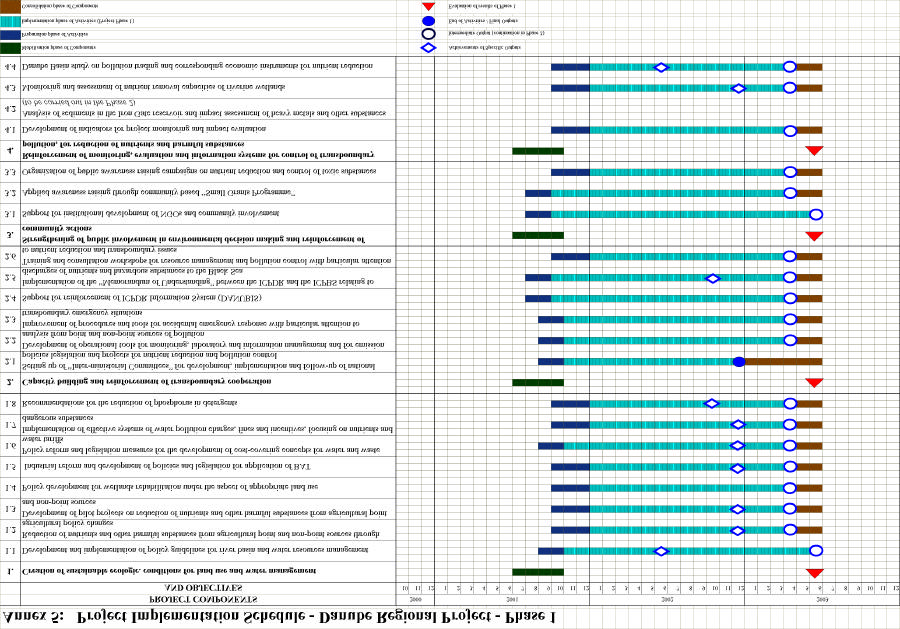
Annex 5: Project Implementation Schedule
Annexes
Project Brief / Danube Regional Project Phase 1
Annexes
ANNEX 6 Assessment of Nutrient Emissions
and Loads Discharged into the
Black Sea
Project Brief / Danube Regional Project Phase 1
Annexes
ANNEX 7 Thematic Maps
Annex 7.1
Distribution of Hot Spots in the Danube
Sub-river Basins
Annex 7.2
Major Hydraulic Structures and
Descriptions in the Danube Basin
Project Brief / Danube Regional Project Phase 1
Annexes
ANNEX 8 Summary Reports on National
Contributions in Support of the
Project Brief
Annex 8.1
Existing and Planned Inter-ministerial
Co-ordination Mechanisms Relating to
Pollution Control and Nutrient
Reduction
Annex 8.2
Existing and Planned Policies and
Legislation Relating to Pollution Control
and Nutrient Reduction
Annex 8.3
Five Year Nutrient Reduction
Action Plan
Annex 8.4
Reinforcement of NGO Activities in
Project Implementation and Awareness
Raising
Annex 8.5
Development of Process, Stress
Reduction and Environmental Status
Indicators to Monitor Nutrients
Reduction and its Effects in the Danube
River Basin and the Black Sea
Project Brief / Danube Regional Project Phase 1
Annexes
ANNEX 9 Danube / Black Sea Basin
Strategic Partnership
Project Brief / Danube Regional Project Phase 1
Annexes
ANNEX 10 Relevance of the GPA for Land-
Based Sources of Pollution in the
frame of the DRPC
Project Brief / Danube Regional Project Phase 1
Annexes
ANNEX 11 Causes and Effects of
Eutrophication in the Black Sea
Project Brief / Danube Regional Project Phase 1
Annexes
ANNEX 12 Evaluation of the UNDP/GEF
Pollution Reduction Programme
Annex 12.1
Terminal Evaluation
Annex 12.2
Terminal Report
Project Brief / Danube Regional Project Phase 1
Annexes
ANNEX 13 Endorsement Letters
Ramon Prudencio C. de Mesa
M:\RAMON\Work Programs\WP03-2001\Danube-Black Sea Harmonized Proposal\Regional Danube Basin (UNDP)\1Project_Brief_&_Anx1-
Anx5_phase_1.doc
April 9, 2001 10:05 AM